Grey Range
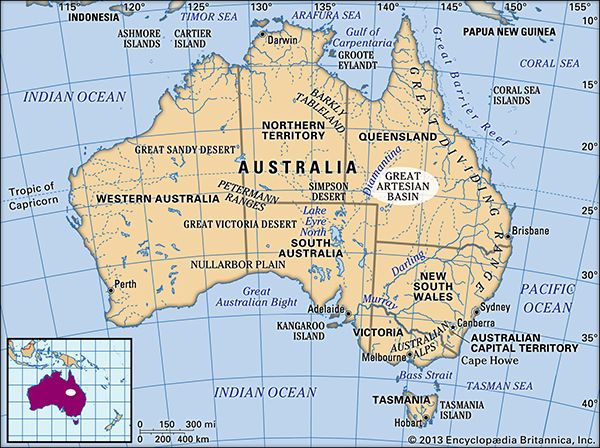
The Grey Range is a mountain range located in southwestern Queensland and northwestern New South Wales, Australiaica.com/place/New-South-Wales), Australia.
What is Grey Range?
The Grey Range is a mountain range located in southwestern Queensland and northwestern New South Wales, Australiaica.com/place/New-South-Wales), Australia.2
It consists of a series of low peaks that rise from the Great Artesian Basin to an average elevation of approximately 1,150 feet (350 metres). The range’s highest points include Mounts Browne, Strut, and Poole.1
What is the Great Artesian Basin?
The Great Artesian Basin is one of the world’s largest underground reservoirs of artesian water, covering approximately 670,000 square miles (1,735,000 square km)—about one-fifth of Australia.3
The basin spans across Queensland, New South Wales, South Australia, and the Northern Territory, encompassing the Lake Eyre and Darling catchments. It serves as a critical water source for pastoral farming and industrial developments, such as the Olympic Dam mine.34
Water is accessed through more than 18,000 boreholes, with an average daily discharge of 350 million gallons. While this water is essential for irrigation, stock, and domestic use, significant amounts are lost to evaporation and seepage. To address sustainability, a major rehabilitation project was launched in 1989 to improve the management of this vital aquifer.3
How are mountain ranges formed in Australia?
Mountain ranges in Australia were formed through a variety of complex geological processes, including tectonic activity, folding, faulting, and erosion over hundreds of millions of years.
The Eastern Uplands
The Great Dividing Range, which spans the eastern coast, is geologically complex. Its foundations were established in the late Paleozoic era when sediments were folded and faulted. These ancient mountains were later reduced to low relief by erosion during the Mesozoic Era. More recently, the range was rejuvenated by block faulting, creating the high ridges and plateaus seen today. In the Cenozoic Era, volcanic activity also contributed to the landscape, leaving behind lava fields, craters, and volcanic plugs.5
The Western Plateau
The western two-thirds of Australia consist of an ancient shield or craton. Mountainous features here, such as the Flinders and Mount Lofty ranges, often occupy sites of ancient downwarps where sediments were folded and faulted in the early Paleozoic. These areas have experienced recurrent movements, including the uplift of structural blocks (horsts) along fault lines. In other regions, such as the Kimberleys or the MacDonnell Ranges, the landscape is defined by the differential erosion of folded rock strata, where harder sandstones and quartzites remain as ridges while softer shales are eroded into valleys.6
What kind of climate is found in southwestern Queensland?
Southwestern Queensland is characterized by an arid climate, receiving very low annual precipitation that typically ranges from only 5 to 6 inches (125 to 150 mm).12
This region is considered a remote zone of low agricultural potential due to this persistent aridity. While other parts of Queensland experience tropical or subtropical conditions with significantly higher rainfall, the interior—and particularly the southwest—faces a sharp decline in moisture compared to the coastal zones. The area is marked by low open mulga woodland and light red earths, where land use is primarily limited to extensive grazing on very large properties.1312
Sources
- New Zealand - Relief of New Zealand — Encyclopædia Britannica
- Grey Range — Encyclopædia Britannica
- Great Artesian Basin — Encyclopædia Britannica
- South Australia - Drainage — Encyclopædia Britannica
- Australia - The modern geologic framework — Encyclopædia Britannica
- Exploring 7 of Earth’s Great Mountain Ranges - Great Dividing Range — Encyclopædia Britannica
- Australia - Chronological summary — Encyclopædia Britannica
- Great Dividing Range — Encyclopædia Britannica
- Australia - The Eastern Uplands — Encyclopædia Britannica
- Australia - The Mesozoic and Cenozoic eras — Encyclopædia Britannica
- Australia - The Western Plateau — Encyclopædia Britannica
- Queensland - Climate — Encyclopædia Britannica
- Queensland - Settlement patterns — Encyclopædia Britannica
Published on · 2 min read