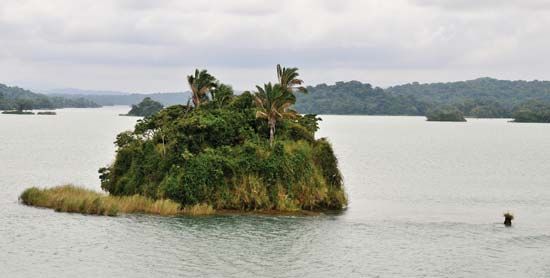
Gulf of Panama
The Gulf of Panama is an inlet of the Pacific Ocean located along the southern coast of the Isthmus of Panama. Measuring approximately 115 miles (185 km) at…
What is Gulf of Panama?
The Gulf of Panama is an inlet of the Pacific Ocean located along the southern coast of the Isthmus of Panama. Measuring approximately 115 miles (185 km) at its widest point and 100 miles (160 km) in length, this relatively shallow gulf serves as a geographic separator between the mountain ranges of western Panama and the Colombian Serranía de Baudó.1
The gulf features several distinct indentations, including Parita Bay to the west, the Bay of Panama to the north, and the San Miguel Gulf to the east. It is home to the Pearl Islands, which are significant for their fisheries, and Panama City serves as the primary urban center along its shore. Economically, the gulf is vital for the fishing industry, as its shallow continental shelf waters provide a major catch of shrimp, anchovy, and herring.12
What are the Pearl Islands known for?
The Pearl Islands are an archipelago located in the Gulf of Panama, approximately 50 miles southeast of Panama City. The archipelago is primarily known for the following:
- Geography: It consists of 183 islands, 39 of which are considered sizable. Key islands include del Rey Island—home to the principal town of San Miguel—as well as San José, Pedro González, and Saboga.4
- Fisheries: The islands are a popular destination for fishermen who visit to take advantage of the abundant marine life found in the surrounding waters.4
Please note that the information provided regarding the marine biodiversity and scuba-diving reputation in your search results refers to the nation of Palau, not the Pearl Islands of Panama.5
How does the Panama Canal connect to the Pacific Ocean?
The Panama Canal connects to the Pacific Ocean through a series of locks and dredged channels that lower vessels from the elevated interior of the Isthmus of Panama to sea level.782
As ships travel from the Atlantic side toward the Pacific, they pass through Gatún Lake and the Gaillard Cut before reaching the Pacific descent:82
- Pedro Miguel Locks: Vessels are lowered 30 feet (9 meters) from the level of the Gaillard Cut into Miraflores Lake, which sits at an elevation of 52 feet (16 meters) above sea level.82
- Miraflores Locks: After crossing the lake, ships enter these two-stepped locks, where they are lowered to the level of the Pacific Ocean.82
- Pacific Approach: The final segment is a 7-mile-long dredged approach passage that leads ships into the Bay of Panama near Balboa.82
Throughout the transit, ships are typically guided by electric towing locomotives to ensure they remain centered within the lock chambers.9
What makes the Gulf of Panama an important area for commercial fishing?
The Gulf of Panama is a vital region for commercial fishing primarily due to its geography and the productivity of its marine environment.
The gulf is characterized by its relatively shallow waters, which feature an extensive continental shelf. This environment supports significant populations of fish and crustaceans, making it the primary location for the country’s commercial catch. Key aspects of this industry include:
- Primary Species: The most significant commercial catches in the gulf consist of shrimp, anchovy, and herring. Shrimp, in particular, serves as one of Panama’s most important exports, with several thousand tons harvested annually.3
- Strategic Locations: Beyond the open waters of the gulf, the Pearl Islands are specifically noted for hosting important fisheries that contribute to the region’s economic output.31
While aquaculture has also grown as a successful venture in Panama, the natural shallow-water ecosystems of the Gulf of Panama remain a cornerstone of the nation’s fishing industry.3
Sources
- Gulf of Panama — Encyclopædia Britannica
- canals and inland waterways - The Panama Canal — Encyclopædia Britannica
- Panama - Agriculture, forestry, and fishing — Encyclopædia Britannica
- Pearl Islands — Encyclopædia Britannica
- list of islands - Panama — Encyclopædia Britannica
- Palau - Plant and animal life — Encyclopædia Britannica
- Panama Canal: Top Questions — Encyclopædia Britannica
- Panama Canal — Encyclopædia Britannica
- Timeline and Map of the Panama Canal — Encyclopædia Britannica
- Panama Canal - Locks — Encyclopædia Britannica
- Panama Canal - The canal — Encyclopædia Britannica
Published on · 3 min read