Haro Strait
Haro Strait is a passage in the eastern North Pacific Ocean located between the Canadian islands of Vancouver and Saturna to the west and the American…
What is Haro Strait?
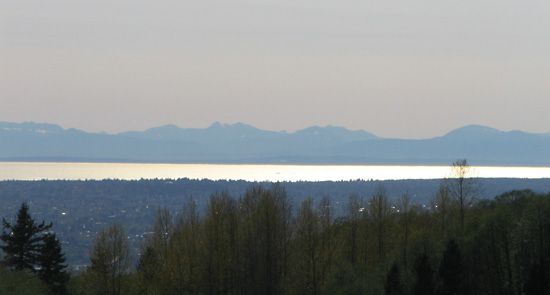
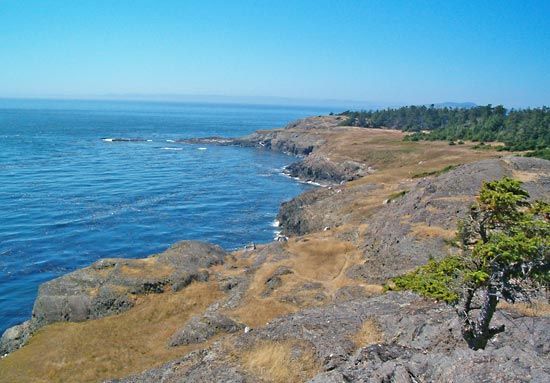
Haro Strait is a passage in the eastern North Pacific Ocean located between the Canadian islands of Vancouver and Saturna to the west and the American islands of San Juan and Stuart to the east. It serves as a significant maritime route, with part of the international border between the United States and Canada running through its center.1
The strait connects the Strait of Georgia in the north to the Juan de Fuca Strait in the south. It is a vital shipping lane, commonly used by vessels traveling toward the city of Vancouver. The waterway, which reaches depths of 600–900 feet in its mid-channel, was named after the Spanish explorer Gonzalo López de Haro, who likely surveyed the area in 1790.12
How does the Haro Strait serve as an international border?
The Haro Strait serves as a segment of the international boundary between the United States and Canada by running directly through the center of the passage. This maritime border separates the Canadian islands of Vancouver and Saturna to the west from the American islands of San Juan and Stuart to the east.1
The establishment of this boundary was finalized following the resolution of a long-standing territorial dispute. In the mid-19th century, the sovereignty of the San Juan Islands was contested, leading to the 1859 “Pig War,” a tense standoff between British and American forces. Following 12 years of joint military occupation, the islands were formally awarded to the United States in 1872 through international arbitration, which solidified the current path of the border through the Haro Strait. Today, this channel remains a vital shipping route connecting the Juan de Fuca Strait to the Strait of Georgia.312
What marine life is commonly found in the San Juan Islands?
The waters surrounding the San Juan Islands are home to a diverse array of marine life, supported by the nutrient-rich environment of upper Puget Sound.34
Marine Mammals
The region is perhaps best known for its whale populations, which are a major draw for tourism. These include:
- Killer whales: Frequently tracked during whale-watching excursions.34
- Gray and humpback whales: Also inhabit the waters around the archipelago.4
- Other marine mammals: The broader Puget Sound region provides sanctuary for various marine mammals within several national wildlife refuges.4
Fish and Shellfish
The coastal bays and surrounding waters serve as critical habitats for a variety of aquatic species:
- Salmon: Five species of Pacific salmon migrate through the area to reach spawning grounds in western Washington streams.4
- Shellfish: The bays and sound are productive habitats for various shellfish populations.4
- Other fish: The region supports diverse fish populations, including species such as sturgeon, trout, and bass.4
What is the connection between the Haro Strait and the Strait of Georgia?
The Haro Strait serves as a vital maritime corridor that connects the Juan de Fuca Strait to the south with the Strait of Georgia to the north.1
This passage acts as a primary navigational route for vessels traveling toward the city of Vancouver, which must traverse the Haro Strait through the surrounding islands to reach the Strait of Georgia. Geographically, the strait is situated between the Canadian islands of Vancouver and Saturna to the west and the American islands of San Juan and Stuart to the east, with the international border between the United States and Canada running through its center.1
Sources
- Haro Strait — Encyclopædia Britannica
- Juan de Fuca Strait — Encyclopædia Britannica
- San Juan Islands — Encyclopædia Britannica
- Washington - Plant and animal life — Encyclopædia Britannica
Published on · 3 min read