Heinrich Event
A Heinrich event refers to a series of at least six massive discharges of icebergs into the North Atlantic Ocean that occurred between approximately 60,000…
What is a Heinrich event?
A Heinrich event refers to a series of at least six massive discharges of icebergs into the North Atlantic Ocean that occurred between approximately 60,000 and 16,800 years ago during the Pleistocene Epoch.1
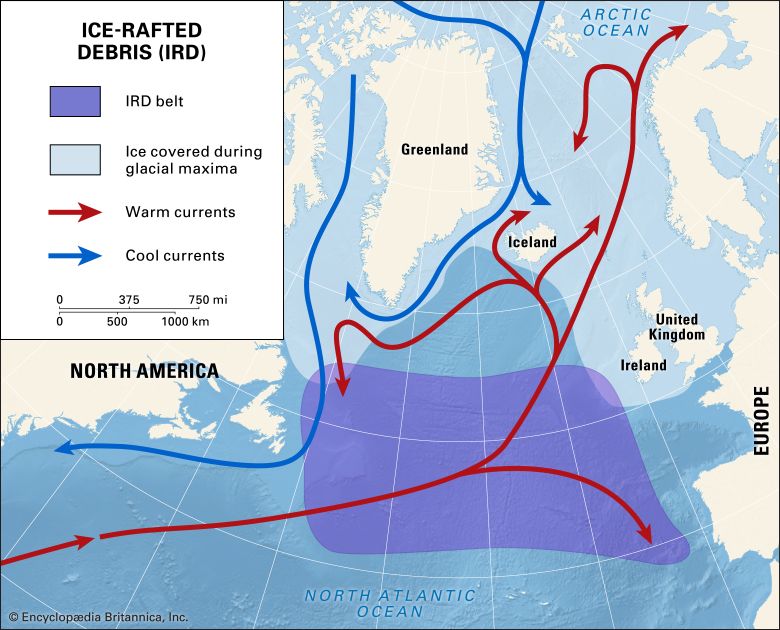
Named for marine geologist Hartmut Heinrich, these events are identified by layers of coarse-grained, ice-rafted debris found on the ocean floor between 40° and 55° N. This material, which originated from North American ice sheets, was transported by icebergs that eventually melted and deposited the rocky sediment.1
While the exact causes remain a subject of scientific study, researchers believe these events are linked to Dansgaard-Oeschger events and Bond cycles. Hypotheses regarding their origin range from the mechanical instability of glaciers to the impact of climate warming on sea levels and thermohaline circulation, which regulates global heat transport.1
When and where do Heinrich events happen?
Heinrich events occurred during the most recent ice age of the Pleistocene Epoch, specifically between approximately 60,000 and 16,800 years ago. These events took place in roughly 8,000–9,000-year cycles, with each event lasting between 200 and 2,300 years.1
The estimated peak times for the six primary events (H1–H6) are as follows:
- H1: 16,800 years ago1
- H2: 24,000 years ago1
- H3: 31,000 years ago1
- H4: 38,000 years ago1
- H5: 45,000 years ago1
- H6: 60,000 years ago1
Geographically, these events are identified by deposits on the ocean floor within the North Atlantic Ocean, specifically between 40° and 55° N in a region known as the Ruddiman, or IRD (ice-rafted debris), belt. The debris originated primarily from North American ice sheets, though some researchers suggest Europe may have been the source for events H3 and H6.1
What causes a Heinrich event to occur?
The exact causes of Heinrich events remain a subject of scientific study, and several hypotheses have been proposed to explain these massive discharges of icebergs into the North Atlantic Ocean:1
- Glacial Instability: One hypothesis suggests that cooling conditions increased the mass of continental glaciers. This weight pressed down on the loose sediment of the continental shelf, and the unconsolidated nature of this material allowed the ice to slide away from the continent and calve into icebergs.1
- Climate Warming and Sea-Level Rise: Another theory posits that abrupt climate warming released vast amounts of fresh water from continental ice sheets, causing sea levels to rise. This rising water would have stressed the connections between ice shelves and the glaciers they extended from, while lifting landed sea ice—which acted as ice dams—off the rocky substrate.1
- Thermohaline Circulation Fluctuations: A third hypothesis suggests that the influx of fresh water reduced the ocean’s salinity, weakening thermohaline circulation. This would have led to cooler water, increasing the thickness of ice shelves. As the freshwater flow decreased and circulation recovered, warmer water would have then weakened these shelves from below, causing them to fragment.1
How do Heinrich events affect the climate?
Heinrich events significantly impact the climate primarily by altering ocean structure and circulation patterns. When massive armadas of icebergs are released into the North Atlantic Ocean, their subsequent melting introduces vast quantities of fresh water to the surface.14
This influx of fresh water reduces the salinity of the surface waters, which can disrupt or “turn off” normal winter convection processes. Because these processes are essential for driving thermohaline circulation—the system that transports heat from the tropics to the poles—their weakening can lead to a reduction in the strength of the Gulf Stream. Consequently, such disruptions have been linked to periods of significant cooling, potentially returning regions like northern Europe to ice-age conditions for extended periods, as seen in the Younger Dryas event.14
Additionally, the release of these icebergs affects the mass balance of parent ice sheets and contributes to changes in global sea level.2
Sources
- Heinrich event — Encyclopædia Britannica
- iceberg - Impacts on ice sheets and sea level — Encyclopædia Britannica
- Pleistocene Epoch - Coastal environments and sea-level changes — Encyclopædia Britannica
- iceberg - Impact on ocean structure — Encyclopædia Britannica
Published on · 3 min read

