Dansgaard-Oeschger Event
A Dansgaard-Oeschger (D-O) event is a dramatic, rapid climatic oscillation that occurred during the last ice age. These events are characterized by a period…
What is a Dansgaard-Oeschger event?
A Dansgaard-Oeschger (D-O) event is a dramatic, rapid climatic oscillation that occurred during the last ice age. These events are characterized by a period of abrupt warming—often shifting temperatures by 5–15 °C (9–27 °F) within a few decades—followed by a gradual cooling interval that spans centuries or millennia.1
Evidence for these events is primarily derived from ice cores extracted from Greenland, though they are considered globally synchronous. While the exact causal mechanisms remain uncertain, scientists have observed a potential 1,500-year cycle in their occurrence, leading to theories involving solar activity, oceanic currents, or complex interactions between the atmosphere and polar ice.1
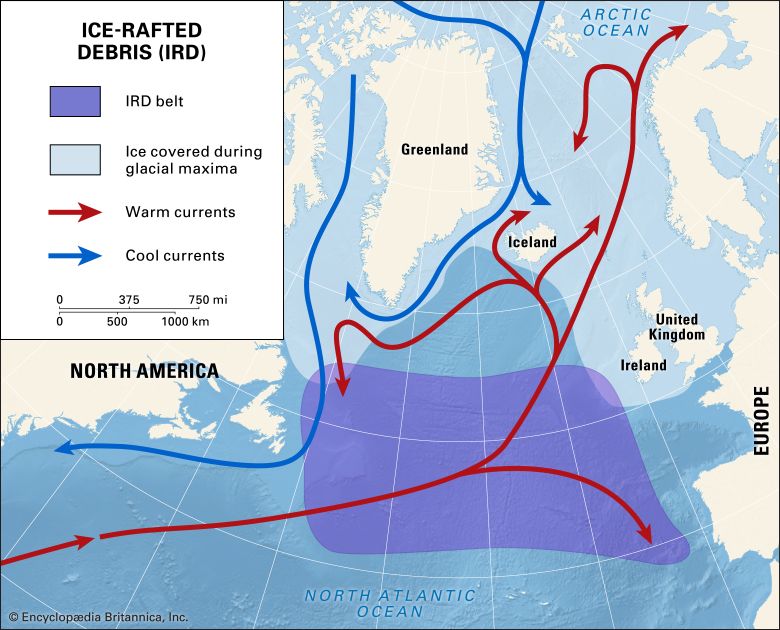
D-O events are named after Willi Dansgaard and Hans Oeschger, pioneers in ice core and greenhouse effect research. They are also linked to Heinrich events, which involve massive iceberg discharges into the North Atlantic Ocean.12
When and where have Dansgaard-Oeschger events been observed?
Dansgaard-Oeschger (D-O) events are rapid, globally synchronous climatic oscillations that occurred during the last ice age. While evidence is most prominently observed in Greenland ice cores, these events have been identified in records from Antarctica, Canada’s Arctic Archipelago, and high mountain glaciers in South America.1
Regarding their timing, these events occurred throughout the most recent 120,000 years. Detailed analysis of Greenland ice cores indicates that 13 distinct D-O events took place between 11,600 and 45,000 years ago, often exhibiting an average periodicity of approximately 1,470 years. Some researchers suggest that as many as 25 such events may have occurred during the last 120,000 years, and some interpretations even suggest that the Little Ice Age of the 14th century may have been a D-O oscillation.1
How do scientists know these events happened in the past?
Scientists identify Dansgaard-Oeschger (D-O) events primarily through the analysis of ice cores—long cylinders of ice extracted from glaciers and ice sheets in regions like Greenland and Antarctica. Because these ice sheets accumulate snow over millennia, they preserve a continuous, layered record of past environmental conditions.145
Key methods used to detect these events include:
- Oxygen Isotope Analysis: Scientists measure the ratio of oxygen isotopes (specifically oxygen-18 to oxygen-16) within the ice. Because these ratios are temperature-dependent, they serve as a reliable proxy for reconstructing ancient air temperatures.65
- Annual Layer Counting: In areas with high snow accumulation, researchers can visually identify and count annual layers, similar to tree rings, to establish a high-resolution chronology of climate shifts.45
- Dust and Chemical Analysis: Variations in dust content, marine salts, and chemical ions help scientists infer changes in wind patterns, atmospheric circulation, and precipitation.45
- Trapped Air Bubbles: Ancient air trapped within the ice allows for the direct measurement of past greenhouse gas concentrations, such as carbon dioxide and methane, which are linked to climate fluctuations.45
What causes Dansgaard-Oeschger events to happen?
The exact causal mechanisms behind the timing and amplitude of Dansgaard-Oeschger (D-O) events remain a subject of ongoing scientific research, and no definitive proof has been established. However, current hypotheses focus on complex interactions within the Earth system:1
- Ocean-Atmosphere Interactions: Many researchers believe these events result from complex feedback loops between the atmosphere, the oceans, and polar ice sheets. These interactions influence thermohaline circulation—the global system of ocean currents that transports heat from the tropics toward the poles.1210
- North Atlantic Dynamics: Modeling studies suggest that the northern part of the subpolar gyre in the North Atlantic plays a critical role. In this region, where wind systems and ocean currents meet, sharp thermal gradients caused by southward-reaching ice may trigger the onset of these events under specific conditions.1
- External Forcing: Suggestions of solar or other external causes have been proposed, though these remain unproven.1
Scientists continue to study these cycles intensely to better understand how the coupled ocean-atmosphere system drives such dramatic, rapid climate fluctuations.211
Sources
- Dansgaard-Oeschger event — Encyclopædia Britannica
- Heinrich event — Encyclopædia Britannica
- Quaternary - Correlation of Quaternary deposits — Encyclopædia Britannica
- ice core — Encyclopædia Britannica
- Pleistocene Epoch - Marine oxygen isotope record — Encyclopædia Britannica
- Quaternary - Paleoclimate — Encyclopædia Britannica
- glacier - Information from deep cores — Encyclopædia Britannica
- Global warming - Prehistorical climate records — Encyclopædia Britannica
- Global warming - Climate research — Encyclopædia Britannica
- Climate change - Glacial and interglacial cycles of the Pleistocene — Encyclopædia Britannica
- Climate change - The most recent glacial phase — Encyclopædia Britannica
- thermohaline circulation — Encyclopædia Britannica
Published on · 3 min read