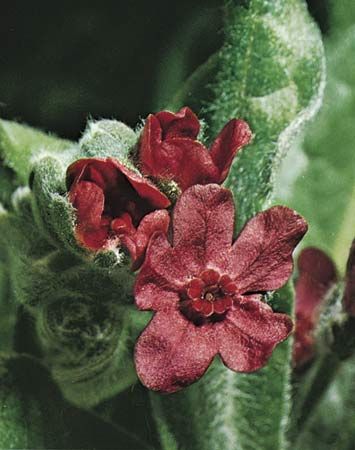
Heliotrope
Heliotrope refers to several distinct concepts, primarily in botany, mineralogy, and color theory.

What is Heliotrope?
Heliotrope refers to several distinct concepts, primarily in botany, mineralogy, and color theory.
Botanical Definition
The term most commonly refers to the genus Heliotropium, which consists of approximately 250 species of herbs and shrubs within the Boraginaceae family. These plants are found in tropical and temperate regions worldwide. The most well-known variety is the garden heliotrope, a fragrant, shrubby perennial known for its clusters of purple to white flowers that resemble forget-me-nots. The name derives from the Greek heliotropion (“sun-turning”), reflecting the plant’s tendency to orient its blossoms toward the sun.12
Other Meanings
- Mineralogy: Heliotrope is another name for bloodstone, a green variety of chalcedony containing spots of red jasper.2
- Color: It describes a variable color that averages a moderate to reddish purple.2
What is the process of heliotropism in plants?
Heliotropism is a form of phototropism in which a plant orients its leaves or flowers toward the sun as it moves across the sky. This behavior is common among many flowers and leaves, with sunflowers (Helianthus annuus) serving as a primary example.324
The process is driven by the plant’s internal circadian clock, which coordinates differential growth on opposite sides of the stem. For young sunflowers, cells on the east side of the stem grow faster during the day, causing the plant to bend westward to follow the sun. At night, growth accelerates on the west side, bending the plant back toward the east in preparation for sunrise.4
This tracking increases exposure to light, which promotes photosynthesis and vigorous growth. As plants mature, this daily movement typically decreases and eventually stops. Mature flower heads often remain fixed facing east, which helps them warm more quickly in the morning, attracting more pollinating insects and potentially improving reproductive success through larger, heavier seeds4.4
How does the sunflower compare to the heliotrope?
While both the sunflower (Helianthus annuus) and the heliotrope (genus Heliotropium) are associated with the sun, they differ significantly in their biology and their relationship to the phenomenon of heliotropism.
Heliotropism
The term “heliotropism” describes the movement of plant parts toward the sun. While the name “heliotrope” implies this behavior, sunflowers are actually more dramatically heliotropic than the genus Heliotropium. Young sunflowers actively track the sun’s movement across the sky from east to west each day, a process driven by their internal circadian clock and differential stem growth. In contrast, while heliotropes are named for this sun-turning tendency, the term is more broadly applied to their genus, which contains many species that do not exhibit this movement as prominently as the sunflower.2417
Botanical Characteristics
- Sunflowers: These are large, annual herbs known for their showy flower heads and edible seeds. They are native to North America and are widely cultivated for oil and food.1
- Heliotropes: These are mostly herbaceous plants or shrubs in the Boraginaceae family. The best-known species, the garden heliotrope, is a fragrant ornamental with clusters of small flowers that resemble forget-me-nots.27
What is the significance of the god Helios in Greek mythology?
In Greek religion, Helios was the personification of the sun and a Titan. His primary mythological role was driving his chariot across the sky from east to west each day, before sailing around the northern stream of the Ocean in a massive cup at night.8
Helios held significant status in Rhodes, where he was regarded as the island’s chief deity from at least the 5th century BCE. His influence is also famously illustrated in the myth of his son, Phaethon, who attempted to drive the sun chariot but lost control, forcing Zeus to intervene to prevent the earth from being scorched.89
Over time, the worship of Helios became increasingly intertwined with other deities. By the 5th century BCE, Apollo—originally a god of purity, prophecy, and healing—was frequently interpreted as a sun god, eventually absorbing many of the solar associations previously held by Helios. Under the Roman Empire, this solar veneration culminated in the worship of the sun as the “Unconquered Sun”.810
Sources
- Heliotrope — Encyclopædia Britannica
- heliotrope — Merriam-Webster
- Did you know? — Merriam-Webster
- Do sunflowers really follow the Sun? — Encyclopædia Britannica
- heliotropism — Merriam-Webster
- diaheliotropism — Merriam-Webster
- Sunflower — Encyclopædia Britannica
- Helios — Encyclopædia Britannica
- Apollo — Encyclopædia Britannica
- Phaethon — Encyclopædia Britannica
- Helios — Merriam-Webster
Published on · 3 min read