Hound’s-tongue
Hound’s-tongue refers to any of approximately 75 species of plants belonging to the genus Cynoglossum within the Boraginaceae family. These plants are named…
What is Hound’s-tongue?
Hound’s-tongue refers to any of approximately 75 species of plants belonging to the genus Cynoglossum within the Boraginaceae family. These plants are named for their characteristic rough, tongue-shaped leaves.12
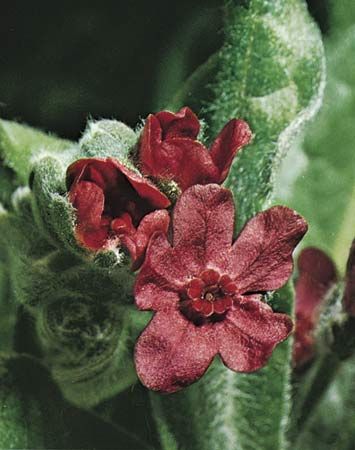
They are found primarily in temperate regions across the New World and Old World. While some species, such as the Chinese forget-me-not (C. amabile), are known for their bright-blue flowers, others like C. officinale and C. germanicum produce purplish-red blooms. These European species typically grow between 60 and 90 cm (2 to 3 feet) tall, often appearing along roadsides or in dry soils, and are distinguished by their curving sprays of five-lobed flowers and spined, sticktight seeds. C. officinale has become naturalized in North America.12
What are some other plants in the Boraginaceae family?
The Boraginaceae family, also known as the borage or forget-me-not family, includes over 2,700 species of flowering plants. These plants are typically herbaceous, often featuring hairy textures and flower clusters that coil like a scorpion’s tail.3
Beyond the genus Cynoglossum (hound’s-tongue), the family includes a diverse array of garden ornamentals, medicinal plants, and even parasitic species. Notable examples include:
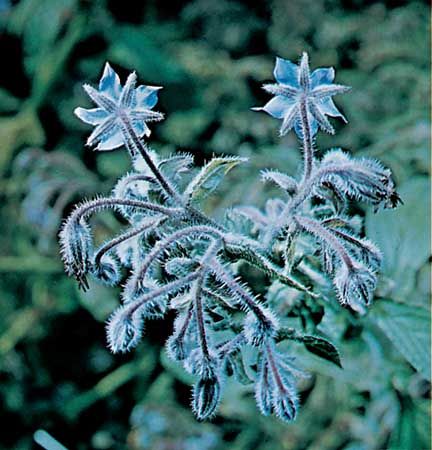
- Borage (Borago officinalis): An edible annual known for its starlike blue flowers and cucumber-flavored leaves.34
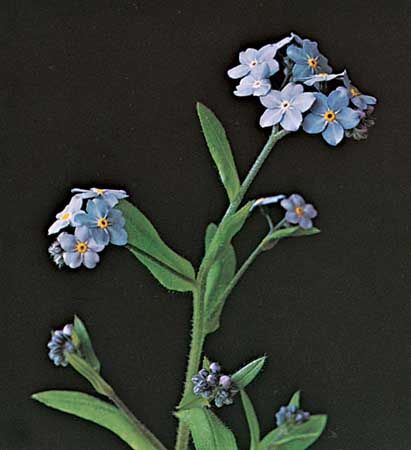
- Forget-me-not (Myosotis): Popular garden flowers often recognized for their delicate appearance.3
- Heliotrope (Heliotropium): Frequently grown as an ornamental.3
- Lungwort (Pulmonaria): A common garden plant.3
- Comfrey (Symphytum officinale): Historically used for medicinal purposes.3
- Puccoon (Lithospermum): Also known as stoneseed.3
- Phacelia: Also called scorpion weed, belonging to the subfamily Hydrophylloideae.3
- Virginia bluebell (Mertensia virginica): A well-known ornamental.3
- Cordia: A diverse tropical genus that includes important timber species.ia](https://www.britannica.com/plant/Cordia)**: A diverse tropical genus that includes important timber species.3
How do plants like hound’s-tongue use their spined seeds to spread?
Plants like hound’s-tongue utilize a process known as epizoochory to spread their seeds. In this method, the plant relies on the inadvertent assistance of animals to transport its offspring away from the parent plant.6
The seeds of these plants are equipped with specialized structures—such as spines, hooks, or bristles—that allow them to function as “hitchhikers.” These features enable the seeds to cling tenaciously to the fur or hair of passing terrestrial mammals. As the animal moves through its environment, the seeds are carried along and eventually fall off or are groomed away, often in a new location suitable for germination and growth. This strategy helps the plant colonize new areas and reduces competition for resources between the parent and its offspring.67
Why are some hound’s-tongue species considered invasive in North America?
The common hound’s-tongue (Cynoglossum officinale), a species native to Europe, has become naturalized in North America where it is often considered invasive.1
Species become invasive when they are introduced to a new environment and possess a competitive advantage over indigenous plants, particularly when the local ecosystem lacks natural predators or controls to keep their population in check. Once established, these plants can disrupt local habitats by outcompeting native species for essential resources like food and living space, which can lead to a reduction in biodiversity.8
In the case of hound’s-tongue, its ability to thrive along roadsides and in dry soils allows it to colonize disturbed areas effectively. Furthermore, its production of “sticktight” clusters of spined seeds facilitates rapid spread, as these seeds easily attach to animals and are transported to new locations. By effectively replacing native vegetation, such invasive species can cause significant ecological and economic harm.18
Sources
- Hound’s-tongue — Encyclopædia Britannica
- hound's-tongue — Merriam-Webster
- Boraginaceae — Encyclopædia Britannica
- Borage — Encyclopædia Britannica
- Boraginaceae — Merriam-Webster
- Seed - Dispersal by animals — Encyclopædia Britannica
- Seed dispersal — Encyclopædia Britannica
- invasive species — Encyclopædia Britannica
Published on · 3 min read