Herrerasaurus
The name Herrerasaurus translates to "Herrera's lizard." It was named in honor of Victorino Herrera, a local rancher who discovered the first fossil remains…
What does the name Herrerasaurus mean, and why was it given this name?
The name Herrerasaurus translates to “Herrera’s lizard.” It was named in honor of Victorino Herrera, a local rancher who discovered the first fossil remains of this dinosaur in the early 1960s in the Ischigualasto Formation of northwestern Argentina.1
Herrerasaurus was a primitive carnivorous dinosaur—or a very close relative—that lived during the Late Triassic Period. It is a significant find for paleontologists because it helps clarify the early evolutionary history of dinosaurs, retaining many ancestral features while exhibiting some characteristics seen in later theropods. While fragmentary remains were found decades ago, it was not until 1988 that researchers, including paleontologist Paul Sereno, were able to recover well-preserved skeletons that provided a complete picture of the animal.12
In what geographical regions have Herrerasaurus fossils been found?
Herrerasaurus fossils have been found exclusively in the Ischigualasto Formation of northwestern Argentina. Specifically, these significant discoveries were made near the foothills of the Andes in the vicinity of San Juan, Argentina.12
How big was Herrerasaurus compared to modern animals?
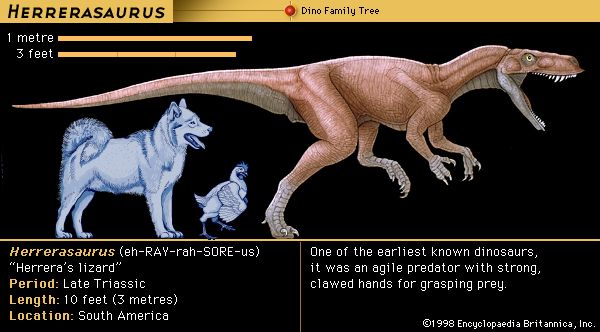
Herrerasaurus reached a length of approximately 3 meters (10 feet) and weighed about 180 kg (400 pounds).1
To put this in perspective, its size is comparable to a large modern jaguar or a small lion, though its build was significantly different due to its bipedal, dinosaurian anatomy. While it was a formidable predator for its time, it was much smaller than the massive theropods that would evolve millions of years later, such as Tyrannosaurus rex.
How did Herrerasaurus move, and what adaptations did it have for locomotion?
Herrerasaurus was a bipedal predator, meaning it moved primarily on its two hind legs. Its primary adaptation for locomotion was its long, powerful hind limbs, which were well-suited for running and pursuing prey during the Triassic Period.1
While its legs were specialized for speed and movement, its forelimbs were relatively short and adapted for interaction with prey rather than locomotion. These forelimbs featured three recurved claws, which the animal used for grasping and raking. Although its three-toed feet share similarities with later theropod dinosaurs, Herrerasaurus lacked certain advanced skeletal features, such as specialized wrist bones, that would later characterize the movement and dexterity of more derived dinosaur lineages.11
Sources
- Herrerasaurus — Encyclopædia Britannica
- Paul Sereno — Encyclopædia Britannica
Published on · 2 min read