Hesperornis
Hesperornis was a large, flightless, aquatic bird from the Late Cretaceous Period that was significantly larger than most modern diving birds. While it…
How large was Hesperornis compared to modern diving birds?
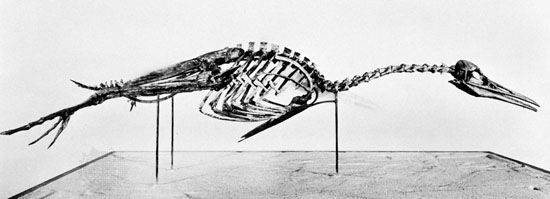
Hesperornis was a large, flightless, aquatic bird from the Late Cretaceous Period that was significantly larger than most modern diving birds. While it shared a similar form and lifestyle with modern loons—being an active swimmer adapted for rapid diving—some specimens of Hesperornis reached lengths exceeding five feet.12
In contrast, modern diving birds like loons are generally much smaller. Hesperornis was distinct from contemporary birds of its time, such as the pigeon-sized Ichthyornis, due to its specialized adaptations for swimming, including small, vestigial wings and a lack of a prominent keel on the breastbone, which prevented flight. Its powerful legs were its primary means of propulsion, allowing it to chase and catch fish in a manner similar to modern divers.13
How does Hesperornis differ from modern birds?
Hesperornis differed significantly from modern birds, primarily due to its primitive skeletal features and specialized adaptations for an aquatic lifestyle. While it shared a superficial resemblance to modern loons and grebes, these similarities were the result of convergent evolution rather than common ancestry.1
Key differences include:
- Dentition: Unlike modern birds, which possess a horny beak and lack teeth, Hesperornis had teeth set in grooves in its lower jaw and the rear of its upper jaw.51
- Flightlessness: Hesperornis lacked a keeled sternum, which is necessary to anchor the muscles required for flight. Its wings were vestigial and splintlike, rendering them useless for flight.51
- Specialized Anatomy: It featured a unique rotary ball-and-flange articulation on its fourth toe and possessed tail vertebrae that allowed for limited vertical motion, creating a beaverlike swimming action.1
- Evolutionary Status: Hesperornis belonged to the group Odontornithes, a lineage distinct from the modern Neornithes that began appearing during the Late Cretaceous Period.1
What adaptations did Hesperornis have for an aquatic lifestyle?
Hesperornis possessed several specialized adaptations that allowed it to thrive as an active, aquatic predator during the Late Cretaceous Period. Its anatomy was highly refined for a life spent chasing and catching fish in the water.1
Key aquatic adaptations included:
- Powerful Locomotion: The legs of Hesperornis were robust and powerfully developed, serving as the primary means of propulsion for rapid swimming and diving.1
- Streamlined Form: The bird featured a slender neck and a long, tapered head, both of which were capable of rapid side-to-side movement to assist in capturing prey.1
- Vestigial Wings: Because it relied entirely on its legs for movement, its wings were small, splintlike, and useless for flight. Furthermore, the breastbone lacked the prominent keel typically used to anchor flight muscles, confirming its strictly aquatic nature.1
- Diving Capability: Similar to modern loons, Hesperornis was an adept diver, with skeletal features that suggest it was well-suited for an underwater lifestyle.13
What are the key physical characteristics of Hesperornis?
Hesperornis was a specialized, flightless aquatic bird from the Late Cretaceous Period that reached lengths of up to 1.8 meters (6 feet). Its physical characteristics reflect a highly adapted lifestyle as a foot-propelled diver:15
- Dentition: Unlike modern birds, Hesperornis possessed teeth set in grooves along its lower jaw and the rear of its upper jaw, indicating that the modern horny beak had not yet evolved.15
- Flightlessness: The bird lacked a keeled sternum, which is necessary to anchor flight muscles. Its wings were vestigial, small, and splintlike, rendering them useless for flight.15
- Aquatic Anatomy: It featured a slender neck and a long, tapered head capable of rapid movement to catch fish. Its legs were powerfully developed for swimming.1
- Unique Skeletal Features: Hesperornis possessed a stout fourth toe with a specialized rotary ball-and-flange articulation and tail vertebrae that allowed for limited vertical motion, creating a beaverlike swimming action.5
While its form superficially resembled modern loons and grebes, these traits were the result of convergent evolution.15
Sources
- Hesperornis — Encyclopædia Britannica
- Hesperornithiformes — Merriam-Webster
- Ichthyornis — Encyclopædia Britannica
- Hesperornis — Merriam-Webster
- Bird - Fossil birds — Encyclopædia Britannica
Published on · 3 min read