Hessian Fly
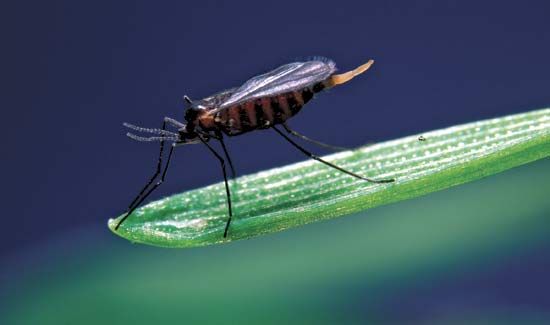
The Hessian fly (Mayetiola destructor) is a destructive pest that infests wheat, barley, and rye crops.
How did the Hessian fly get its name, and what is its historical significance?
The Hessian fly (Mayetiola destructor) is a destructive pest that infests wheat, barley, and rye crops.1
The insect earned its common name due to the belief that it was introduced to North America during the American Revolution (1775–1783). It is widely theorized that the fly arrived in the straw bedding used by Hessian troops—German mercenaries hired by the British to fight in the war.1
Historically, the Hessian fly has been significant for its devastating impact on agriculture. As a member of the gall midge family, its larvae feed on plant sap, which can severely damage or destroy cereal crops. First recorded in North America in 1786, the pest prompted farmers to develop specific agricultural strategies, such as delaying planting times and deep plowing of stubble, to mitigate its spread and protect harvests.12
What methods do farmers use to control and prevent Hessian fly damage?
Farmers employ several strategic methods to control and prevent damage from the Hessian fly, focusing primarily on cultural practices and the use of resistant crop varieties.13
Key management strategies include:
- Delayed Planting: The most effective method is to delay planting in the spring or autumn so that the wheat plants do not emerge until after the adult flies have completed their egg-laying cycle and died.14
- Resistant Varieties: Farmers utilize specific wheat varieties that have been bred for resistance to the pest.13
- Stubble Management: Deep plowing of wheat stubble is a critical mechanical practice that helps prevent the emergence of the flies in the spring by burying the puparia.1
- Integrated Control: Modern approaches often combine these techniques with other integrated pest management strategies, such as monitoring populations and using chemical insecticides only as a last resort.3
These methods are essential for protecting cereal crops from the larvae, which feed on plant sap and can cause significant agricultural loss.1
How does the Hessian fly’s feeding behavior affect the growth and yield of wheat plants?
The Hessian fly (Mayetiola destructor) significantly impacts wheat, barley, and rye through the feeding behavior of its larvae. After hatching from eggs laid on young plants, the larvae feed on the plant’s sap for approximately one month.1
By extracting this vital sap, the larvae deprive the developing plant of essential nutrients, which stunts growth and weakens the structural integrity of the stems. This infestation often leads to reduced crop yields, as the weakened plants may fail to produce healthy grain or may collapse entirely under the pressure of the pest’s feeding activity. Because the larvae specifically target the stems of these cereal crops, the damage is most severe when the infestation occurs during the plant’s early developmental stages.14
What is the Hessian fly and why is it considered a significant agricultural pest?
The Hessian fly (Mayetiola destructor) is a small insect belonging to the gall midge family. It is considered a significant agricultural pest primarily due to its destructive impact on wheat, barley, and rye crops.1
The pest’s lifecycle is highly synchronized with the growth of these cereal crops. In the spring, females lay hundreds of eggs on young plants. Upon hatching, the larvae feed on the plant’s sap for approximately one month, which severely stunts growth and weakens the stems. This feeding behavior can lead to substantial crop loss, as the weakened plants may collapse or fail to produce grain.1
The Hessian fly is also notable for its history; it is believed to have been introduced to North America in the straw bedding of Hessian troops during the American Revolution. Because of its ability to rapidly infest fields and its resilience in overwintering as puparia on stubble, it remains a persistent challenge for farmers.1
Sources
- Hessian fly — Encyclopædia Britannica
- Hessian fly — Merriam-Webster
- Pest — Encyclopædia Britannica
- Cereal farming - Insects — Encyclopædia Britannica
Published on · 3 min read