High Plains
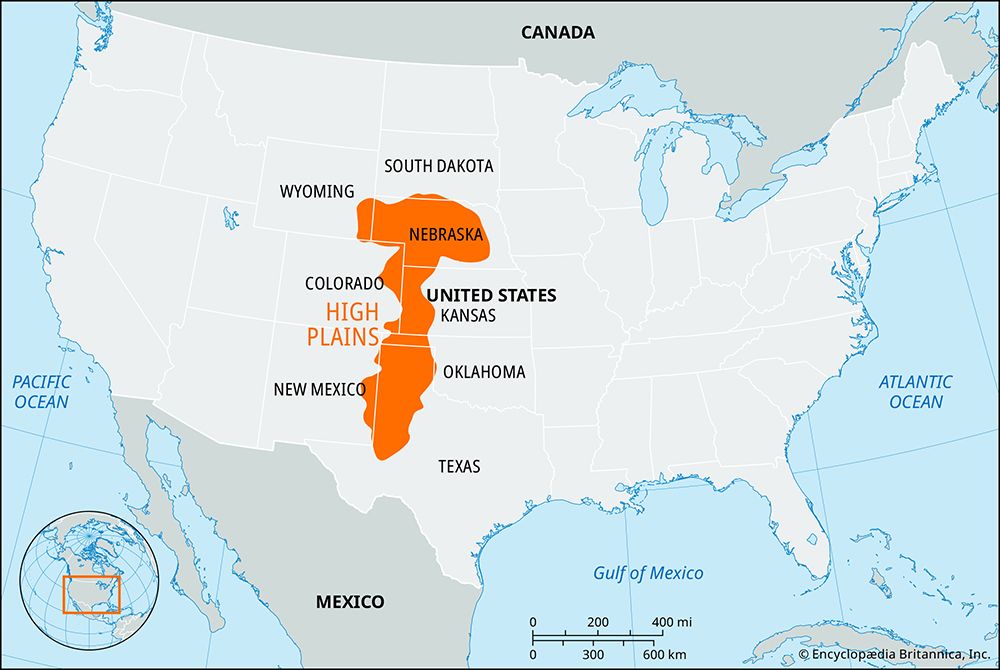
The High Plains is a region in the United States that comprises the southern portion of the Great Plains. In its most specific sense, the term refers to the…
What is High Plains?
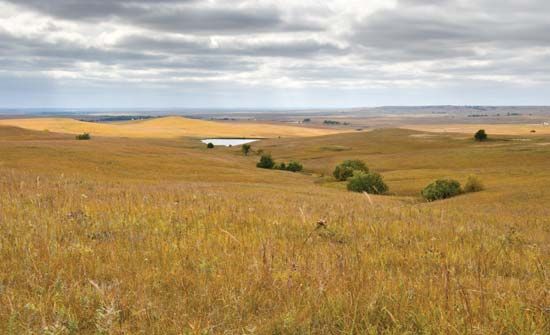
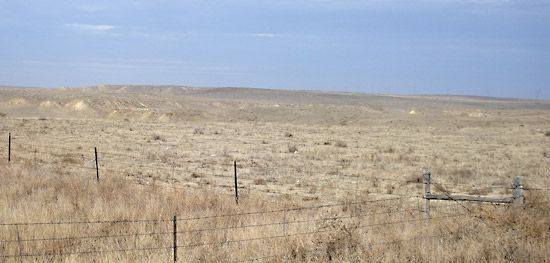
The High Plains is a region in the United States that comprises the southern portion of the Great Plains. In its most specific sense, the term refers to the northern portion of the Llano Estacado, or “Staked Plain,” covering the northernmost Panhandle of Texas, northeastern New Mexico, eastern Colorado, and westernmost Kansas.1
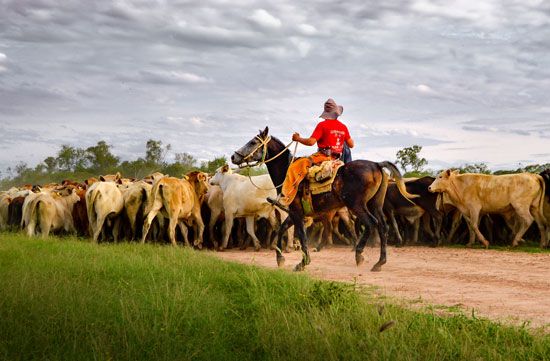
Geographically, the High Plains are characterized by generally flat grasslands. The region is drained eastward by the Platte, Arkansas, and Canadian rivers. Its economy is primarily supported by cattle ranching, dry farming, and irrigated agriculture—often utilizing water from the Ogallala Aquifer—as well as the extraction of natural gas and petroleum.12
What is the Ogallala Aquifer and why is it important to the High Plains?
The Ogallala Aquifer is a vast, relatively shallow underground water formation that lies beneath the Great Plains, spanning portions of eight states from South Dakota to the Texas Panhandle.43
Its importance to the High Plains and the broader Great Plains region is profound:
- Agricultural Foundation: The aquifer is a critical resource for the region’s economy, providing approximately 30 percent of the groundwater used for irrigation in the United States. It supports the production of essential crops such as wheat, corn, cotton, and sorghum, and sustains cattle feedlots where livestock are fattened for market.45
- Essential Water Supply: Beyond agriculture, the Ogallala serves as the primary source of drinking water for most of the people living within its reach.4
However, the aquifer faces a significant sustainability crisis. Water is being extracted for human use at rates that far exceed natural recharge. It is estimated that up to 60 percent of the aquifer’s total storage has already been depleted. As water levels drop, extraction becomes increasingly expensive, raising serious concerns about the long-term viability of the region’s agricultural and social systems.43
How does the chinook wind affect the climate of the Great Plains?
The chinook is a warm, dry wind that descends the eastern slopes of the Rocky Mountains, serving as a distinctive winter phenomenon for the western Great Plains.672
This wind significantly impacts the region’s continental climate by causing sudden, dramatic temperature shifts. As the chinook blows down the mountain slopes, it can raise local temperatures by as much as 30 to 40 °F (17 to 22 °C) within a very short period. These rapid changes are characteristic of the Great Plains, which are generally defined by cold winters, warm summers, and high wind variability.72
What are the main differences between dry farming and irrigated farming?
The primary difference between dry farming and irrigated farming lies in how they manage water availability to support crop growth.
Dry Farming
Dry farming is the cultivation of crops without irrigation in regions that typically receive less than 20 inches (500 millimeters) of annual precipitation. Success depends on efficient soil moisture storage and the use of specific agricultural techniques, such as:
- Moisture Conservation: Farmers focus on destroying weeds and preventing runoff to keep water in the soil.
- Crop Selection: Crops are specifically chosen for being drought-resistant (like sorghum) or drought-evasive. These plants are often smaller and mature more quickly than those grown in humid conditions.89
Irrigated Farming
Irrigation involves the artificial application of water to land to assist in the production of crops. It is often used to extend crop acreage or to supplement rainfall in productive districts.10
- Technological Application: Irrigated farming allows for the full use of modern agricultural technology, including the application of fertilizers and the cultivation of more productive crop varieties.10
- Methods: Water is sourced from streams, lakes, wells, or reservoirs and distributed via sprinkler systems, canals, or tube wells.10
While irrigation can significantly increase output, it can also lead to challenges such as soil salinity, land subsidence, or a lowered water table if water is extracted faster than it can be replenished.10
Sources
- High Plains — Encyclopædia Britannica
- Great Plains - Soils and climate — Encyclopædia Britannica
- Great Plains - The people and economy — Encyclopædia Britannica
- aquifer and Agriculture — Merriam-Webster
- hydrologic sciences - Concern over groundwater quantity and quality — Encyclopædia Britannica
- Chinook — Encyclopædia Britannica
- Great Plains: Top Questions — Encyclopædia Britannica
- Dry farming — Encyclopædia Britannica
- Origins of agriculture - Irrigation — Encyclopædia Britannica
- Agricultural technology - Dryland farming — Encyclopædia Britannica
Published on · 3 min read