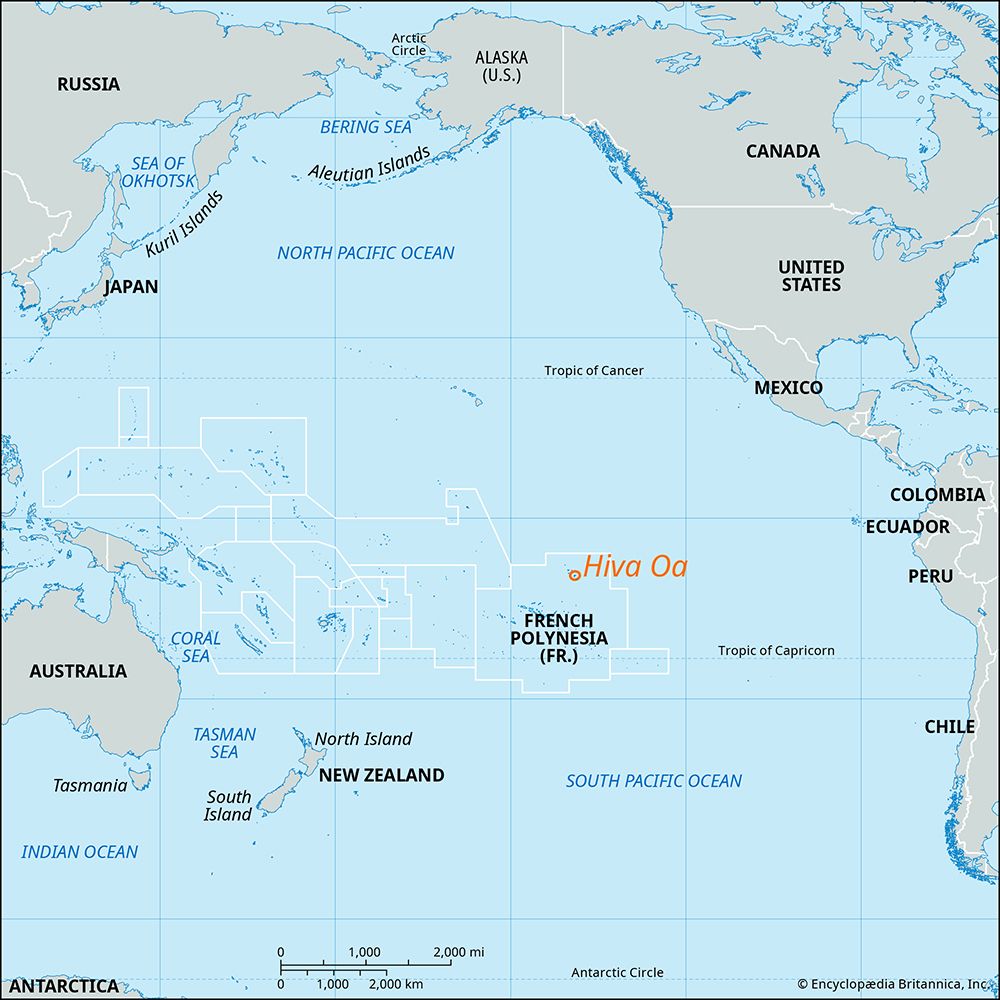
Hiva Oa
European contact with Hiva Oa, part of the Marquesas Islands, began with Spanish sightings in 1595, but the archipelago was formally annexed by France in…
How did European contact, particularly French colonization, impact Hiva Oa?
European contact with Hiva Oa, part of the Marquesas Islands, began with Spanish sightings in 1595, but the archipelago was formally annexed by France in 1842.12
The impact of French colonization and broader European influence was profound, particularly regarding cultural erosion. Beginning in the late 18th century, missionaries arrived in the region and suppressed traditional Polynesian culture, leading to the disappearance of many indigenous practices, including traditional religion, music, and tattooing. Furthermore, the romanticized image of the islands adopted by Europeans often reduced local culture to folklore.3
Economically, the island’s history included a small sandalwood trade in the 19th century, and today, copra remains a primary agricultural product. The island also became a destination for European artists and figures, most notably the French painter Paul Gauguin and the Belgian singer Jacques Brel, both of whom spent their final years on Hiva Oa and are buried there.21
What is the historical background of Hiva Oa, including its early Polynesian settlement?
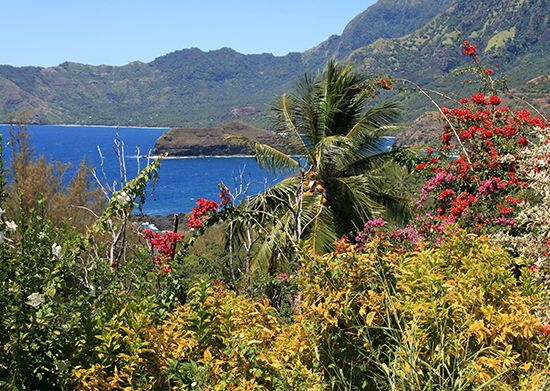
Hiva Oa is the largest and most populated island of the southeastern Marquesas Islands in French Polynesia. Its historical background is defined by early Polynesian settlement and subsequent European contact.21
Early Polynesian Settlement
The Marquesas Islands are believed to have been inhabited as early as 340 BCE, though some research suggests settlement could have occurred as early as the 2nd century BCE. These early settlers were part of the Austronesian expansion, bringing with them a culture that relied on stone, bone, and shell technology, as well as the cultivation of tubers and tree fruits. While these settlers initially brought pottery traditions, the practice disappeared in the Marquesas shortly after the islands were settled. Due to the island’s rugged terrain and lack of coastal plains, habitation was historically restricted to narrow valleys where streams provided access to water.152
European Contact and Colonial History
European contact began in 1595 when the Spanish navigator Álvaro de Mendaña de Neira sighted the southeastern islands. The entire archipelago was formally annexed by France in 1842. In the 19th century, the island participated in a small-scale sandalwood trade, and today, copra remains its primary export. The island also became a final residence for notable figures, including the French painter Paul Gauguin and the Belgian singer Jacques Brel, both of whom are buried in the main village of Atuona.21
How does the population of Hiva Oa compare to other islands in French Polynesia?
With a population of 2,243 recorded in 2017, Hiva Oa is the most populated island within the southeastern group of the Marquesas Islands.21
When compared to the broader context of French Polynesia, Hiva Oa’s population is relatively small. For instance, the Îles du Vent—which include the major islands of Tahiti and Moorea—had a combined population of 207,333 in 2017, reflecting a much higher concentration of residents and commercial activity. While the entire Marquesas archipelago had a total population of 9,346 in 2017, the population density across French Polynesia is significantly influenced by urbanization, with about three-fifths of the total population residing in urban areas, particularly around the capital, Papeete.617
How has tourism affected Hiva Oa’s economy and way of life?
Tourism is a developing industry on Hiva Oa, serving as an increasingly important economic activity for the Marquesas Islands as the region seeks to diversify its economy following the end of the nuclear-testing era in French Polynesia.29
Economic Impact
Historically, the island’s economy relied on subsistence agriculture and the export of copra. Following the decline of the “nuclear economy”—which had previously shifted the region toward a wage-based system—tourism emerged as a vital alternative. Today, the islands are a popular destination for cruising yachts, providing a new stream of revenue for local communities.129
Influence on Way of Life
The impact of tourism on Hiva Oa is closely tied to the broader Western fascination with an imagined “paradise,” a perception long fueled by the presence of figures like Paul Gauguin and Jacques Brel, who are buried on the island. While tourism promotes the region’s natural beauty, it also interacts with a complex cultural landscape where indigenous peoples are actively working to revive and maintain their customs, languages, and traditional arts against the pervasive influence of global media and colonial history.194
Sources
- Marquesas Islands — Encyclopædia Britannica
- Hiva Oa — Encyclopædia Britannica
- Guadeloupe - French rule — Encyclopædia Britannica
- French Polynesia - Cultural life — Encyclopædia Britannica
- Pacific Islands - Origins of Oceanian peoples — Encyclopædia Britannica
- French Polynesia - People — Encyclopædia Britannica
- Îles du Vent — Encyclopædia Britannica
- Hawaii - Settlement patterns — Encyclopædia Britannica
- Hawaii - Services, labor, and taxation — Encyclopædia Britannica
- Polynesian culture - Contemporary Polynesia — Encyclopædia Britannica
Published on · 3 min read