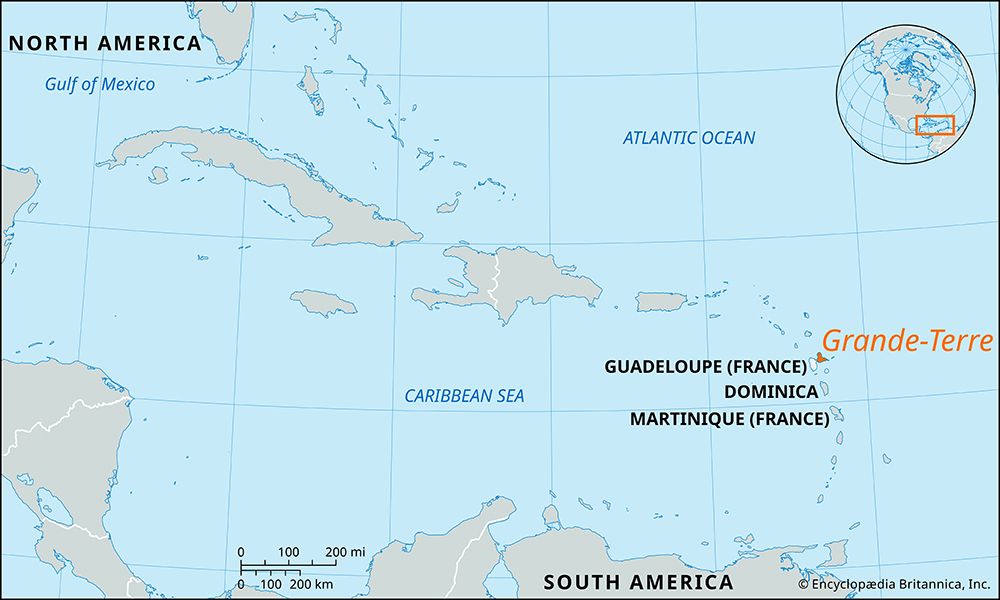
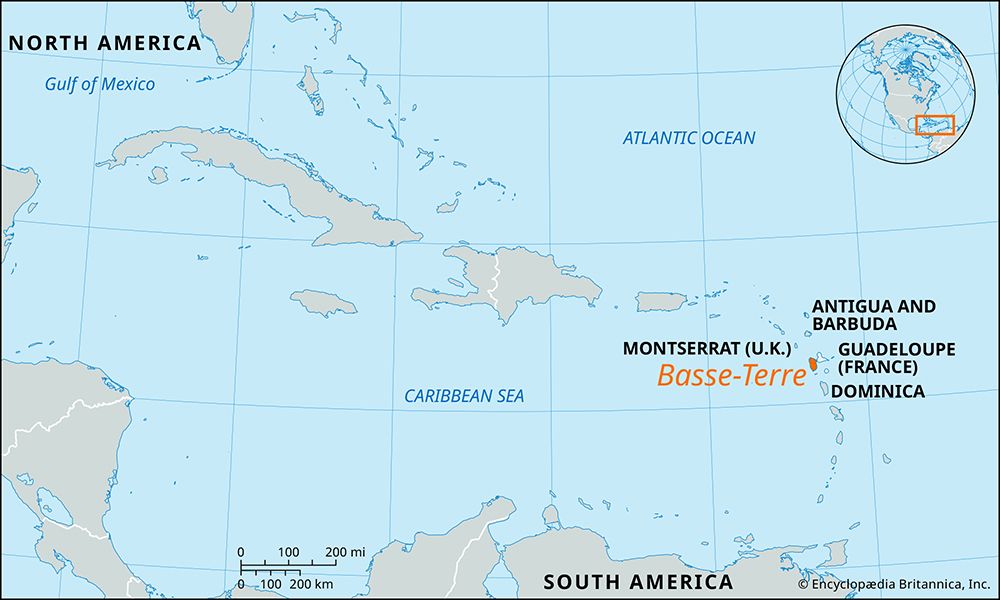
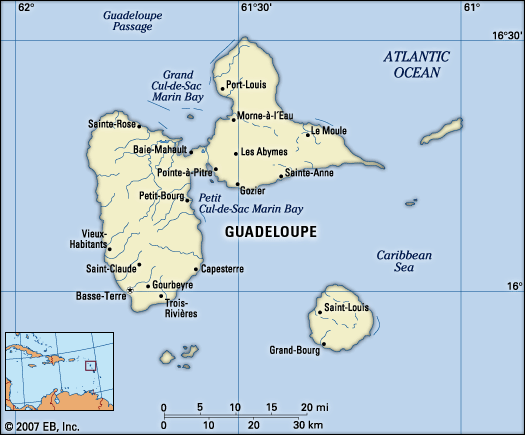
Guadeloupe
Guadeloupe became an overseas department of France in 1946. This change in status was part of the broader political restructuring following World War II…
How did Guadeloupe become an overseas department of France?
Guadeloupe became an overseas department of France in 1946. This change in status was part of the broader political restructuring following World War II, established by the constitution of the Fourth French Republic.12
Under this new constitutional framework, the French Union was created to replace the former colonial empire with a semifederal entity. By transitioning to the status of a département, Guadeloupe was integrated into the French state, moving away from its previous colonial designation. This administrative shift granted the territory a different legal standing, later evolving in 1974 when it also became a région of France.21
How does Guadeloupe’s economy differ from mainland France?
Guadeloupe’s economy differs from mainland France in several key structural ways, primarily characterized by a heavy reliance on imports and a significant trade imbalance. While mainland France maintains a diverse, industrialized economy, Guadeloupe experiences a chronically large annual deficit in its balance of external trade, as the value of its imports—largely food, machinery, and vehicles—vastly outstrips its exports.3
Key economic distinctions include:
- Trade Dependency: Guadeloupe’s trade is heavily oriented toward France, which serves as its primary partner for both imports and the export of agricultural goods like bananas, raw sugar, rum, and flowers.3
- Sector Composition: The service sector, particularly public administration, education, and health services, is the largest contributor to the gross domestic product and the primary source of employment. Tourism also plays a vital role in the local economy.4
- Industrial Focus: Manufacturing is more limited compared to the mainland, concentrated in areas like the industrial zone at Jarry, producing goods such as cement, clothing, and metalware.4
How does the education system in Guadeloupe compare to that of mainland France?
The education system in Guadeloupe is modeled directly after that of mainland France, ensuring a high degree of administrative and structural consistency between the overseas department and the metropole.
Key features of the system include:
- Language and Curriculum: French serves as the medium of instruction, and the educational framework mirrors the standards and requirements found in metropolitan France.7
- Compulsory Education: As in mainland France, schooling is mandatory for all children between the ages of 6 and 16.7
- School Structure: The system follows the French model, consisting of primary schools, collèges (lower secondary schools), and lycées (upper secondary schools).7
- Higher Education: Opportunities for advanced study are available through the University of the Antilles and Guiana, which maintains schools of humanities, law and economics, medicine, and science located in Pointe-à-Pitre.7
Because Guadeloupe is a full région of France, its educational policies are integrated into the broader French national system, ensuring that students follow a curriculum consistent with national standards.87
How do the people of Guadeloupe maintain their unique identity while being part of France?
The people of Guadeloupe maintain a distinct cultural identity while remaining an integral part of France by blending their unique heritage with the administrative and political framework of the French state. This identity is rooted in the concept of créolité (“creole-ness”), which recognizes the population as a hybrid of African, European, and Caribbean influences.9
Key ways this identity is expressed include:
- Language: While French is the official language, a local creole is widely spoken, serving as a vital marker of cultural heritage and social connection.1011
- Music and Dance: Cultural pride is deeply tied to music, particularly zouk, which emerged as an emblem of identity by incorporating Creole lyrics and traditional rhythms like the gwoka drum patterns. Other traditions, such as the beguine dance and the wearing of traditional madras et foulard costumes during holidays, remain significant expressions of local folk culture.912
- Cultural Movements: The ideology of créolité has fostered a movement that seeks to validate the region’s hybrid culture as both legitimate and distinct from its parent cultures.9
- Political Integration: Despite a history of independence movements, the majority of the population has maintained its status within the French union. Today, Guadeloupe functions as a full région of France, participating in the French political system while exercising local control through its departmental and regional councils.71
Sources
- Guadeloupe - French rule — Encyclopædia Britannica
- French Union — Encyclopædia Britannica
- Guadeloupe - Transportation — Encyclopædia Britannica
- Guadeloupe - Trade — Encyclopædia Britannica
- French Guiana - Economy — Encyclopædia Britannica
- Guadeloupe - Manufacturing and services — Encyclopædia Britannica
- Guadeloupe - Government and society — Encyclopædia Britannica
- Guadeloupe - Education — Encyclopædia Britannica
- Guadeloupe - People of Guadeloupe — Encyclopædia Britannica
- zouk — Encyclopædia Britannica
- Guadeloupe: Top Questions — Encyclopædia Britannica
- Guadeloupe - Political and economic changes since 1950 — Encyclopædia Britannica
- Guadeloupe - Cultural life — Encyclopædia Britannica
- Grande-Terre — Encyclopædia Britannica
Published on · 3 min read