Hoary Bat
The hoary bat (Lasiurus cinereus) is a migratory bat native to North America, ranging from Canada to Mexico. As a member of the vesper bat family…
What is hoary bat?
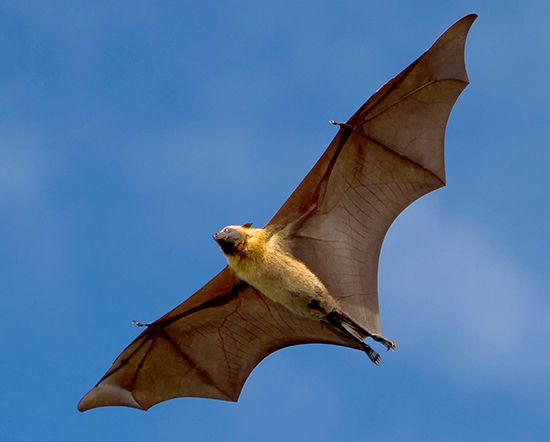
The hoary bat (Lasiurus cinereus) is a migratory bat native to North America, ranging from Canada to Mexico. As a member of the vesper bat family (Vespertilionidae), it typically measures 13–14 cm in length and weighs approximately 30 grams.1
The species is named for its distinctive thick fur, which is yellowish or reddish brown and tipped with silver, giving it a frosted or “hoary” appearance. This coloration helps the bat camouflage against lichen-covered tree bark, where it roosts. These solitary, strong-flying mammals are insectivores.1
During the fall, hoary bats migrate from the northern United States and Canada toward the southern United States and beyond, returning north in the spring. Notably, a subspecies of the hoary bat is the only bat species native to the Hawaiian Islands.21
How do bats use echolocation to hunt insects?
Bats use echolocation—a biological form of sonar—to hunt insects by emitting high-frequency sound pulses and interpreting the returning echoes. These pulses are produced in the larynx and emitted through the mouth or nose, often channeled by facial structures like nose leaves.3
When these sound waves strike an insect, the energy is reflected back to the bat. By analyzing these echoes, bats determine the target’s direction, distance, velocity, and size. The hunting process occurs in three distinct phases:3
- Search: The bat emits pulses at a steady rate (about 10 per second) while scanning for prey.3
- Approach: Upon detecting an insect, the bat increases its pulse rate to 25–50 per second and shortens the pulses as it closes the distance.3
- Terminal: During the final interception, the bat emits extremely short pulses at a rapid rate of 200 or more per second, allowing for precise tracking during the final maneuver.3
To process this information, bats rely on specialized ears and a nervous system capable of integrating vocal and auditory data in milliseconds, allowing them to distinguish their own echoes from background noise and other bats.3
Why is the hoary bat considered a solitary animal?
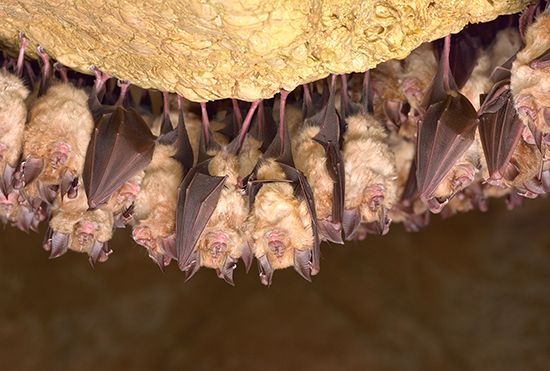
The hoary bat is characterized as a solitary animal because it typically roosts alone in trees rather than in the large, dense colonies common to many other bat species. While many bats are colonial, the hoary bat’s solitary nature is linked to its roosting behavior; it often rests on tree trunks or branches, where its frosted, silver-tipped fur provides camouflage against lichen-covered bark.16
Furthermore, the social structure of migratory species like the hoary bat is distinct. Research indicates that for these long-distance migrants, the sexes may meet only briefly each year. While the specific evolutionary advantages of a solitary versus colonial lifestyle in bats have not yet been fully established, the hoary bat’s preference for solitary roosting contrasts with species that rely on the heat and protection provided by large, clustered groups in caves or buildings.26
What makes the Hawaiian hoary bat unique compared to its mainland relatives?
The Hawaiian hoary bat, known locally as the ope‘ape‘a, is unique primarily because it is the only native land mammal found in the Hawaiian Islands. While its mainland relative, the hoary bat (Lasiurus cinereus), is a wide-ranging migratory species found across North America, the Hawaiian population is a distinct subspecies that has adapted to an isolated, island-based environment far from the species’ primary continental range.1
Unlike the mainland hoary bat, which is known for its extensive seasonal migrations across North America, the Hawaiian subspecies has established a permanent, non-migratory presence within the archipelago. This isolation makes it a significant subject of study regarding how bats colonize and adapt to remote oceanic islands.1
Sources
- hoary bat — Encyclopædia Britannica
- bat - Migration — Encyclopædia Britannica
- bat - Orientation — Encyclopædia Britannica
- bat - Anatomical specializations — Encyclopædia Britannica
- bat - Senses — Encyclopædia Britannica
- bat - Social interactions — Encyclopædia Britannica
- bat - Roosting — Encyclopædia Britannica
Published on · 3 min read