Ghost Bat
The term "ghost bat" refers to several distinct species characterized by their white or gray fur, though the name is not applied to every bat with white…
What are the different species that are referred to as ghost bats?
The term “ghost bat” refers to several distinct species characterized by their white or gray fur, though the name is not applied to every bat with white coloration. These species are categorized into different families and geographic regions:1
- New World Ghost Bats (Diclidurus genus): There are four species in this genus belonging to the family Emballonuridae, found in Central and South America. The most notable is D. albus, a snowy-white bat that hunts moths in open tropical forests using high-pitched echolocation.1
- Honduran White Bat (Ectophylla alba): This is a separate New World species that is classified as a leaf-nosed bat.1
- Australian Ghost Bat (Macroderma gigas): Also known as the Australian giant false vampire bat, this is the only ghost bat found outside of the Americas. It is a large, grayish member of the family Megadermatidae and is currently considered an endangered species1.2
While these bats share the “ghost” moniker due to their appearance, they belong to diverse evolutionary lineages, ranging from sheath-tailed bats to leaf-nosed and false vampire bat families.12
What are the physical characteristics of ghost bats?
The physical characteristics of ghost bats vary significantly depending on the species, as the term encompasses different evolutionary lineages.
New World Ghost Bats (Diclidurus genus)
These bats are members of the family Emballonuridae and are defined by their distinct coloration and size:
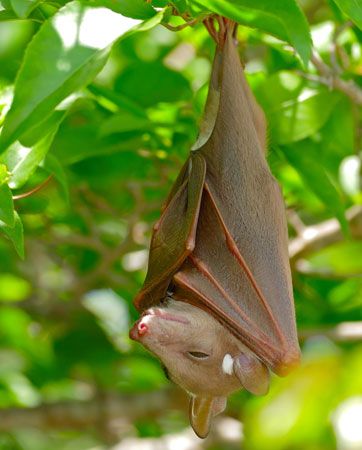
- Appearance: D. albus is characterized by its snowy-white fur, dark eyes, and yellow-edged ears. They possess long, nearly transparent wings.1
- Size: They are medium-sized, measuring approximately 9 cm (3.5 inches) in length with a wingspan of about 40 cm (16 inches) and a body mass of roughly 20 grams (0.7 ounce).1
- Unique Features: Males feature a peculiar, hook-shaped ornament on their tail membrane, the specific function of which remains unclear.1
Australian Ghost Bat (Macroderma gigas)
As a member of the family Megadermatidae, this species is physically distinct from the New World varieties:
- Appearance: It is a large, grayish or brownish bat.13
- Size: It is the largest bat in the suborder Microchiroptera, reaching lengths of up to 14 cm.3
- Features: Like other megadermatids, it possesses a conspicuous nose leaf (a flap of skin and connective tissue around the nostrils) and large, rounded ears that are joined at the base. It lacks an external tail.23
How do ghost bats interact with other bat species in their habitats?
The interaction between ghost bats and other bat species varies significantly depending on the specific lineage, primarily due to their differing dietary habits and ecological roles.
Predatory Interactions
The Australian ghost bat (Macroderma gigas), a member of the family Megadermatidae, is classified as a false vampire bat. Unlike many other bats that focus on insects, this species is carnivorous. It actively preys on small vertebrates, which explicitly includes other bat species, alongside lizards and mice. As the largest bat in the suborder Microchiroptera, its role in the ecosystem is that of a predator rather than a competitor for the same food sources as smaller insectivorous bats.1
Ecological Niche Separation
In contrast, the New World ghost bats of the genus Diclidurus (family Emballonuridae) are specialized insectivores. Their hunting behavior, which involves emitting high-pitched, constant-frequency signals to track moths in open tropical forests, is highly specialized for their specific environment. These signals are distinct from those of fruit bats, which navigate and forage within the dense forest canopy. This difference in acoustic signaling and foraging habitat suggests a degree of niche partitioning that minimizes direct competition with other bat groups.2
How did ghost bats get their common name?
The common name “ghost bat” is primarily derived from the distinctive physical appearance of certain species, particularly their coloration. Many bats grouped under this name possess white or gray fur, which gives them a pale, ethereal look.1
For instance, the New World ghost bat Diclidurus albus is noted for its snowy-white fur, dark eyes, and nearly transparent wings, contributing to its ghostly appearance. While the term is used for several species, it is important to note that not every bat with white fur is classified as a ghost bat.1
In the case of the Australian ghost bat (Macroderma gigas), the name is also associated with its classification as a false vampire bat. This species is a large, grayish bat that was historically grouped with others that were mistakenly thought to feed on blood, similar to true vampire bats.12
Sources
- ghost bat — Encyclopædia Britannica
- false vampire bat — Encyclopædia Britannica
- Megadermatidae — Merriam-Webster
- List of bats — Encyclopædia Britannica
Published on · 3 min read