Fruit Bat
A fruit bat is a member of the family Pteropodidae (often referred to as Old World fruit bats), which includes more than 180 species of bats that primarily…
What is fruit bat?
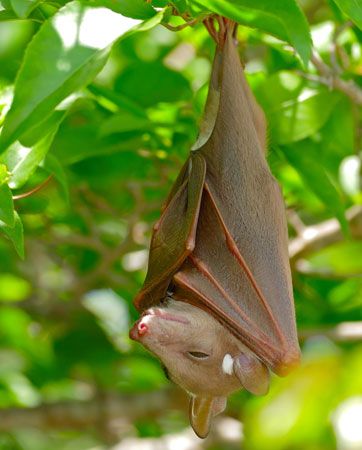
A fruit bat is a member of the family Pteropodidae (often referred to as Old World fruit bats), which includes more than 180 species of bats that primarily feed on fruit, pollen, and nectar.12
These bats are widely distributed across tropical and subtropical regions of Africa, Asia, and Australia. They are generally characterized by their large eyes and reliance on vision for navigation, as most species do not use echolocation—with the notable exception of rousette bats (Rousettus).123
Key characteristics include:
- Diversity in Size: They range from the long-tongued fruit bat, which is quite small, to the flying fox (Pteropus), which is the largest of all bats and can have a wingspan of up to 1.5 meters (5 feet).145
- Behavior: Most species roost in trees, though some inhabit caves or buildings. They play a vital ecological role in seed dispersal and forest regeneration.16
- New World Species: While the term “fruit bat” is most commonly associated with the Old World Pteropodidae, it is also used for certain New World species, such as the Jamaican fruit bat, which belongs to the leaf-nosed bat family and does use echolocation.6
How do fruit bats help plants and flowers grow?
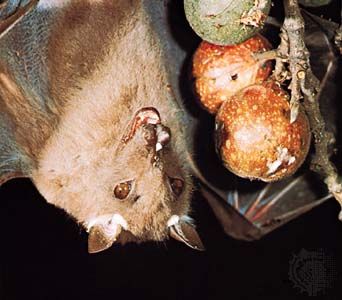
Fruit bats play a vital role in the health and reproduction of many plant species, primarily through two processes: pollination and seed dispersal.7
Pollination
Many tropical plants have evolved to rely on bats for reproduction. These plants often produce pale, fragrant flowers that open in the evening, which are highly attractive to night-flying bats. As bats visit these flowers to feed on nectar and protein-rich pollen, they inadvertently become dusted with pollen, which they then transport to other flowers.78
Plants adapted for bat pollination often feature:
- Structural adaptations: Large, sturdy, bell-shaped flowers that are sometimes positioned on the trunk or main limbs (cauliflory) to facilitate the bat’s approach.8
- Sensory cues: A powerful, often rancid or urinelike odor that helps bats locate the flowers in the dark.8
Seed Dispersal
Fruit bats are essential for the survival of many trees, as they transport seeds away from the parent plant, reducing competition and helping the species expand its range.79
- Feeding behavior: Bats are attracted to sweet, fragrant fruits. They often carry fruit away from the source tree to a feeding roost.79
- Dispersal methods: While eating, bats may drop seeds at the roost site, or they may swallow smaller seeds whole, which are later voided in flight.79
- Ecological impact: This behavior ensures that seeds are deposited in new locations, often away from seed predators that congregate beneath parent trees. In some cases, such as with the almendro tree, fruit bats work in tandem with other animals to ensure successful germination.79
What is the difference between echolocation and visual navigation in bats?
The primary difference between echolocation and visual navigation in bats lies in the sensory mechanism used to perceive the environment.
Echolocation
Most bats, specifically those in the suborder Microchiroptera, use echolocation as their primary method for orientation, obstacle avoidance, and hunting. This process involves emitting high-frequency sound pulses and interpreting the returning echoes to determine the distance, direction, velocity, and nature of objects.101
- Mechanism: Bats produce sound via the larynx and emit it through the nose or mouth. The returning echoes are analyzed by the bat’s specialized auditory system and brain to create a detailed spatial map.10
- Precision: This system is highly effective for tracking fast-moving prey, such as insects, and detecting fine obstacles like thin wires, even in total darkness.10
Visual Navigation
In contrast, most Old World fruit bats (family Pteropodidae) rely on vision rather than echolocation to navigate.11
- Mechanism: These bats possess large eyes capable of making visual discriminations at very low light levels, allowing them to fly through jungle canopies at night.12
- Usage: While Microchiroptera also possess eyes and use vision for long-distance navigation and synchronizing their internal clocks, they rely on sound for immediate, goal-oriented maneuvers. Conversely, fruit bats use vision to avoid obstacles, though the rousette bat (Rousettus) is a notable exception that has independently evolved a basic echolocation system for obstacle avoidance.121011
Why are some fruit bat species considered endangered?
Many fruit bat species, particularly those in the genus Pteropus (commonly known as flying foxes), face significant conservation challenges. According to the International Union for Conservation of Nature (IUCN), approximately half of all flying fox species are experiencing population declines, with many classified as vulnerable or endangered.14
A primary factor contributing to these declines is human activity. In various regions of Southeast Asia and on several Pacific islands, these bats are hunted for food. Additionally, because they feed on fruit, they are sometimes viewed as agricultural pests and may face persecution or habitat loss as humans seek to protect cultivated crops like bananas and figs.314
Protecting these species is essential, as they serve as critical pollinators and agents of seed dispersal, playing a fundamental role in the health and regeneration of tropical ecosystems.34
Sources
- Old World fruit bat — Encyclopædia Britannica
- fruit bat — Merriam-Webster
- flying fox — Encyclopædia Britannica
- Jamaican fruit bat — Encyclopædia Britannica
- bat - General features — Encyclopædia Britannica
- bat - Annotated classification — Encyclopædia Britannica
- pollination - Mammals — Encyclopædia Britannica
- Tropical rainforest - Relationships between the flora and fauna — Encyclopædia Britannica
- Hitching a ride — Encyclopædia Britannica
- bat - Orientation — Encyclopædia Britannica
- bat - Senses — Encyclopædia Britannica
- Echolocation — Encyclopædia Britannica
- Migration - Other animals — Encyclopædia Britannica
- bat - Importance to humans — Encyclopædia Britannica
Published on · 4 min read