Homo Habilis
The diet of Homo habilis was likely omnivorous, consisting of a variety of plant foods such as fruits, nuts, roots, and tubers, supplemented by meat obtained…
What was the diet of Homo habilis, and how did it differ from earlier hominins?
The diet of Homo habilis was likely omnivorous, consisting of a variety of plant foods such as fruits, nuts, roots, and tubers, supplemented by meat obtained through scavenging. While H. habilis is associated with the Oldowan industry—crude stone tools used for cutting meat and pounding bones for marrow—evidence suggests they were primarily opportunistic scavengers rather than confirmed hunters.12
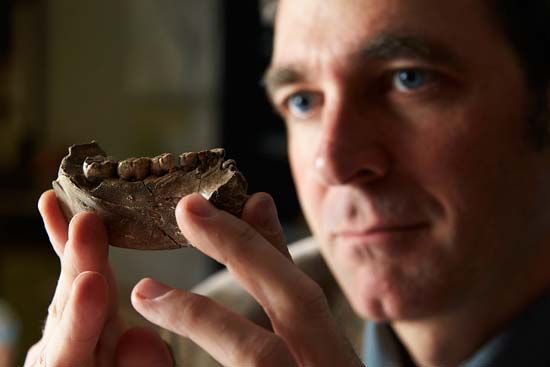
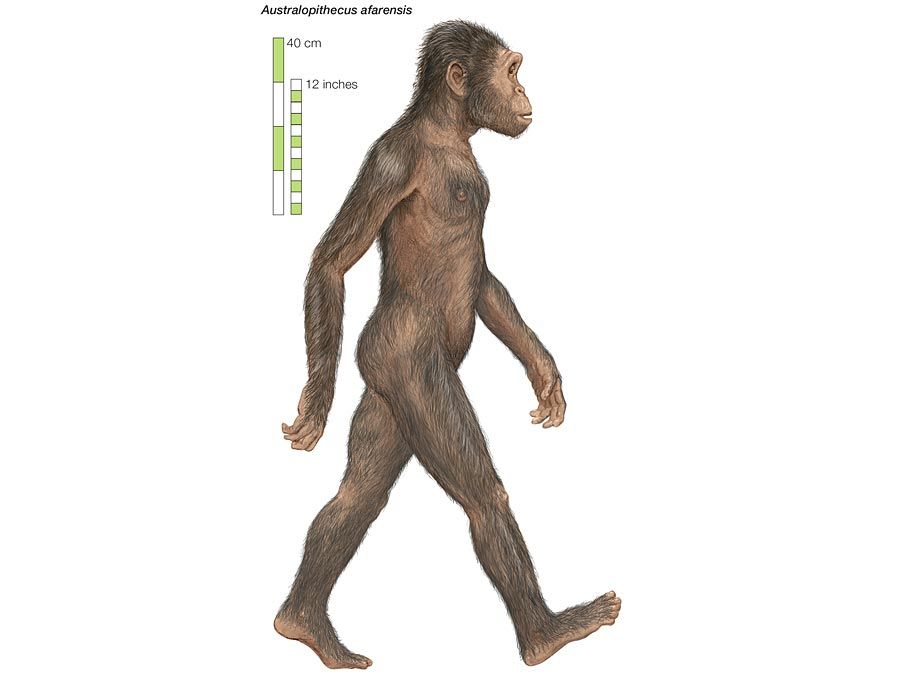
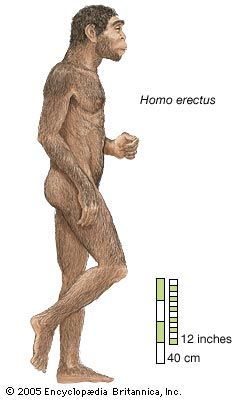
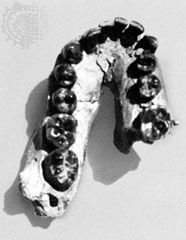
Compared to earlier hominins, such as Australopithecus, H. habilis exhibited a trend toward smaller premolar and molar crowns, even though their jaws remained robust. While earlier hominins relied on large, thick-enameled teeth to process tough, abrasive vegetation, the emergence of Homo marked a shift toward smaller teeth over time. This reduction is often linked to the development of improved stone tools for food processing, which reduced the mechanical demands on the teeth. Unlike the later Homo erectus, there is no definitive evidence that H. habilis mastered fire for cooking, which would have further reduced the need for large, powerful chewing apparatuses.2341
What tools were associated with Homo habilis, and how did they use them?
Homo habilis, whose name means “handy man,” is associated with the Oldowan industry, a tradition of toolmaking that dates back approximately 2 million years. These tools were not produced according to a standardized pattern but were instead fashioned from pebbles of quartz, quartzite, or basalt.89
Tool Construction and Use
The Oldowan toolkit primarily consisted of:
- Chopping tools: Pebbles chipped in two directions to create rough, all-purpose implements.9
- Sharp flakes: These were produced during the creation of chopping tools and were utilized as effective cutting instruments.910
- Other materials: While stone tools are the most prominent, evidence suggests H. habilis also used tools made of bone and wood, such as a lissoir (a smoothing tool) found at Olduvai Gorge.9
These implements were used for a variety of tasks, including cutting meat, scraping hides, and processing plant materials. They were also essential for pounding open hard-shelled fruits and nuts, as well as breaking bones to access nutrient-rich marrow and skulls to reach brains. While these tools were once thought to be evidence of systematic hunting, it is now understood that H. habilis likely used them for scavenging carcasses already killed by other predators.9210
What is Homo habilis and when did it exist?
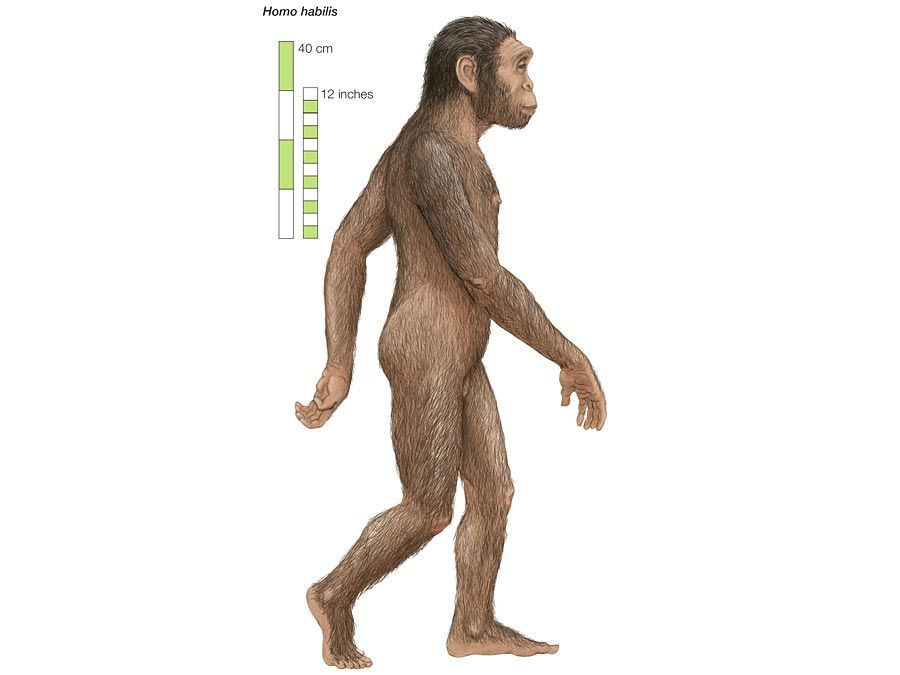
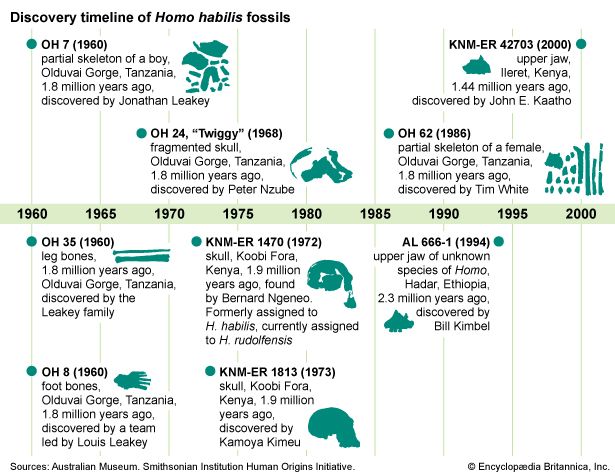
Homo habilis, often referred to as “handy man,” is an extinct species of human and the most ancient representative of the genus Homo. First discovered at Olduvai Gorge in Tanzania, this species is characterized by a larger cranial capacity and smaller teeth compared to the more primitive Australopithecus.8
Regarding its existence, Homo habilis inhabited parts of sub-Saharan Africa during the Pleistocene Epoch. While estimates vary based on fossil classification, the species is generally considered to have flourished between approximately 2.4 million and 1.5 million years ago. Some researchers have proposed even earlier dates, such as a 2013 discovery in Ethiopia dated to 2.8–2.75 million years ago, though its definitive assignment to H. habilis remains a subject of scientific discussion.81112
Homo habilis is recognized as a pivotal link in human evolution, exhibiting anatomical features that bridge the gap between earlier, apelike hominins and the more advanced Homo erectus.811
How did the brain size of Homo habilis compare to earlier hominins and modern humans?
The brain size of Homo habilis represented a significant evolutionary increase compared to earlier hominins, marking the beginning of a trend toward larger brain volumes in the genus Homo.1
Comparison of Brain Capacity
Fossil evidence indicates that H. habilis possessed a larger cranial capacity than its predecessors, such as Australopithecus and Paranthropus. While brain sizes for H. habilis vary significantly among specimens—ranging from approximately 510 cc to nearly 800 cc—the average capacity is estimated at 640 cc. In contrast, Australopithecus species typically averaged around 440 cc, and Paranthropus averaged about 519 cc.131
Compared to modern humans (Homo sapiens), who have an average brain capacity of approximately 1,350 cc, the brain of H. habilis was considerably smaller. However, when considering brain size relative to estimated body mass, H. habilis is noted for being particularly “brainy,” even when compared to some later Homo species.131
Average Braincase Capacity
Hominin
Average Capacity (cc)
Australopithecus
440
Paranthropus
519
Homo habilis
640
Homo sapiens
1,350
This expansion in brain size is often studied alongside the development of stone tool technology, though scientists caution against directly linking brain volume alone to cognitive complexity or specific human behaviors.1
Sources
- Homo habilis - Body structure — Encyclopædia Britannica
- human evolution - Refinements in hand structure — Encyclopædia Britannica
- human evolution - Background and beginnings in the Miocene — Encyclopædia Britannica
- Homo erectus - Behavioral inferences — Encyclopædia Britannica
- human evolution - Reduction in tooth size — Encyclopædia Britannica
- human evolution - The fossil evidence — Encyclopædia Britannica
- human evolution - Hominin habitats — Encyclopædia Britannica
- Homo habilis — Encyclopædia Britannica
- Oldowan industry — Encyclopædia Britannica
- Homo habilis - Behavioral inferences — Encyclopædia Britannica
- Homo habilis — Merriam-Webster
- Homo habilis - The fossil evidence — Encyclopædia Britannica
- human evolution - Increasing brain size — Encyclopædia Britannica
Published on · 4 min read