Homo Erectus
Compared to earlier hominins, such as Australopithecus and Homo habilis, Homo erectus exhibited a more sophisticated and opportunistic approach to diet.…
How did the diet of Homo erectus differ from earlier hominins?
Compared to earlier hominins, such as Australopithecus and Homo habilis, Homo erectus exhibited a more sophisticated and opportunistic approach to diet. While earlier species are often characterized as scavengers or opportunists who primarily consumed vegetal foods, Homo erectus is considered a confirmed hunter that preyed on animals of all age groups.1
Key differences in their dietary habits include:
- Hunting and Variety: H. erectus likely utilized superior food-collecting techniques and tools to hunt larger game. Their diet was highly diverse, incorporating meat from the hunt alongside “juicy morsels” such as fish, tortoises, rodents, birds, eggs, and various insects.1
- Omnivory and Adaptability: H. erectus was clearly omnivorous, consuming a wide range of vegetable matter, including fruits, nuts, roots, tubers, and fleshy leaves. This opportunistic diet provided the species with significant evolutionary flexibility.1
- Food Preparation: A major shift occurred with the mastery of fire, which allowed H. erectus to cook food. Cooking reduced the mechanical work required for chewing, which likely contributed to the evolutionary reduction in the size of their teeth and jaws compared to their predecessors.12
What are the key physical characteristics that distinguish Homo erectus from other early human species?
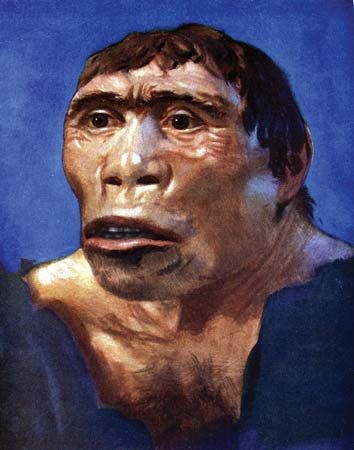
Homo erectus is distinguished from earlier hominins, such as Australopithecus and Homo habilis, by a unique combination of cranial and skeletal features that reflect its evolutionary transition toward modern humans.5
Cranial Characteristics
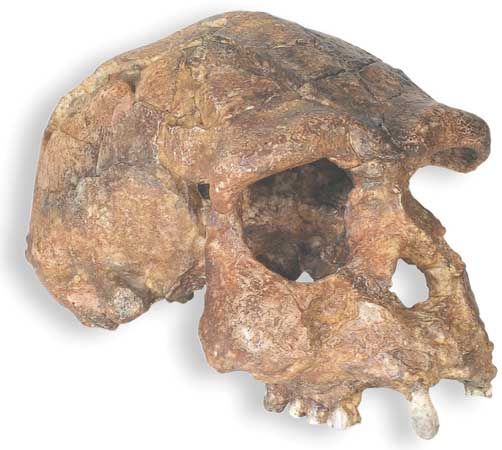
The skull of H. erectus is highly distinctive, characterized by a low-profile braincase and a significantly larger average endocranial capacity—typically ranging from 850 to 1,067 cubic cm in African specimens—which far exceeds that of the australopiths. Other notable features include:5
- Massive Face: The face is robustly constructed with forward-projecting lower parts.5
- Browridges: They possess strongly jutting browridges (supraorbital torus) and a flattened forehead.5
- Skull Thickness: The bones of the braincase are notably thick, with sides that taper upward.5
- Nasal Structure: The nasal bridge is relatively high and prominent, a development that likely helped conserve moisture in arid environments.5
- Jaw and Teeth: The lower jaw is deep and robust, lacking a chin, and the teeth are generally larger than those of Homo sapiens.5
Skeletal Structure and Stature
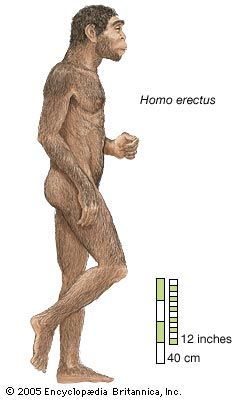
Unlike earlier hominins that retained arboreal adaptations, the skeleton of H. erectus is robust and comparable to that of modern humans, indicating that the species was an efficient, obligate biped. Their limb bones suggest a physically demanding lifestyle, and evidence from the Nariokotome boy indicates that H. erectus could reach heights of up to 180 cm (6 feet). By approximately 1.5 million years ago, the uniquely human locomotor system and associated cooling mechanisms were well-established.56
How did the brain size of Homo erectus compare to earlier hominins and modern humans?
The brain size of Homo erectus represents a significant evolutionary step, falling between that of earlier hominins and modern Homo sapiens.5
Comparison of Brain Capacity
The average endocranial capacity of Homo erectus typically ranges from approximately 850 to 1,067 cubic cm in African specimens, with some Asian populations averaging around 930 to 1,029 cubic cm. This capacity is notably larger than that of earlier hominins but remains smaller than that of modern humans.5
Hominin
Average Braincase Capacity (cc)
Australopithecus
440
Paranthropus
519
Homo habilis
640
Javanese
Homo erectus
930
Chinese
Homo erectus
1,029
Homo sapiens
1,350
Evolutionary Context
While the brain size of H. erectus clearly exceeds that of the australopiths and H. habilis, it does not reach the average 1,350 cubic cm seen in modern Homo sapiens. However, the upper range of H. erectus (estimated at 1,200 cubic cm) does overlap with the lower values found in recent humans.5
It is important to note that brain size alone is an imperfect predictor of cognitive ability. For instance, the diminutive H. floresiensis possessed a brain mass comparable to that of chimpanzees, yet demonstrated sophisticated tool-making capabilities. Similarly, while Neanderthals had brains that rivaled those of modern humans in absolute size, they were less “brainy” when measured relative to their body mass.6
When and where did Homo erectus first appear in the fossil record?
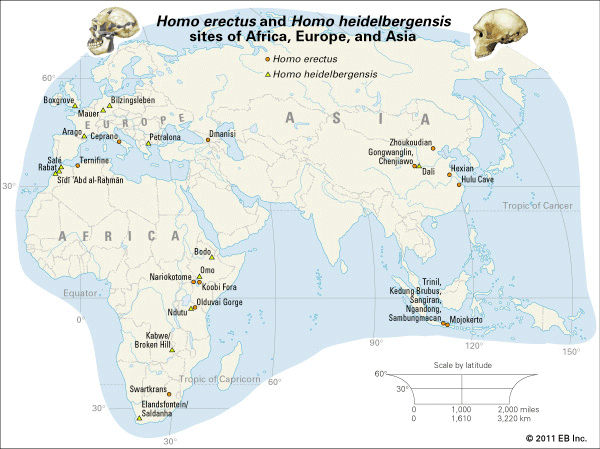
Homo erectus is believed to have originated in Africa, though an origin in Eurasia remains a possibility. The species began to disperse widely across the African tropics, Europe, and Asia starting approximately 1.9 million years ago (mya).8
In the fossil record, some of the most ancient evidence for H. erectus comes from the Koobi Fora sites near Lake Turkana in Kenya, where fossils have been dated to roughly 1.7 to 1.75 mya. While the first fossils ever attributed to the species were discovered by Eugène Dubois in Java in 1891—famously known as “Java man”—these specimens are generally considered younger than the earliest African finds. Some paleontologists classify the older African specimens as a separate species, H. ergaster, though this remains a subject of ongoing scientific discussion.9101112
Sources
- Homo erectus - Behavioral inferences — Encyclopædia Britannica
- human evolution - Reduction in tooth size — Encyclopædia Britannica
- Homo sapiens - Origin — Encyclopædia Britannica
- Australopithecus - Quality of the fossil record — Encyclopædia Britannica
- Homo erectus - Body structure — Encyclopædia Britannica
- human evolution - Increasing brain size — Encyclopædia Britannica
- human evolution - The fossil evidence — Encyclopædia Britannica
- Homo erectus - African fossils — Encyclopædia Britannica
- Homo erectus - Dating the fossils — Encyclopædia Britannica
- Homo erectus - The earliest finds — Encyclopædia Britannica
- Homo erectus — Encyclopædia Britannica
- Homo erectus - The question of ancestry — Encyclopædia Britannica
Published on · 4 min read