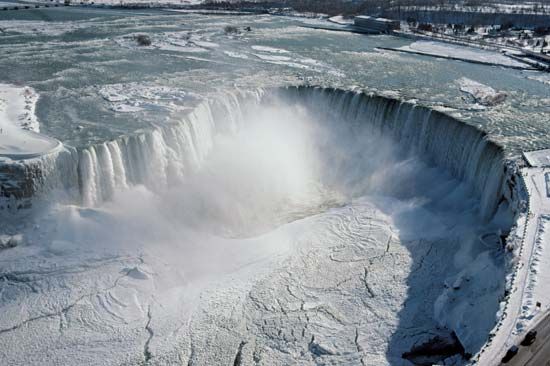
Horseshoe Falls
Horseshoe Falls is the larger, predominantly Canadian section of Niagara Falls, located on the Niagara River. It is separated from the American Falls by Goat…
What is Horseshoe Falls?
Horseshoe Falls is the larger, predominantly Canadian section of Niagara Falls, located on the Niagara River. It is separated from the American Falls by Goat Island and derives its name from its distinctive, curving 2,200-foot (670-metre) crest line.123
Standing 188 feet (57 metres) high, the falls carry approximately 90 percent of the river’s total discharge. While the cataract was historically known for a rapid rate of recession due to erosion, the diversion of water for hydroelectric power and the implementation of upstream control works have significantly slowed this process, helping to preserve the waterfall’s structure. Visitors often view the falls from vantage points such as Queen Victoria Park in Ontario or via the Rainbow Bridge in Ontario or via the Rainbow Bridge.32
How does the Niagara River generate hydroelectric power?
The Niagara River serves as a major source of hydroelectric power due to its high, steady flow and significant vertical drop of approximately 326 feet (99 metres).4
The generation process relies on the diversion of water before it reaches Niagara Falls:
- Water Diversion: Under a 1950 treaty, the United States and Canada reserve a specific amount of water to maintain the scenic flow of the falls. Any excess water—averaging about 130,000 cubic feet per second—is diverted for power generation.4
- Transport: Large quantities of water are pulled from the river above the falls and directed into tunnels and canals.43
- Power Plants: This water is channeled to large public-authority power plants located downstream at the end of the Niagara Gorge, specifically near Lewiston, New York, and Queenston, Ontario.4
- Impact: This diversion not only produces electricity for nearby industries and cities but also helps preserve the falls by slowing the rate of erosion.43
What geological processes cause waterfalls to recede over time?
Waterfalls are temporary geological features that recede over time as rivers work to smooth their longitudinal profiles through erosion. The primary process driving this retreat is headward erosion, which occurs as the waterfall wears away the rock at its base and face.5
Key mechanisms of this recession include:
- Plunge Pool Formation: The immense energy of falling water scours a plunge pool into the riverbed at the base of the falls. As this basin deepens and widens, it undermines the stability of the cliff face above.5
- Structural Collapse: When a waterfall consists of a resistant rock cap overlying softer layers—such as the dolomite and shale found at Niagara Falls—the erosion of the weaker underlying rock causes the unsupported cap to collapse. This process forces the cliff face to retreat upstream.5
- Downcutting: In some instances, erosion acts downward to bevel the entire reach of the river, gradually eliminating the vertical drop.5
The rate of this retreat is influenced by the waterfall’s height, water volume, and the specific geology of the site.5
What are the differences between the American Falls and Horseshoe Falls?
The American Falls and Horseshoe Falls are the two primary sections of Niagara Falls, separated by Goat Island. While they share the same river system, they differ significantly in their physical characteristics and behavior:
Feature
American Falls
Horseshoe Falls
Height
190 feet (58 metres)
188 feet (57 metres)
Crest Length
1,060 feet (320 metres)
~2,200–3,000 feet (curving)
Water Volume
Receives a smaller portion of flow
Carries about 90% of river discharge
Recession Rate
Very slow (~0.08 metre/year)
Historically much faster
Key Differences:
- Flow Distribution: The Horseshoe Falls is the larger division and dominates the river’s discharge, carrying approximately 90 percent of the water over its distinctively curved crest.3
- Erosion and Stability: The Horseshoe Falls has historically experienced a much higher rate of upstream recession compared to the American Falls. At the American Falls, the erosion rate is currently so slow that large blocks of dolomite accumulate at the base, which has led to concerns about the falls eventually transitioning into rapids.13
- Geography: The American Falls adjoins the U.S. bank, while the Horseshoe Falls adjoins the Canadian bank.3
Sources
- Horseshoe Falls — Encyclopædia Britannica
- Why is Niagara Falls famous? — Encyclopædia Britannica
- Niagara Falls — Encyclopædia Britannica
- Niagara River — Encyclopædia Britannica
- waterfall — Encyclopædia Britannica
- river - Development of waterfalls — Encyclopædia Britannica
Published on · 3 min read