K–T Extinction
The K–T extinction (also known as the Cretaceous–Paleogene extinction) was a global mass extinction event that occurred approximately 66 million years ago.…
What exactly is the K-T extinction event, and when did it occur?
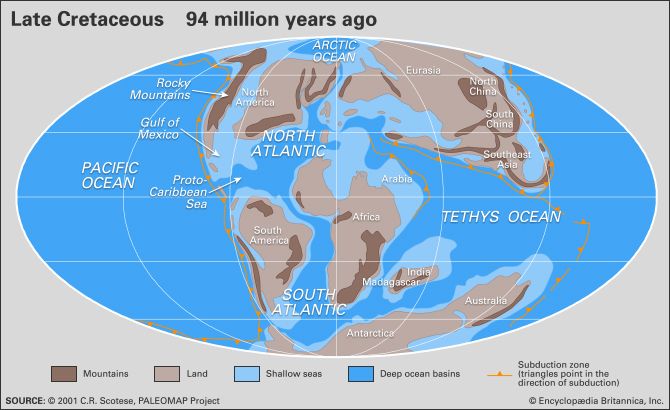
The K–T extinction (also known as the Cretaceous–Paleogene extinction) was a global mass extinction event that occurred approximately 66 million years ago. It resulted in the loss of roughly 80 percent of all animal species, most notably marking the end of the dinosaurs.12
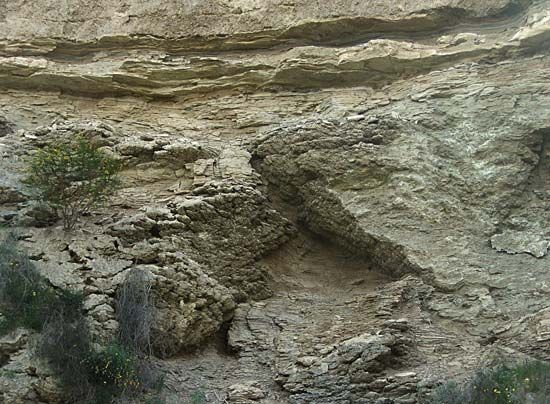
The event is named for the boundary between the Cretaceous Period (Kreide, German for “chalk”) and the Paleogene Period (formerly associated with the Tertiary Period).1
The most widely accepted explanation is the “asteroid theory,” which posits that a massive asteroid impact—evidenced by the Chicxulub crater in Mexico and a global iridium anomaly—ejected debris that blocked sunlight, halted photosynthesis, and collapsed food chains. However, some scientists suggest that terrestrial factors, such as massive volcanic activity from the Deccan Traps or continental drift, also contributed to the environmental deterioration of the era.132
How did the K-T extinction pave the way for the rise of mammals?
The K–T extinction event paved the way for the rise of mammals by eradicating the dominant dinosaurs and other large reptiles, which had previously occupied the primary ecological niches on land and in the sea.45
Prior to this event, mammals had existed for over 100 million years but were largely restricted to small forms that lived in the undergrowth, often hiding from dinosaurs. The sudden removal of these dominant competitors and predators left vast ecological spaces vacant, triggering a period of rapid adaptive radiation.46
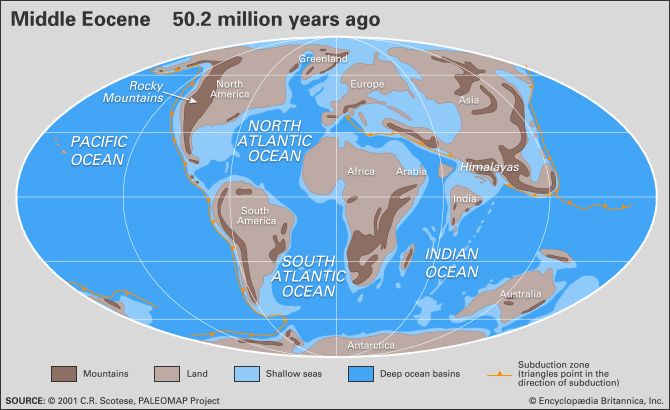
During the subsequent Paleocene Epoch, mammals underwent significant evolutionary diversification. While early forms were often archaic or highly specialized, they quickly evolved into a wide array of types, including early primates and various ungulates. By the early Eocene, more than 20 orders of mammals had been established, setting the stage for the modern mammalian groups that dominate terrestrial environments today.546
Which groups of animals and plants were most affected by the K-T extinction?
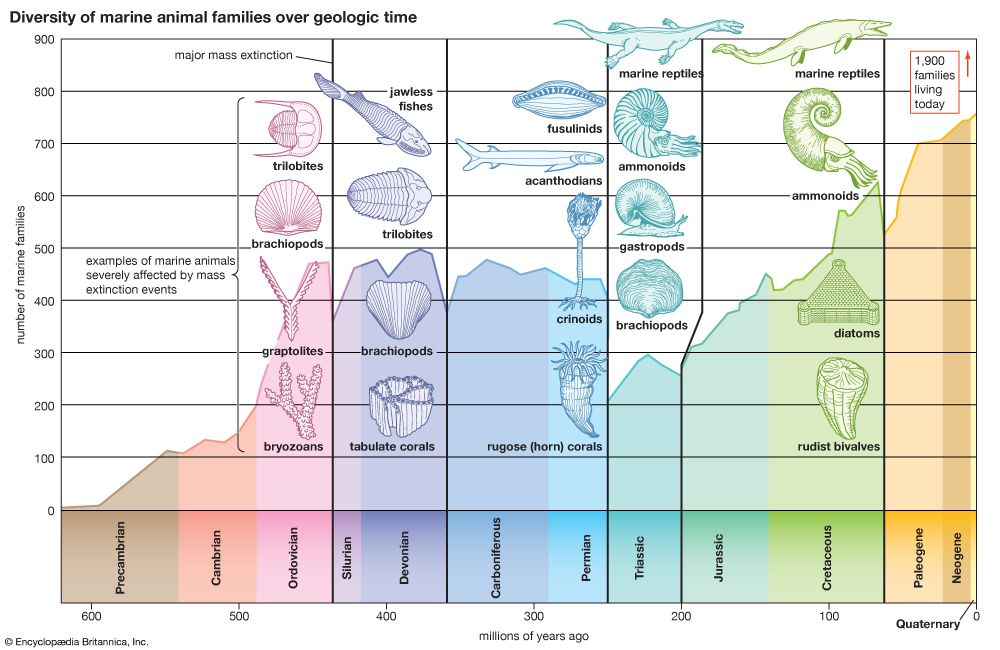
The K–T extinction event, which occurred approximately 66 million years ago, caused a profound loss of biodiversity, eliminating roughly 80 percent of all animal species. The impact on various groups was uneven, with some suffering total collapse while others remained relatively stable.14
Marine Life
Marine ecosystems experienced severe losses, particularly among planktonic and free-swimming organisms:
- Plankton: Only about 13 percent of coccolithophore and planktonic foraminiferal genera survived.1
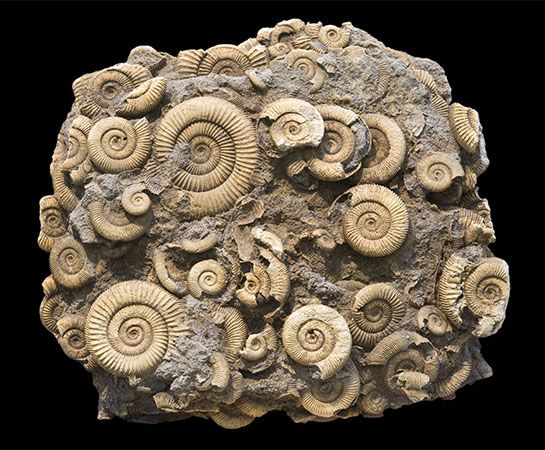
- Mollusks: Ammonoids and belemnoids became extinct, as did reef-building rudist bivalves.18
- Other Invertebrates: Larger foraminifers (orbitoids) died out, and hermatypic corals were reduced to approximately one-fifth of their previous genera.1
- Marine Reptiles: Large swimming reptiles, including ichthyosaurs, mosasaurs, and plesiosaurs, were eradicated.18
Terrestrial Life
The extinction patterns on land were distinct:
- Dinosaurs: Nearly all dinosaurs were eliminated, with the notable exception of the lineages that evolved into modern birds.1
- Plants: While land plants generally fared better than animals, there is evidence of widespread extinctions among angiosperms and significant shifts in plant communities.1
- Survivors: Groups such as turtles, crocodilians, lizards, snakes, amphibians, and mammals were either unaffected or experienced only mild impacts.1
What was the Chicxulub crater, and how is it related to the K-T extinction?
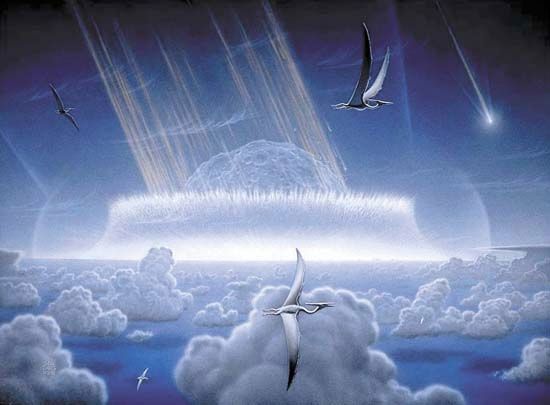
The Chicxulub crater is a massive impact crater measuring approximately 180 kilometers (112 miles) in diameter, located off the Yucatán Peninsula in Mexico. Formed about 66 million years ago, it is widely considered the site where a 10- to 15-km-wide asteroid struck Earth, serving as a primary catalyst for the K–T extinction event.910
The impact triggered a global mass extinction that eliminated roughly 80 percent of all species, including the dinosaurs. The collision vaporized sulfur-rich rocks, releasing massive amounts of sulfur into the atmosphere and creating acid rain. Furthermore, the impact ejected fine dust particles that blocked sunlight for years, halting photosynthesis and causing global temperatures to plummet by as much as 28 °C (50 °F).1110
While the crater is largely buried or underwater, its existence was confirmed in 1990 through magnetic field data and core samples, linking it to the global layer of iridium that marks the end of the Cretaceous Period.1110
Sources
- K–T extinction — Encyclopædia Britannica
- dinosaur - The asteroid theory — Encyclopædia Britannica
- Cretaceous Period - Mass extinction — Encyclopædia Britannica
- Cenozoic Era - Cenozoic life — Encyclopædia Britannica
- Paleocene Epoch — Encyclopædia Britannica
- Tertiary Period - The rise of mammals — Encyclopædia Britannica
- dinosaur - Habitats — Encyclopædia Britannica
- Tertiary Period - Tertiary life — Encyclopædia Britannica
- How Big Was the Asteroid That Contributed to Dinosaur Extinction? — Encyclopædia Britannica
- Chicxulub crater: Top Questions — Encyclopædia Britannica
- Chicxulub crater — Encyclopædia Britannica
Published on · 4 min read