Hypecoeae
Hypecoeae is a tribe within the poppy family, Papaveraceae, consisting of 15 species belonging to the single genus Hypecoum. While these plants were…
What is Hypecoeae?
Hypecoeae is a tribe within the poppy family, Papaveraceae, consisting of 15 species belonging to the single genus Hypecoum. While these plants were previously classified in their own family, Hypecoaceae, molecular evidence now confirms they are evolutionarily derived from the poppy family.1
These herbs are native to warm temperate regions stretching from the Mediterranean to eastern Asia and are characterized by watery sap, glaucous, deeply divided leaves, and small flowers with four stamens1. One notable species, H. procumbens, is sometimes grown as a hardy garden annual for its bright yellow blooms. The plants produce seeds within capsules.1
What are the main characteristics of the poppy family?
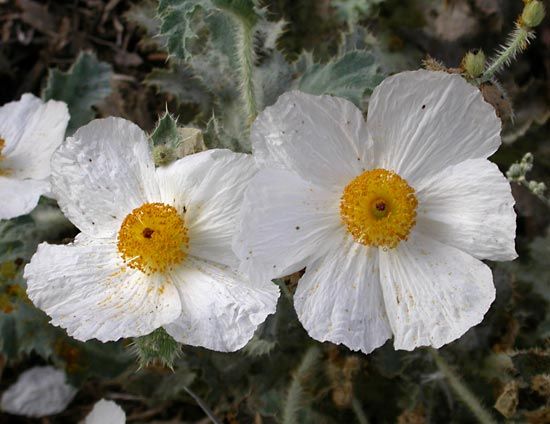
The Papaveraceae family, commonly known as the poppy family, comprises approximately 48 genera and 2,220 species of flowering plants. While primarily composed of herbaceous plants, the family also includes some woody shrubs and a genus of small tropical trees.2
Key characteristics of the family include:
- Foliage: The leaves are typically deeply cut, lobed, or divided into leaflets.23
- Sap: Many members are distinguished by their colored or milky sap.23
- Flowers: Floral structures vary by subfamily. Members of the subfamily Papaveroideae feature large, often nodding, bisexual, regular, dish-shaped flowers with 4 to 12 crinkled petals and numerous stamens. Conversely, the subfamily Fumarioideae exhibits bilaterally symmetrical flowers with two dissimilar pairs of petals.2
- Fruit: The fruit is generally a spherical or linear capsule that often releases seeds through pores when shaken by the wind.23
The family is highly valued for its ornamental garden species and its pharmaceutical significance, most notably as the source of opiate drugs derived from the opium poppy.23
How do scientists use molecular evidence to classify plants?
Scientists use molecular evidence to classify plants by analyzing the genetic material within their cells to determine evolutionary relationships, or phylogeny. This approach has become a cornerstone of modern plant taxonomy, often providing more objective and quantitative data than traditional methods based solely on physical appearance.45
Key methods and principles include:
- Measuring Molecular Similarity: Researchers compare the sequences of units within DNA and protein molecules. The fundamental principle is that closely related plants share more similarities in their genetic sequences than unrelated ones, allowing scientists to measure the degree of divergence since two species shared a common ancestor.45
- Selecting Appropriate Markers: Because different molecules evolve at different rates, scientists select specific genes based on the age of the group being studied. For example, mitochondrial DNA is often used to establish relationships among recently diverged groups due to its high mutation rate, while slower-evolving molecules like ribosomal RNA are better for deeper evolutionary timeframes.4
- Chemotaxonomy: This field, also known as biochemical systematics, involves identifying specific chemical compounds produced by plants. Differences in metabolic products can serve as supplemental evidence to confirm taxonomic classifications.5
- Numerical Taxonomy: Computer techniques are used to process these molecular data points, allowing researchers to determine relationships quantitatively and depict them graphically.5
What does it mean for a plant to be an annual?
An annual is a plant that completes its entire life cycle—from germination and growth to flowering, seed production, and death—within a single growing season.91011
Key characteristics of annuals include:
- Survival Strategy: The only part of an annual plant that survives from one growing season to the next is the dormant seed.9
- Life Cycle: These plants typically accumulate food reserves rapidly over a period of weeks or months. Environmental cues, such as changes in temperature or day length, trigger a shift from vegetative growth to the production of flowers, fruits, and seeds, which ultimately exhausts the plant’s resources and leads to its death.11
- Variability: While many are categorized as “summer annuals” (germinating in spring and seeding by autumn) or “winter annuals” (germinating in autumn and seeding by the following spring), some desert annuals can complete their entire cycle in just a few weeks following rainfall.9
- Examples: This category includes many weeds, wildflowers, and essential food crops like corn, wheat, and peas.910
Sources
- Hypecoeae — Encyclopædia Britannica
- Papaveraceae — Encyclopædia Britannica
- poppy — Encyclopædia Britannica
- phylogeny - Evidence for specific phylogenies — Encyclopædia Britannica
- botany - Taxonomic aspects — Encyclopædia Britannica
- chloroplast: Top Questions — Encyclopædia Britannica
- Morphology — Encyclopædia Britannica
- 6 Questions About DNA Answered — Encyclopædia Britannica
- annual — Encyclopædia Britannica
- Is That Plant 'Perennial' or 'Annual'? — Merriam-Webster
- angiosperm - General features — Encyclopædia Britannica
- life span - Annuals — Encyclopædia Britannica
- life span - Biennials — Encyclopædia Britannica
Published on · 3 min read