Icicle Fish
The term "icicle fish" refers to members of the genus Salanx, which are distinct from the Antarctic "icefish" (family Channichthyidae) that are known for…
What is icicle fish?
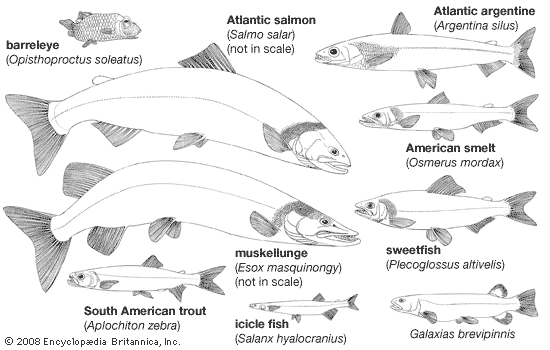
The term “icicle fish” refers to members of the genus Salanx, which are distinct from the Antarctic “icefish” (family Channichthyidae) that are known for lacking hemoglobin.1
Icicle fish belong to the family Salangidae and are found in the fresh and salt waters of eastern Asia. These fish are characterized by their semitransparent, slender, and troutlike appearance. They are typically small, rarely exceeding 15 centimeters (6 inches) in length, and are either scaleless or possess very fine scales. Despite their small size, they are predatory, featuring large mouths equipped with prominent canine teeth. In Chinese cuisine, these fish are considered a delicacy.2
How do icefish survive in freezing Antarctic waters?
Antarctic icefish (family Channichthyidae) survive in the freezing temperatures of the Southern Ocean through specialized physiological adaptations.1
To prevent their body fluids from freezing, these fishes produce specialized proteins that act as antifreeze. These glycoproteins serve as cryoprotectants by inhibiting the growth of ice crystals within their cells and tissues, effectively lowering the freezing point of their internal fluids.345
Additionally, icefish have evolved unique circulatory adaptations to compensate for the lack of red blood cells and hemoglobin. They possess larger hearts and more extensive gill blood vessels, which allow them to circulate a greater volume of blood. This increased circulation enables them to extract sufficient oxygen from the oxygen-rich polar waters despite the absence of oxygen-carrying pigments.1
Why are some icefish called white-blooded fish?
Certain icefish, specifically members of the family Channichthyidae, are referred to as white-blooded fish because they completely lack red blood cells and hemoglobin.1
In most vertebrates, hemoglobin serves as the essential respiratory protein that carries oxygen through the bloodstream, typically giving blood its characteristic red color. Because these icefish lack this pigment, their blood appears colorless or whitish. While their blood carries significantly less oxygen than that of red-blooded species, they have evolved compensatory mechanisms to survive in the oxygen-rich waters of the Southern Ocean. These adaptations include larger hearts and more extensive gill blood vessels, which allow them to circulate a much greater volume of blood to meet their metabolic needs.1
What makes the icicle fish a delicacy in Asia?
The premise that the “icicle fish” is a specific delicacy due to unique culinary properties is not supported by the available data; rather, the icicle fish (Salanx) is simply a group of semitransparent, slender, troutlike fishes found in the fresh and salt waters of eastern Asia that are considered a delicacy by the Chinese.2
These small predators, which rarely exceed 15 centimeters (6 inches) in length, are members of the family Salangidae. While they are recognized as a food source in the region, the provided information does not detail specific culinary attributes or preparation methods that define their status as a delicacy beyond their general classification as such.2
Sources
- icefish — Encyclopædia Britannica
- icicle fish — Encyclopædia Britannica
- antifreeze — Encyclopædia Britannica
- Ectotherm — Encyclopædia Britannica
- antifreeze — Merriam-Webster
- Protein - Hemoglobin — Encyclopædia Britannica
- perciform - Use as food — Encyclopædia Britannica
Published on · 2 min read