IJsselmeer Polders
The reclamation of land in the IJsselmeer region, a central component of the Zuiderzee project, has significantly expanded the Netherlands' agricultural…
How has the reclamation of land in the IJsselmeer region affected agriculture in the Netherlands?
The reclamation of land in the IJsselmeer region, a central component of the Zuiderzee project, has significantly expanded the Netherlands’ agricultural capacity by creating vast tracts of fertile land.12
Agricultural Impact
The four polders reclaimed from the IJsselmeer—Wieringermeer, Northeast, East Flevoland, and South Flevoland—added approximately 626 square miles (1,620 square km) of territory to the country.1
- Crop Production: The reclaimed areas consist of rich marine clay, which was originally intended almost exclusively for agricultural use. These lands have been highly productive, supporting the cultivation of maize, wheat, oilseeds, sugar beets, and potatoes. Modern production in the Flevoland province also includes apples, flowers, and dairy cattle.13
- Soil Management: Because newly reclaimed land often contains high levels of salt, the Dutch implemented specialized procedures to desalinate the soil, ensuring it could support plant life and become agriculturally viable.4
- Land Use Evolution: While the earlier polders (Wieringermeer and Northeast) remain primarily agricultural, the later polders (East and South Flevoland) have increasingly been utilized for residential, industrial, and recreational purposes to accommodate the country’s growing population.12
What engineering techniques were used to create the IJsselmeer Polders?
The creation of the IJsselmeer Polders was a monumental engineering undertaking that transformed a former saltwater inlet into fertile land through a systematic, multi-stage process.
Key Engineering Techniques
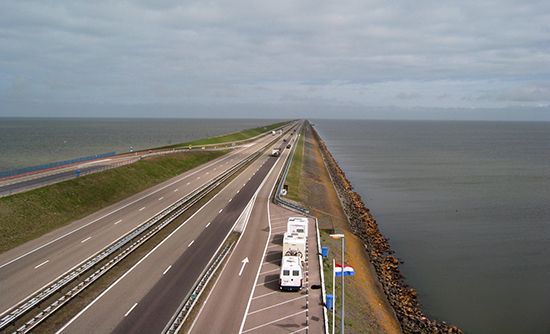
- Enclosure: The foundation of the project was the construction of the Afsluitdijk, a 19-mile (30-km) dam completed in 1932. This barrier separated the Zuiderzee from the North Sea, converting the inner body of water into the freshwater IJsselmeer. The dam was built using boulder clay backed by sand, faced with stone, and set upon a base of boulders resting on willow mats.71
- Diking: To reclaim specific tracts of land, engineers constructed encircling dikes around the designated polder areas.18
- Drainage and Pumping: Once an area was enclosed, the water was removed through an elaborate system of pumping stations, sluices, and locks. This process lowered the water table, allowing the land to emerge.78
- Soil Desalination: Because the newly reclaimed marine clay contained high levels of salt, specialized procedures were required to flush the soil with fresh water. This process was essential to make the land agriculturally viable.83
- Subsurface Management: Following initial drainage, engineers installed drainage channels and, in many locations, subsurface drains to ensure the root zone of crops remained properly aerated and drained.8
How has the creation of the IJsselmeer Polders affected the local ecosystem and wildlife?
The creation of the IJsselmeer Polders and the construction of the Afsluitdijk fundamentally altered the local ecosystem by transforming a saltwater inlet into a freshwater lake.87
Ecological and Wildlife Impacts
- Transition to Freshwater: The most significant change was the conversion of the formerly brackish Zuiderzee into the freshwater IJsselmeer. This shift necessitated a complete change in the local aquatic life.87
- Fisheries: The original marine-based fishing industry, which targeted species such as herring, anchovies, and flounder, was rendered obsolete by the change in salinity. It has since been replaced by freshwater fisheries, with the catch now consisting primarily of eels.8
- Eel Migration: The lake remains a vital habitat for eels. Each spring, eel larvae that are born in the Sargasso Sea migrate into the lake through the locks, continuing a cycle that persists despite the human-engineered barriers.8
- Habitat Loss and Creation: The reclamation of 626 square miles of land significantly reduced the total surface area of the water, replacing aquatic habitats with terrestrial environments that are now used for agriculture, industry, and human settlement.81
How has the creation of the IJsselmeer Polders influenced Dutch water management practices?
The creation of the IJsselmeer Polders served as a transformative model for Dutch water management, shifting the focus from purely reactive flood defense to proactive, large-scale landscape engineering.73
Influence on Water Management Practices
- Integrated Basin Management: The project demonstrated the effectiveness of creating controlled freshwater basins. By sealing off the Zuiderzee with the Afsluitdijk, the Dutch established a reliable freshwater reservoir that remains vital for mitigating summer droughts and combating soil salination in surrounding provinces.79
- Systematic Land Reclamation: The success of the polders refined the technical process of enclosing areas with dikes, utilizing advanced pumping stations, and managing soil through desalination. This methodology provided a blueprint for future land expansion and agricultural development.13
- Strategic Infrastructure Planning: The project validated the vision of engineer-statesman Cornelis Lely, proving that massive, multi-decade infrastructure projects could be successfully implemented to reshape national geography.73
- Evolution toward the Delta Project: The experience gained from the Zuiderzee project directly informed the Delta Project. Following the 1953 floods, the Dutch applied these lessons to shorten the coastline, implement storm-surge barriers, and balance flood protection with environmental and commercial needs.8
Sources
- IJsselmeer Polders — Encyclopædia Britannica
- Flevoland — Encyclopædia Britannica
- Netherlands - Drainage and dikes — Encyclopædia Britannica
- polder — Encyclopædia Britannica
- Netherlands: Top Questions — Encyclopædia Britannica
- North Sea - Reclamation and flood-control projects — Encyclopædia Britannica
- Zuiderzee — Encyclopædia Britannica
- IJsselmeer — Encyclopædia Britannica
- Drainage - Land reclamation — Encyclopædia Britannica
Published on · 4 min read