Indri
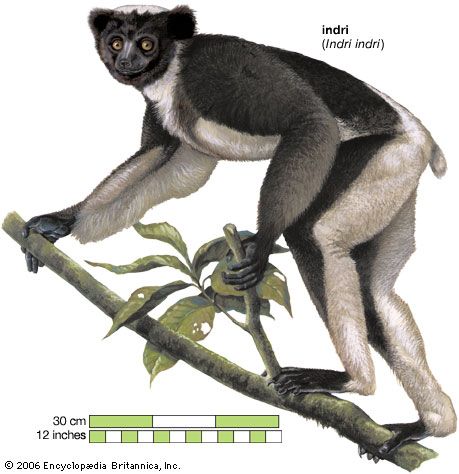
The indri (Indri indri) is the largest species of lemur, a slender, long-limbed primate native to the forests of Madagascar.
What is indri?
The indri (Indri indri) is the largest species of lemur, a slender, long-limbed primate native to the forests of Madagascar1.
Measuring 60–70 cm (24–28 inches) in length, the indri is characterized by a rudimentary tail, large hands and feet, and a round head with a pointed face and furry ears. Its coat is primarily black with varying patches of white. As an arboreal animal, it spends its time in trees, moving in an upright position while feeding on leaves, fruit, and flowers.1
The indri belongs to the family Indridae, which also includes sifakas and avahis. Currently, the indri is classified as an endangered species and is protected by law in its native range in northeastern Madagascar.1
What makes the indri’s song unique among lemurs?
Sorry, the Britannica knowledge base does not contain this information.
How do indri lemurs move through the trees?
The indri (Indri indri) is a thoroughly arboreal animal that moves through the trees by clinging to trunks and climbing in an upright position. As a member of the family Indridae, which is collectively known as the “leaping lemurs,” the indri is well-adapted for life in the canopy.1
When navigating its environment, the indri uses its large hands and feet to maintain a secure grip on branches and tree trunks while it feeds on leaves, fruit, flowers, and other vegetation.1
What are some other types of lemurs found in Madagascar?
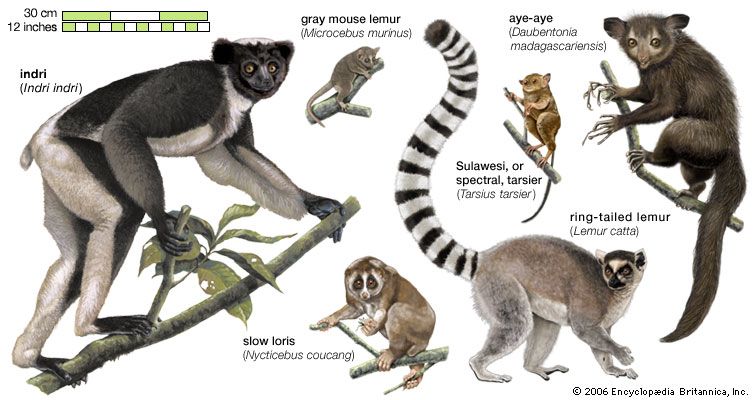
Madagascar is home to a diverse array of lemurs, which are indigenous primates belonging to the suborder Strepsirrhini. Beyond the indri, several other notable types include:2
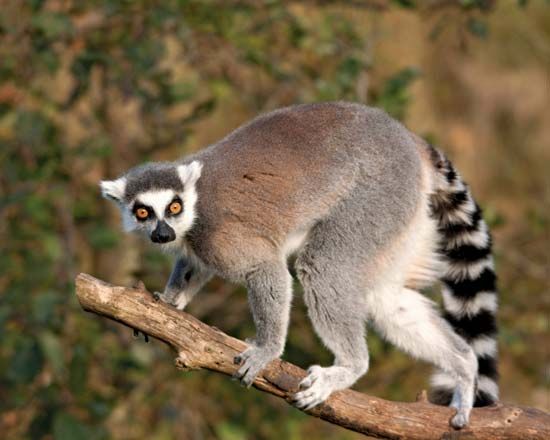
- True Lemurs (Family Lemuridae): This group includes about 20 species, such as the well-known ring-tailed lemur, which is unique for its striped tail and tendency to spend significant time on the ground. Other members include the black lemur, ruffed lemurs, and the bamboo-eating gentle and greater bamboo lemurs.24
- Sifakas (Genus Propithecus): These are leaping, arboreal lemurs found in Madagascar’s coastal forests. There are nine species, including the diademed sifaka and Coquerel’s sifaka, all of which are related to the indri and the avahi.25
- Aye-aye (Daubentonia madagascariensis): A rare, nocturnal, and solitary primate, the aye-aye is the sole living member of its family. It is distinguished by its rodent-like incisors and a specialized, elongated third digit used to extract insect larvae from trees.26
- Sportive Lemurs (Family Lepilemuridae): There are at least 25 species of these solitary, nocturnal lemurs that inhabit both rainforests and dry forests.2
- Dwarf and Mouse Lemurs (Family Cheirogaleidae): This family includes the mouse lemur, which holds the title of the smallest living primate, as well as dwarf, hairy-eared, and fork-crowned lemurs.2
Sources
Published on · 2 min read