Aye-aye
The aye-aye (Daubentonia madagascariensis) is a highly specialized primate that differs significantly from other lemurs in several key anatomical and…
How do aye-ayes compare to other lemur species in Madagascar?
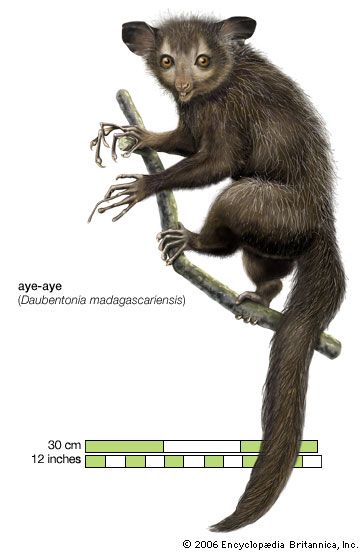
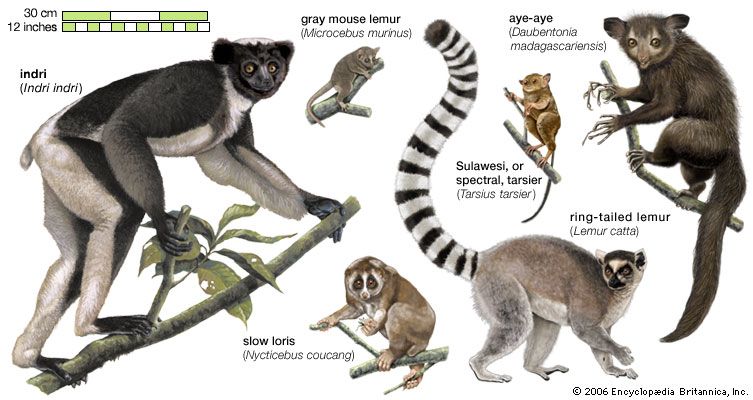
The aye-aye (Daubentonia madagascariensis) is a highly specialized primate that differs significantly from other lemurs in several key anatomical and behavioral ways. While most lemurs possess comblike lower front teeth, the aye-aye lacks this feature, instead sporting ever-growing incisors similar to those of rodents.12
Key distinctions include:
- Unique Anatomy: The aye-aye is the only primate with a “pseudo-thumb,” a distinct bony digit. Its third finger is exceptionally long and slender, used for tapping on trees to locate wood-boring larvae and extracting them, a specialized foraging method not seen in other lemur species.1
- Physical Appearance: Unlike other lemurs, which typically have woolly fur in shades of red, gray, or brown, the aye-aye is covered in long, coarse, dark brown or black fur.12
- Social Structure: While many lemurs are gregarious and live in groups, the aye-aye is solitary and nocturnal, constructing large, ball-like nests in tree branches.12
- Evolutionary History: Evidence suggests that while other lemurs may have arrived in Madagascar via a separate migration, the ancestors of the aye-aye originated in Africa before dispersing to the island.12
How do aye-ayes communicate and interact with each other?
The provided search results do not contain information regarding how aye-ayes communicate or interact with one another. While the sources confirm that the aye-aye is a solitary and nocturnal primate, they do not detail their social behaviors or methods of communication.
How have scientific studies and observations of aye-ayes in captivity contributed to our understanding of the species?
Sorry, the Britannica knowledge base does not contain information regarding how scientific studies and observations of aye-ayes in captivity have contributed to our understanding of the species.
Where are aye-ayes found in the wild, and what is their habitat like?
The aye-aye (Daubentonia madagascariensis) is a rare, nocturnal primate found exclusively in the wild on the island of Madagascar. While they are primarily associated with the rainforests of the eastern part of the island, they are also found in northern Madagascar.13
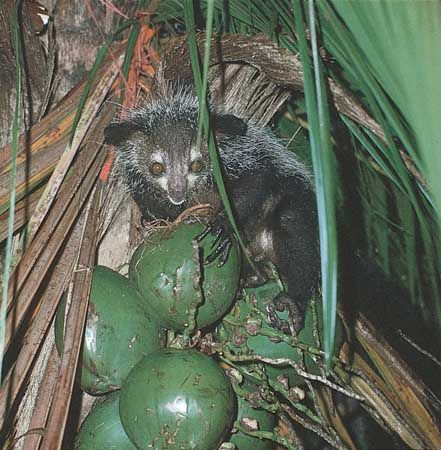
Their habitat is strictly arboreal, meaning they spend their lives in the trees. Within these forest environments, aye-ayes construct large, ball-shaped nests made of leaves positioned in the forked branches of trees. These solitary animals rely on these forested areas to forage for their primary food sources, which include fruit and wood-boring insect [larvae]. Due to habitat loss and other pressures, the species is currently classified as an endangered species by the International Union for Conservation of Nature.1
Sources
- aye-aye — Encyclopædia Britannica
- lemur — Encyclopædia Britannica
- aye-aye — Merriam-Webster
Published on · 2 min read