False Sunbird
The term "false sunbird" refers to either of two species of birds native to Madagascar belonging to the family Philepittidae. While they were historically…
What is False sunbird?
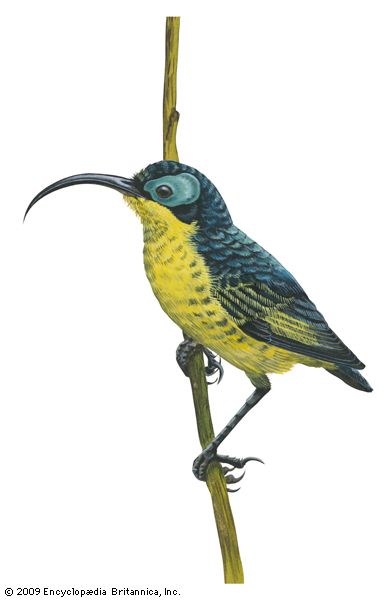
The term “false sunbird” refers to either of two species of birds native to Madagascar belonging to the family Philepittidae. While they were historically misclassified as true sunbirds (family Nectariniidae), anatomical studies in 1951 revealed they are more closely related to asities, despite their distinct external appearance.12
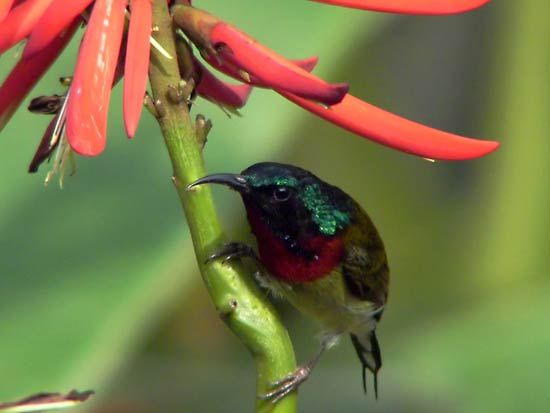
These birds are approximately 10 cm (4 inches) long and possess short tails and long, downcurved bills. The wattled false sunbird (Neodrepanis coruscans) exhibits sexual dimorphism: males are glossy blue above and yellow below with a prominent eye wattle, while females have dark green upperparts. They primarily forage for insects along branches but also feed on nectar from trumpet-shaped flowers. The second species, N. hypoxantha, is characterized by brighter coloration and a thinner bill.1
What are asities and how are they related to the false sunbird?
Asities are small birds belonging to the family Philepittidae, an order of Passeriformes found exclusively in the forests of Madagascar.3
The family Philepittidae consists of two distinct groups: the asities (Philepitta) and the false sunbirds (Neodrepanis). While they share the same family, they differ significantly in appearance and behavior:3
- Asities: These are plump, stout-legged birds that grow to about 15 cm (6 inches) in length. They primarily browse foliage to feed on berries and other fruit and are known for building unique hanging nests with roofed entrances.34
- False sunbirds: These are smaller (approximately 10 cm or 4 inches) with weaker legs and long, downcurved bills adapted for feeding on nectar and small insects.31
The two groups are related through their shared anatomical characteristics, such as the presence of bare skin or wattles around the eyes. Although false sunbirds were once misclassified as true sunbirds, research in 1951 confirmed their anatomical affinity to asities, despite their differing external forms.31
How do true sunbirds differ from hummingbirds?
Although sunbirds and hummingbirds share a similar appearance and diet due to convergent evolution, they are unrelated species belonging to different orders and geographic regions.
Key Differences
- Geographic Distribution: Hummingbirds are native exclusively to the Americas, whereas sunbirds are found primarily in Africa and eastward to the Pacific islands.256
- Flight and Feeding: Hummingbirds are renowned for their ability to hover in front of flowers while feeding, made possible by wing joints that allow them to fly in all directions, including backward. In contrast, sunbirds rarely hover; they typically perch on a flower stalk or nearby twig to access nectar.627
- Classification: Hummingbirds belong to the family Trochilidae (often placed in the order Apodiformes), while sunbirds belong to the family Nectariniidae (order Passeriformes).26
- Anatomy: Hummingbirds have compact, strongly muscled bodies with specialized wing structures for their acrobatic flight. Sunbirds are generally 9 to 15 cm long and possess slender, often curved bills and brush-tipped tongues adapted for nectar feeding.627
What unique wildlife is found in Madagascar?
Madagascar is renowned for its high level of biodiversity and unique wildlife, much of which is endemic due to the island’s long-standing geographic isolation.1011
Unique Mammals
- Lemurs: Madagascar is the only home to these primitive primates. There are about 40 indigenous species, ranging from the tiny Madame Berthe’s mouse lemur to the larger indri.1111
- Tenrecs: These hedgehoglike insectivores are a distinctive group of mammals that have evolved into various unique forms on the island.1011
Reptiles and Fish
- Chameleons: The island hosts a wide variety of chameleons of varying sizes.11
- Coelacanth: Often called a “living fossil,” this rare fish was once thought to be extinct for millions of years but is found in the waters off the coast of Madagascar and the nearby Comoro Islands.1112
Extinct Species
- Elephant Birds: The Aepyornithidae family included giant, flightless birds that were once the largest birds to ever live. They survived on the island until roughly 1,300 to 1,560 years ago.1013
Sources
- False sunbird — Encyclopædia Britannica
- Sunbird — Encyclopædia Britannica
- Philepittidae — Encyclopædia Britannica
- Asity — Encyclopædia Britannica
- The rodent that acts like a hippo — Encyclopædia Britannica
- Pollination - Birds — Encyclopædia Britannica
- Apodiform - Distribution and abundance — Encyclopædia Britannica
- Hummingbird — Encyclopædia Britannica
- 11 Questions About Birds Answered — Encyclopædia Britannica
- biogeographic region - Madagascan region — Encyclopædia Britannica
- lemur — Encyclopædia Britannica
- hot spot — Encyclopædia Britannica
- elephant bird — Encyclopædia Britannica
- Madagascar - Plant and animal life — Encyclopædia Britannica
- Comoros - Plant and animal life — Encyclopædia Britannica
Published on · 3 min read