Inland Sea
The Seto Inland Sea is crossed by several remarkable engineering feats, primarily through the Honshu-Shikoku Bridge Project. This massive undertaking…
Are there any famous bridges or structures that cross the Seto Inland Sea?
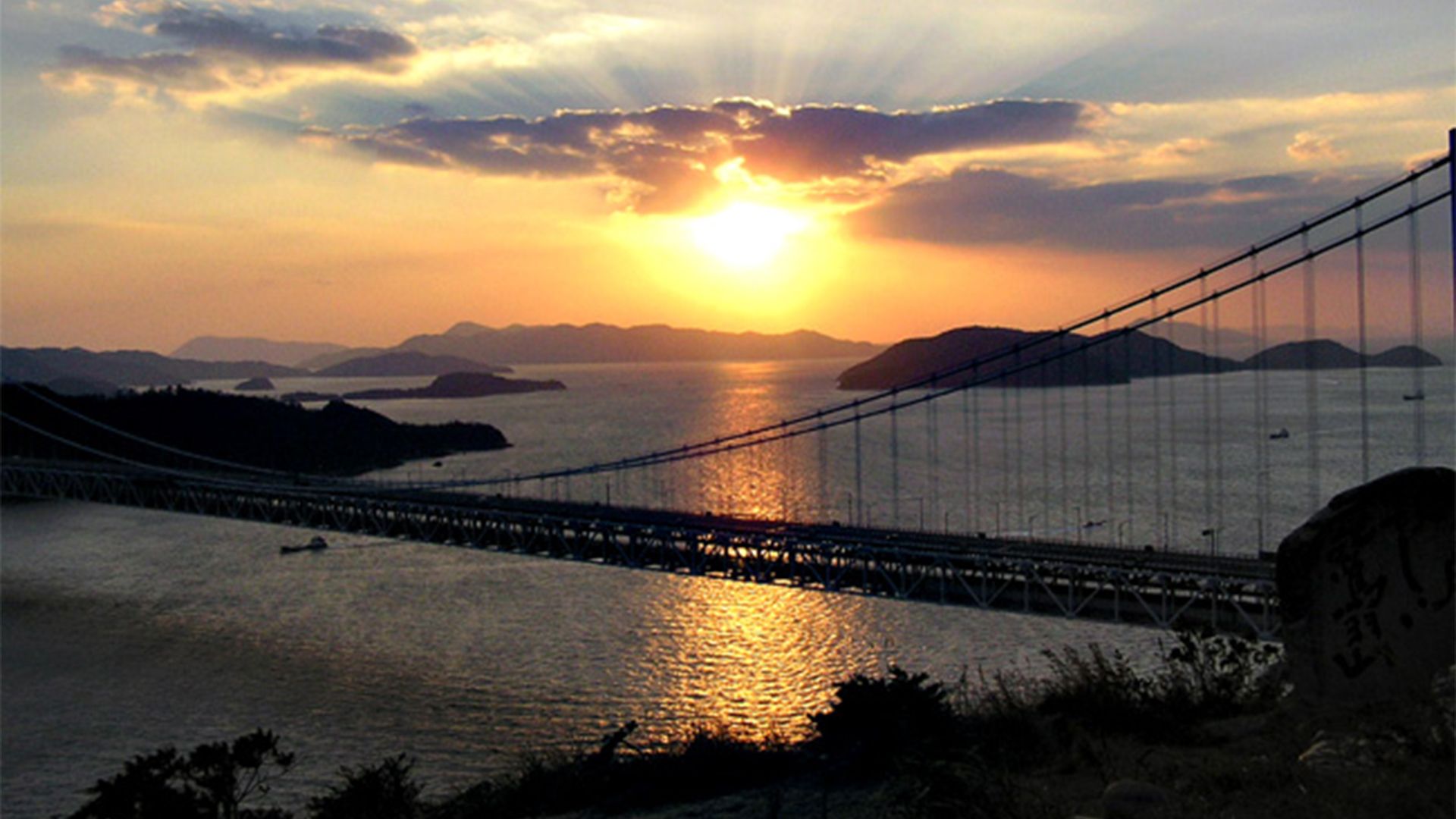
The Seto Inland Sea is crossed by several remarkable engineering feats, primarily through the Honshu-Shikoku Bridge Project. This massive undertaking consists of three main routes connecting the islands of Honshu and Shikoku.12
Key structures include:
- Seto Great Bridge: A series of six bridges spanning 12.2 km that links Kojima and Sakaide. It features a double-tiered design carrying both rail and vehicular traffic.32
- Akashi Kaikyo Bridge: Located on the eastern route, this suspension bridge was the world’s longest at its opening in 1998. It connects Kobe to Awaji Island and is renowned for its massive 1,991-meter central span and 297-meter towers.12
- Tatara Bridge: A significant cable-stayed bridge on the western route (Onomichi-Imabari) that held the record for the longest span of its type when completed in 1999.2
- Ōmishima Bridge: A steel arch bridge that was the longest of its kind in the Eastern Hemisphere for nearly 25 years.2
What traditional fishing methods are still used in the Inland Sea today?
While traditional fishing methods have historically been practiced throughout Japan, the fishing sector in the Inland Sea currently faces significant challenges, including depletion due to overfishing and pollution. As a result, the industry has seen a sharp decline in the number of workers and an aging workforce.45
Information regarding specific traditional fishing methods currently in use within the Inland Sea is not explicitly detailed in the provided search results. However, broader commercial fishing techniques commonly employed in Japanese waters and similar environments include:
- Longline fishing: Historically an important Japanese inshore fishery, this method involves using a main line with numerous baited branch lines.67
- Aquaculture: This has become of increasing importance in the region, focusing on the cultivation of fish, shellfish—particularly clams and oysters—and seaweed.45
- General commercial methods: Techniques such as trawling, purse seining, and the use of various net types are widely utilized in Japanese fisheries, though their specific application as “traditional” methods in the Inland Sea today is not specified in the available data.6
What role does the Inland Sea play in Japan’s transportation and trade?
The Inland Sea serves as a vital artery for Japan’s transportation and trade, acting as a major maritime route connecting the Asian continent with the Kansai region of Honshu and the island of Kyushu. Its easily navigable waters and strategic location have long supported the development of flourishing industrial centers, trading ports, and commercial hubs, most notably the Osaka-Kobe metropolitan area.83
Beyond maritime shipping, the region has become a critical link for surface transportation. The Honshu-Shikoku Bridge Project integrated the islands of Honshu and Shikoku through massive engineering projects like the Seto Great Bridge, which carries both rail and vehicular traffic. These structures, alongside undersea tunnels, have successfully connected all four of Japan’s main islands, facilitating the movement of passengers and goods across the country. Today, the area remains a hub for petrochemical industries and continues to support significant regional commerce.9138
What is the Seto Inland Sea and where is it located in Japan?
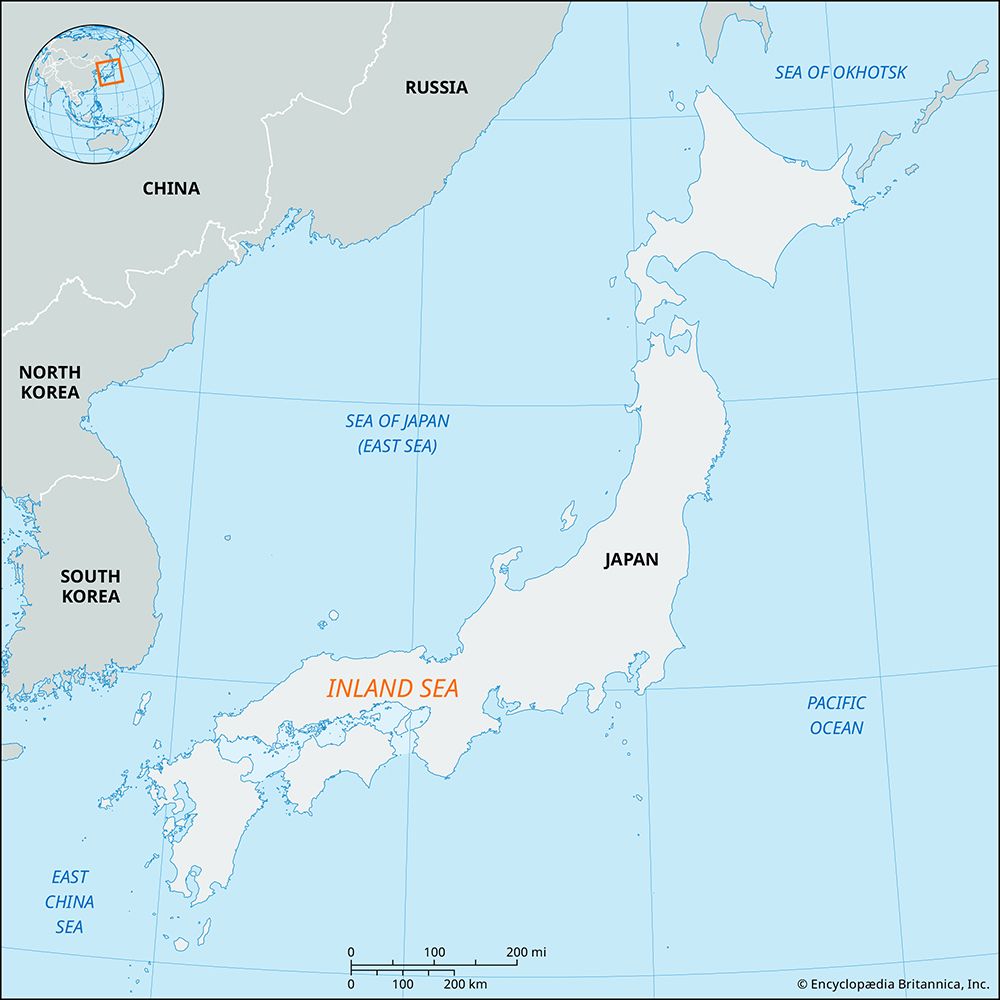
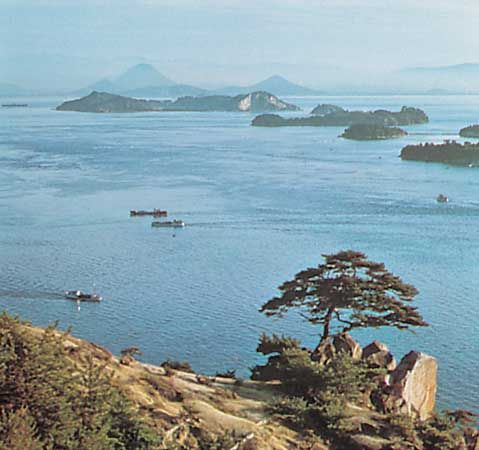
The Inland Sea, also known as Seto-naikai, is a body of water situated in Japan that lies between the islands of Honshu, Shikoku, and Kyushu.81
Spanning approximately 270 miles (440 km) from east to west, the sea is composed of five distinct basins connected by channels. Its geography is characterized by an irregular coastline and hundreds of small islands, the largest being Awaji Island located in the east. The sea is accessible from the Pacific Ocean and the Philippine Sea via the Kii and Bungo straits, while the Shimonoseki Strait at its western end provides a gateway to the East China Sea.88
Beyond its role as a major transportation and industrial hub, the region is celebrated for its scenery and is protected as part of the Inland Sea National Park.8
Sources
- Seto Great Bridge — Encyclopædia Britannica
- Akashi Kaikyo Bridge — Encyclopædia Britannica
- bridge - Island bridges — Encyclopædia Britannica
- commercial fishing - Methods — Encyclopædia Britannica
- economy of Japan - Forestry and fishing — Encyclopædia Britannica
- commercial fishing - Drifting longlines — Encyclopædia Britannica
- Japan - Forestry and fishing — Encyclopædia Britannica
- Inland Sea — Encyclopædia Britannica
- Japan - Transportation and telecommunications — Encyclopædia Britannica
Published on · 3 min read