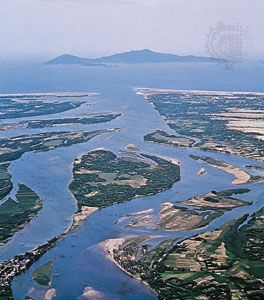
East China Sea
The East China Sea region is significantly impacted by typhoons, which are powerful tropical cyclones characterized by sustained winds of at least 74 mph…
How do typhoons and other extreme weather events impact the East China Sea region?
The East China Sea region is significantly impacted by typhoons, which are powerful tropical cyclones characterized by sustained winds of at least 74 mph (119 km/hr). These storms are a frequent feature of the region’s rainy summer season, driven by the monsoon wind system that brings warm, moist air from the western Pacific.123
The impacts of these extreme weather events are often catastrophic:
- Storm Surges and Flooding: Typhoons generate massive storm surges that cause sea levels to rise, leading to severe coastal flooding. In narrow channels or inlets, these surges can be amplified, resulting in destructive waves that submerge low-lying areas and destroy infrastructure.1
- Secondary Disasters: The torrential rains accompanying typhoons frequently overwhelm dams and drainage systems, triggering widespread inland flooding, landslides, and the failure of water-control works.14
- Economic and Humanitarian Toll: These events cause significant loss of life, displace millions, and devastate local economies by ruining crops, contaminating drinking water, and destroying housing.154
Climatic anomalies, such as La Niña, can further exacerbate these conditions by warming Pacific waters near Asia, creating an environment more conducive to the formation and intensification of typhoons.4
Which countries border the East China Sea, and how does this affect territorial disputes?
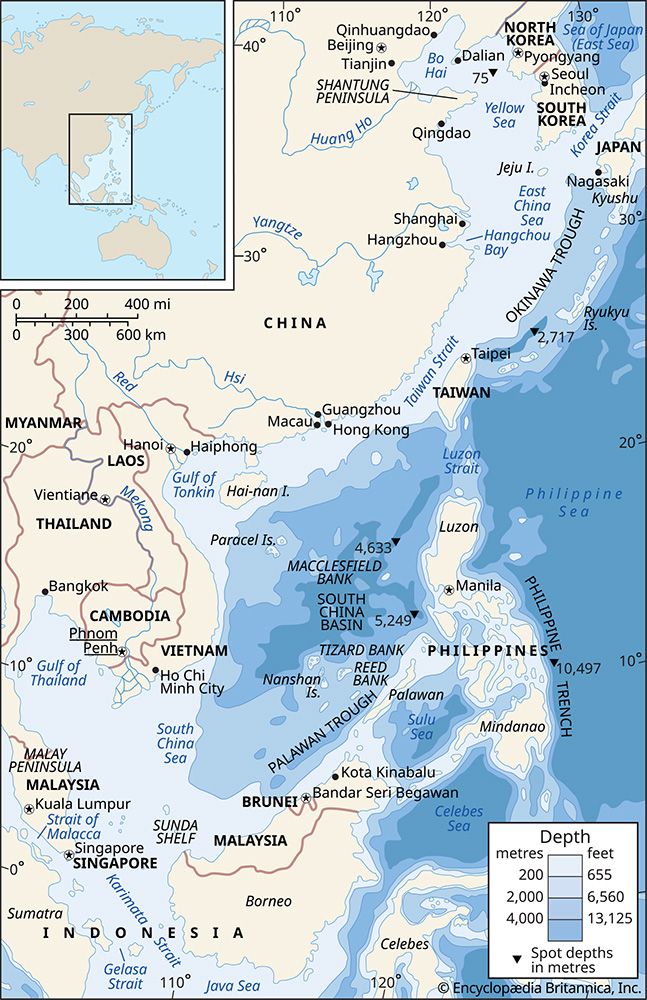
The East China Sea is bordered by China, Japan, South Korea, and Taiwan. These nations are involved in complex territorial and maritime disputes, primarily driven by the desire to control exclusive economic zones (EEZs) and the valuable natural resources within them.178
Drivers of Conflict
- Resource Competition: The discovery of petroleum and natural gas deposits under the continental shelf has intensified competition. Additionally, the region is highly productive for fishing, making control over maritime boundaries economically vital.18
- Overlapping Claims: Under the United Nations Convention on the Law of the Sea (UNCLOS), countries are entitled to a 200-nautical-mile EEZ. Because the sea separating China and Japan is only about 360 nautical miles wide, their claims overlap significantly, leading to persistent disagreements over resource rights.8
- The Senkaku Islands: A major source of friction is the Senkaku Islands (known as the Diaoyu Islands in China and Diaoyutai in Taiwan). While currently administered by Japan, they are claimed by China and Taiwan. These uninhabited islands are significant because they serve as a basis for asserting broader maritime jurisdiction.91
These disputes remain a persistent source of geopolitical tension, often involving maritime patrols and diplomatic friction.98
What significant islands are located within the East China Sea?
The East China Sea contains several significant island groups and individual islands that play key roles in the region’s geography and geopolitics:
- Senkaku Islands: A cluster of five uninhabited islands and three rocks located northeast of Taiwan. While currently administered by Japan, they are also claimed by China and Taiwan. Their strategic importance has grown due to potential oil reserves in the surrounding seabed.712
- Zhoushan Archipelago: A group of more than 400 islands situated off the coast of Zhejiang province, China. These islands are vital for the regional fishing industry and include Putuo Shan, a historically significant center for Buddhism.8
- Ryukyu Islands: An island chain that forms the eastern boundary of the East China Sea. This arc includes several volcanic islands and separates the sea from the deeper Pacific Ocean.13
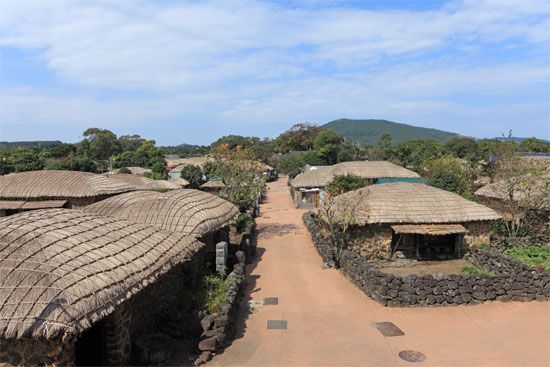
- Cheju Island: Located off the coast of South Korea, this island marks a portion of the northern boundary where the East China Sea meets the Yellow Sea.13
What role does the East China Sea play in international shipping and trade routes?
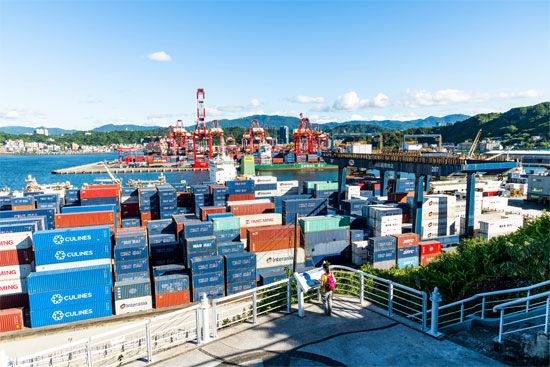
The East China Sea serves as a vital artery for global commerce, functioning primarily as the main shipping route that connects the South China Sea to ports in Japan and the broader North Pacific region.15
Beyond its role as a transit corridor, the sea facilitates significant local maritime traffic, supporting the movement of goods in and out of major regional hubs. Key ports located along the East China Sea include:
- Shanghai, China: A leading center for maritime trade and the administrative hub for the northern marine district.115
- Nagasaki, Japan: A critical port for Japanese trade and connectivity.1
- Chi-lung, Taiwan: A key gateway for Taiwanese shipping and logistics.1
The strategic importance of these routes is underscored by the high volume of trade passing through the broader China Sea region, which connects the Pacific and Indian oceans. This heavy reliance on the sea for international transport makes the maintenance of open and secure shipping lanes a priority for the bordering nations.51
Sources
- East China Sea — Encyclopædia Britannica
- 10 Deadliest Typhoons in History — Encyclopædia Britannica
- Ise Bay typhoon of 1959 — Encyclopædia Britannica
- typhoons — Merriam-Webster
- China Sea — Encyclopædia Britannica
- Asia Floods of 2025 — Encyclopædia Britannica
- Senkaku Islands — Encyclopædia Britannica
- territorial disputes in the South China Sea - 20th-century history — Encyclopædia Britannica
- territorial disputes in the South China Sea - Physiography and economic factors — Encyclopædia Britannica
- territorial disputes in the South China Sea - Early 21st-century developments — Encyclopædia Britannica
- exclusive economic zone — Encyclopædia Britannica
- Zhoushan Archipelago — Encyclopædia Britannica
- list of islands - China — Encyclopædia Britannica
- Senkaku Islands: Top Questions — Encyclopædia Britannica
- China - Port facilities and shipping — Encyclopædia Britannica
Published on · 4 min read