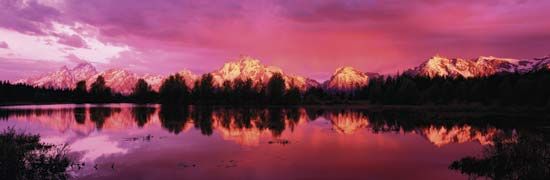
Jackson Hole National Monument
Jackson Hole National Monument was a protected area established in 1943 in northwestern Wyoming. It encompassed a fertile mountain valley and wildlife…
What is Jackson Hole National Monument?
Jackson Hole National Monument was a protected area established in 1943 in northwestern Wyoming. It encompassed a fertile mountain valley and wildlife reserve located just east of the Teton Range.12
In 1950, the majority of the monument’s land was incorporated into the neighboring Grand Teton National Park. Today, the area is recognized for its stunning landscape, which includes the Snake River and a diverse ecosystem supporting wildlife such as elk, moose, and grizzly bears. The region remains a major destination for outdoor recreation and tourism, serving as a gateway to the broader national park system in the area.23
How was the Teton Range formed?
The Teton Range was formed through a geological process involving a massive fault block that began uplifting from the Earth’s crust approximately six million years ago.4
This tectonic activity created a distinct landscape where the mountain range rose abruptly along a fault line, while the adjacent valley of Jackson Hole represents a corresponding block that subsided. Following this uplift, the range was significantly shaped by glaciers that carved out characteristic U-shaped canyons as they moved down the slopes. As these glaciers melted, they deposited large quantities of rock and debris, known as moraines, at the base of the mountains.4
What role does the Snake River play in the valley’s ecosystem?
The Snake River plays a vital role in the ecosystem of the Jackson Hole valley, serving as a primary water source that sustains the region’s diverse flora and fauna.52
By flowing through the valley, the river creates well-watered environments that support the growth of deciduous trees such as cottonwood, poplar, and aspen. These riparian zones are essential for local wildlife; for instance, moose are frequently found grazing in these wetter areas. Additionally, the river and its associated streams are noted for being abundant in fish, which in turn supports various bird species, including bald eagles.5
Beyond its direct biological contributions, the river has shaped the physical landscape of the valley through the formation of glacial lakes, such as Jackson Lake, which was created by a dam across the river. While the river is a central feature of the Grand Teton National Park ecosystem, it also serves as a significant resource for human activity, including irrigation and hydroelectric power generation further downstream.54
Why is the National Elk Refuge important for local wildlife?
The National Elk Refuge is a critical area for local wildlife, particularly serving as a protected habitat that extends northeastward from the town of Jackson, Wyoming.2
While the provided search results confirm the refuge’s location and its association with the Jackson National Fish Hatchery, they do not explicitly detail the specific biological or management functions of the refuge regarding wildlife populations. In the broader region of Grand Teton National Park, which the refuge adjoins, herds of elk, bison, and antelope are known to roam freely, and many species rely on seasonal migrations between high-elevation summer ranges and warmer, lower-elevation winter habitats to survive the severe regional winters.36
Sources
- Jackson Hole National Monument — Encyclopædia Britannica
- Grand Teton National Park — Encyclopædia Britannica
- Jackson — Encyclopædia Britannica
- Teton Range — Encyclopædia Britannica
- Snake River — Encyclopædia Britannica
- Montana - Plant and animal life — Encyclopædia Britannica
- Colorado - Plant and animal life — Encyclopædia Britannica
Published on · 2 min read