Jaintia Hills
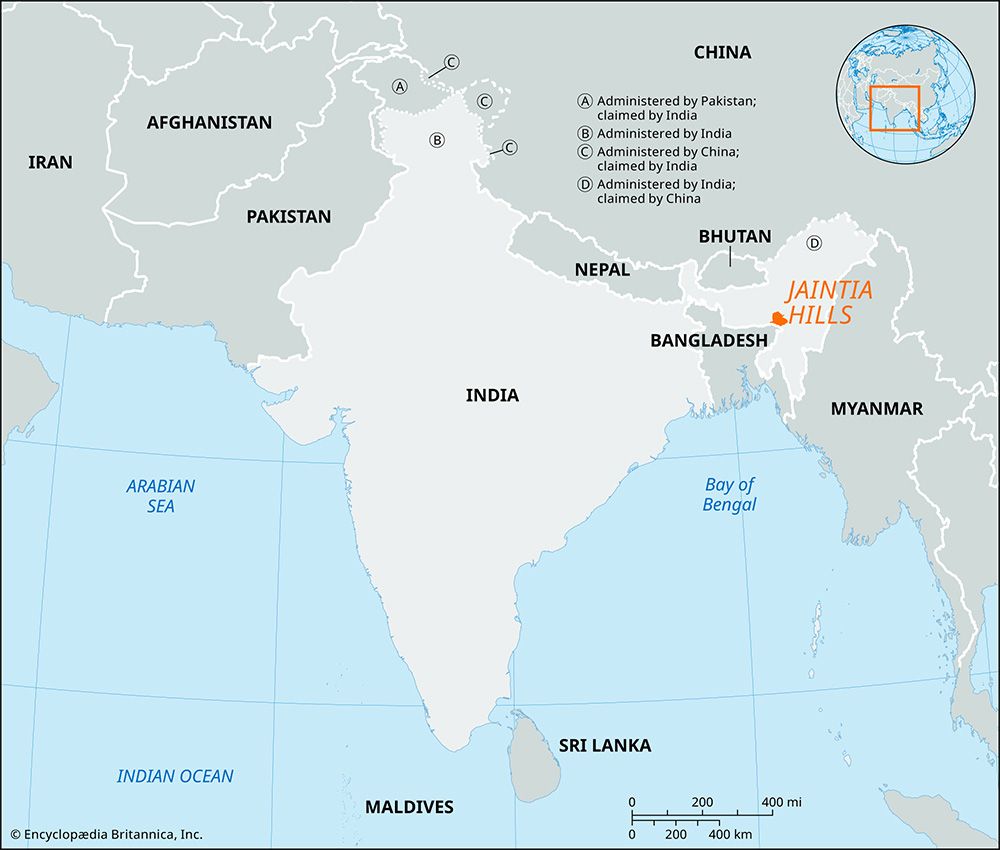
The Jaintia Hills are a mountainous region in Meghalaya, India, characterized by high elevations, dense forests, and heavy rainfall. This rugged geography…
How does the geography and climate of the Jaintia Hills influence the local way of life?
The Jaintia Hills are a mountainous region in Meghalaya, India, characterized by high elevations, dense forests, and heavy rainfall. This rugged geography has historically fostered isolation, which has allowed the local Jaintia people to largely preserve their traditional matriarchal culture.1
The environment directly shapes the local economy and agricultural practices. Due to the terrain, the region has limited industrial development, and the population remains sparse. Traditionally, the inhabitants have relied on shifting cultivation, with potatoes serving as the primary crop. However, the region’s openness to external influences has facilitated a transition toward settled farming, which has been more readily accepted here than among other neighboring tribal groups. Additionally, the dense forests of the plateau support the production of fine timber, while the rocky, swift-flowing Kopili River and the region’s unique wildlife highlight the area’s distinct natural character.1
What are some notable natural resources or industries in the Jaintia Hills region?
The Jaintia Hills region is characterized by limited industrial development, as the mountainous terrain and relative isolation have hindered large-scale commercial expansion. However, the region possesses specific natural resources that support the local economy:1
- Timber: The area is densely forested, and the production of fine timber serves as a notable resource for the region.1
- Agriculture: While shifting cultivation remains a traditional practice, the region has seen a successful transition toward settled farming. Potatoes are the primary crop grown in the area.1
- Water Resources: The Kopili River is the largest stream in the region. While its rocky and swift nature makes it a significant geographical feature, it also contributes to the area’s natural landscape, which includes numerous waterfalls.1
Because the region is sparsely populated and mountainous, it remains less developed compared to other parts of India, with its economic activities primarily centered on these traditional land-based resources.1
How did British colonization impact the Jaintia Hills region?
British colonization significantly altered the political and social landscape of the Jaintia region. Initially, the local raja allied with the British during the 1824 invasion of Assam by Myanmar, but the British subsequently annexed the territory in 1832.2
The arrival of Bengali traders and European tea planters created significant social and economic tension, culminating in a rebellion in 1862. The British suppression of this uprising was so severe that it drew widespread criticism. Furthermore, British rule dismantled the traditional three-tiered administrative system that had governed the Jaintia Hills until the 19th century.21
Despite these disruptions, the period of British hegemony and its subsequent aftermath contributed to a notable degree of unity among the various peoples inhabiting the hill districts of Meghalaya. Following India’s independence, the colonial administrative structures were replaced by a district council for tribal affairs and an Indian officer.1
What are the main ethnic groups and cultures found in the Jaintia Hills?
The primary ethnic group inhabiting the Jaintia Hills is the Jaintia people. Along with the Khasis to their west, the Jaintias are believed to be descendants of the first Mongolian migration to India.1
Cultural Characteristics
- Social Structure: The Jaintias have largely preserved a matriarchal culture, a tradition maintained in part due to the region’s historical isolation.1
- Religious Influence: Compared to other tribal groups in the region, the Jaintias have been more significantly influenced by Hinduism and Aryan cultural practices.1
- Language: While Jaintia is recognized as an official language of Meghalaya, the region also features speakers of Pnar-Synteng, as well as broader regional languages like Bengali, Assamese, and Hindi.3
- Traditions: Tribal life in the broader Meghalaya region is characterized by rich folklore, where music—played on instruments such as buffalo horns, bamboo flutes, and drums—is integral to social and religious functions.3
While the Jaintias historically utilized a three-tiered administrative system, this was dismantled during the British colonial period and replaced after independence by a district council for tribal affairs.1
Sources
- Jaintia Hills — Encyclopædia Britannica
- Jaintia — Encyclopædia Britannica
- Jainism - Festivals — Encyclopædia Britannica
- Meghalaya — Encyclopædia Britannica
Published on · 3 min read