Mount Circeo
Mount Circeo National Park is a protected area covering approximately 33 square miles (86 square km) on the southwestern coast of Italy. The park is…
What types of flora and fauna can be found in the Mount Circeo National Park?
Mount Circeo National Park is a protected area covering approximately 33 square miles (86 square km) on the southwestern coast of Italy. The park is particularly renowned for its diverse flora, which thrives across its limestone ridge and surrounding landscape.1
While the park is recognized for its notable plant life, the provided information does not specify the particular species of flora or fauna found within the region.
What role did Mount Circeo play in ancient Roman history and culture?
Mount Circeo held significant importance in both the mythology and the historical development of ancient Rome.
Mythological Significance
Since classical times, the promontory has been associated with the sorceress Circe. Greco-Roman tradition frequently identified Mount Circeo as the location of her home, Aeaea, where she was said to have transformed those who rejected her or offended her, such as the mortal Picus, whom she turned into a woodpecker.12
Historical Role
Beyond myth, the site played a practical role in Roman expansion and leisure:
- Strategic Settlement: The area was originally a fortress of the Volsci people. It was established as a Roman colony in 393 BCE, serving as a strategic outpost.1
- Imperial Retreat: During the Roman imperial period, the location became a popular summer residence for the elite.1
- Architectural Legacy: The site features the remains of a Roman acropolis situated high on the mountain, reflecting its historical importance as a fortified position.1
What is the geographical location of Mount Circeo in Italy?
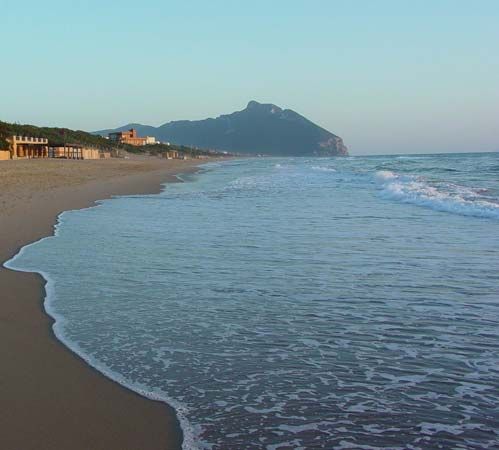
Mount Circeo is an isolated limestone promontory located on the southwestern coast of Italy within the Lazio region.1
Situated in the Latina province, it lies along the Tyrrhenian Sea, positioned just northwest of the Gulf of Gaeta. The promontory consists of a ridge measuring 3.5 miles long and 1 mile wide, reaching an elevation of 1,775 feet (541 m), and is connected to the mainland by a low saddle of alluvial deposits. Because of its unique topography, the mountain appears as an island when viewed from the sea.1
How did Mount Circeo get its name, and what is its connection to Greek mythology?
Mount Circeo derives its name from the legendary Greek sorceress Circe. Since classical times, the promontory has been inextricably linked to her mythic identity, as Greco-Roman tradition frequently identified the mountain as the site of her home, the island of Aeaea.21
In Greek mythology, Circe was a powerful enchantress and the daughter of the sun god Helios. She was famously featured in Homer’s Odyssey, where she transformed the companions of Odysseus into swine using her knowledge of herbs and magic. Because the promontory is connected to the mainland by a low saddle of alluvial deposits, it appears as an island when viewed from the sea, a geographical feature that likely reinforced its identification with Circe’s mythical island home.21
Beyond the Odyssey, Roman legend further cemented this connection by claiming that Circe resided on the mountain, where she famously transformed the mortal Picus into a woodpecker after he rejected her advances.2
Sources
- Mount Circeo — Encyclopædia Britannica
- Circe — Encyclopædia Britannica
- Circean — Merriam-Webster
Published on · 2 min read