James Bay
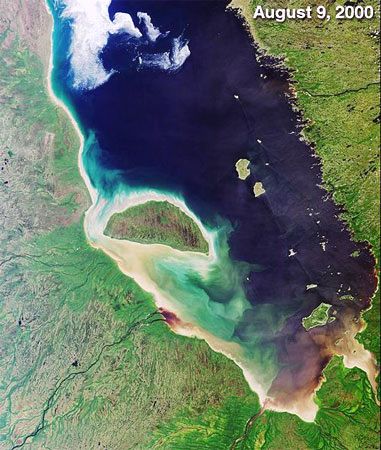
James Bay is a shallow southern extension of Hudson Bay, situated between the Canadian provinces of Ontario and Quebec.
Where is James Bay located, and what are its geographical features?
James Bay is a shallow southern extension of Hudson Bay, situated between the Canadian provinces of Ontario and Quebec.
The bay measures approximately 275 miles (443 km) in length and 135 miles (217 km) in width. It is characterized by its shallow depth, generally remaining less than 200 feet (60 m). The bay contains numerous islands, the largest of which is Akimiski Island, covering 1,159 square miles (3,002 square km). All islands within the bay are administered by the Northwest Territories.
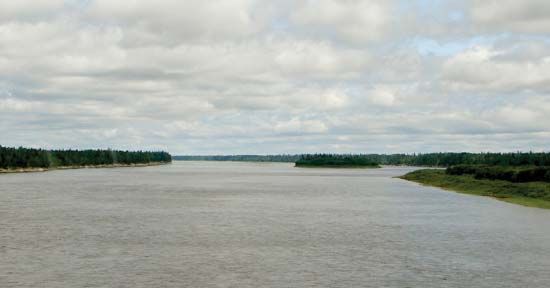
A notable feature of James Bay is its low salinity, which is attributed to the many rivers that flow into it, including the La Grande, Eastmain, Rupert, Broadback, Nottaway, Harricana, Moose, Albany, Attawapiskat, and Ekwan. The shores of the bay are forested, and the region experiences a severe continental climate, with coniferous woods bordering the area.
What is the historical significance of James Bay in Canada’s exploration and development?
James Bay has played a pivotal role in the history of Canadian exploration and economic development, serving as a focal point for both early maritime discovery and later industrial expansion.
Exploration and Early History
The bay was first visited by the English navigator Henry Hudson in 1610 during his search for the Northwest Passage. It was later named after Captain Thomas James, who conducted further explorations of the region in 1631. These early voyages were driven by the European desire to find a short route to Asia, though they ultimately established the basis for English claims to much of Canada.143
Economic Development
In the 17th century, the region became central to the fur trade. The Hudson’s Bay Company, incorporated in 1670, established numerous trading posts along the shores of James and Hudson bays, which were contested by the French until the early 18th century.5
In the 20th century, the bay’s significance shifted toward large-scale resource development. Following an agreement with the local Cree community, Hydro-Québec developed the massive James Bay Hydroelectric project. This project, which involves harnessing the region’s vast water resources, has become a cornerstone of the province’s energy production and export economy.6
What are the major communities and indigenous groups living around James Bay?
The region surrounding James Bay is home to a sparse population, with the Cree people representing one of the largest resident groups in the area. Historically, the Cree have maintained a deep connection to the land and waters of the James Bay basin, traditionally relying on hunting, fishing, and trapping for their subsistence.17
The shores of James Bay are dotted with several notable settlements, many of which originated as historical trading posts. These communities include:
- Fort Albany
- Moose Factory
- Moosonee (the northern terminus of the Ontario Northland Railway)
- Attawapiskat
- Eastmain
- Fort-George
- Nouveau-Comptoir
- Fort-Rupert
- Lake River
These settlements are situated along the forested coastline of the bay, reflecting a long history of interaction between indigenous communities and the fur trade that once dominated the region’s economy.27
What impact do the many rivers flowing into James Bay have on its water quality?
The many rivers that flow into James Bay—including the La Grande, Eastmain, Rupert, Broadback, Nottaway, Harricana, Moose, Albany, Attawapiskat, and Ekwan—have a significant impact on the bay’s water composition. Because these numerous rivers discharge large volumes of freshwater into the relatively shallow basin, they are directly responsible for the bay’s notably low salinity levels.1
Sources
- James Bay — Encyclopædia Britannica
- Hudson Bay — Encyclopædia Britannica
- Henry Hudson — Encyclopædia Britannica
- Quebec - Resources and power — Encyclopædia Britannica
- Hudson’s Bay Company — Encyclopædia Britannica
- Arctic - Early voyages of exploration — Encyclopædia Britannica
- Cree — Encyclopædia Britannica
Published on · 3 min read