Mistassini Lake
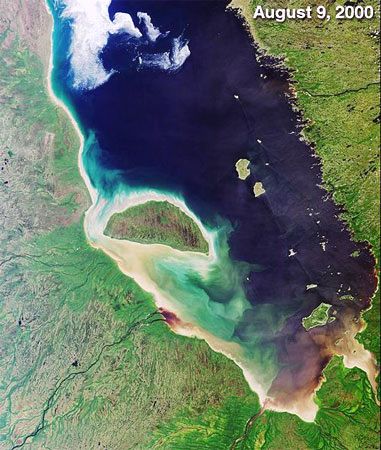
Mistassini Lake is the largest lake in the province of Quebec, Canada. Situated in the west-central Nord-du-Québec region, it serves as the headwaters for…
What is Mistassini Lake?
Mistassini Lake is the largest lake in the province of Quebec, Canada. Situated in the west-central Nord-du-Québec region, it serves as the headwaters for the Rupert River, which flows into James Bay.1
The lake spans approximately 100 miles (160 km) in length and 12 miles (19 km) in width, covering an area of 902 square miles (2,335 square km). It is notably bisected by a chain of islands. The name “Mistassini” is derived from an Indigenous term meaning “great stone,” which refers to a large rock formation within the water. First discovered by French missionary-explorer Charles Albanel in 1672, the lake remains home to Mistassini Post and an Anglican mission at its southern end.1
What is the significance of the Rupert River?
The Rupert River holds historical and geographical significance as a vital waterway in western Quebec, Canada. Rising from Mistassini Lake, it flows westward for 380 miles (610 km) before emptying into Ruperts Bay at the southern end of James Bay.2
Its historical importance is tied to early European exploration and the fur trade:
- Exploration: The river was visited by Henry Hudson during his 1610–1611 expedition.23
- Trade: It was named for Prince Rupert, the first governor of the Hudson’s Bay Company. In 1668, the company established its first trading post, Fort-Rupert, at the river’s mouth.2
- Regional Connectivity: The river served as a corridor for other significant trading posts, including Nemiscau and Mistassini Post.2
Additionally, the Rupert River is one of several major waterways that contribute to the low salinity of James Bay, a shallow southern extension of Hudson Bay.3
How did the Cree people historically use Lake Mistassini?
Sorry, the Britannica knowledge base does not contain specific information regarding the historical use of Lake Mistassini by the Cree people.
What kind of wildlife lives in the Nord-du-Quebec region?
The Nord-du-Québec region encompasses diverse ecological zones, ranging from the northern Arctic tundra to the southern boreal forest, each supporting distinct wildlife populations.4
Arctic Tundra (North of the 56th parallel)
In this treeless landscape, the environment is dominated by mosses, lichens, and peat bogs. Characteristic wildlife includes:
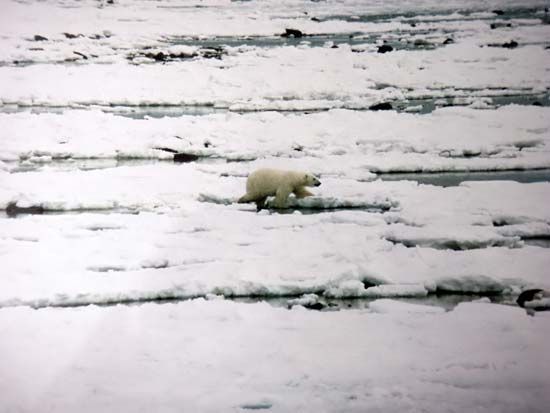
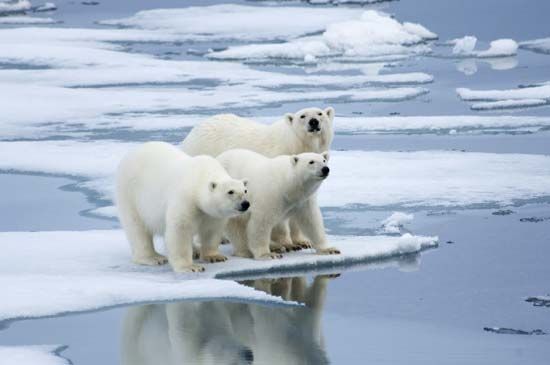
- Mammals: Polar bears, foxes, and Arctic hares.4
Taiga and Boreal Forest (South of the 56th parallel)
As the landscape transitions into taiga and eventually dense boreal forest, the variety of species increases significantly:
- Large Mammals: Roaming herds of caribou are common, along with moose, black bears, and brown bears.45
- Fur-bearing Animals: The region supports populations of martens, mink, beavers, muskrats, and squirrels.5
- Birds: The area is a vital habitat for owls, ravens, and woodpeckers, as well as migratory waterfowl like Canada geese and loons.45
- Aquatic Life: Northern lakes are home to species such as lake trout and pickerel.5
Sources
- Mistassini Lake — Encyclopædia Britannica
- Rupert River — Encyclopædia Britannica
- James Bay — Encyclopædia Britannica
- Quebec - Plant and animal life — Encyclopædia Britannica
- North America - The boreal forest — Encyclopædia Britannica
Published on · 2 min read