Eastmain River
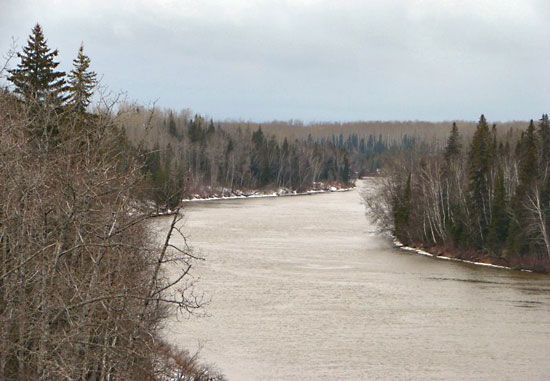
The Eastmain River is a river located in the Nord-du-Québec region of western Quebec, Canada. Rising in the Otish Mountains of central Quebec, the river…
What is Eastmain River?
The Eastmain River is a river located in the Nord-du-Québec region of western Quebec, Canada. Rising in the Otish Mountains of central Quebec, the river flows nearly due west for approximately 500 miles (800 km) before discharging into James Bay.12
The river’s course is characterized by numerous falls and rapids. Historically referred to as the Hudson, Canuse, and Slude, the river was likely discovered around 1685, the same year the Hudson’s Bay Company established a trading post at its mouth.1
What are the Otish Mountains?
The provided search results do not contain information regarding the Otish Mountains.
Sorry, the Britannica knowledge base does not contain this information.
How does the James Bay Project affect rivers in Quebec?
The James Bay Hydroelectric project, developed by Hydro-Québec, has significantly altered the landscape of northern Quebec. By harnessing the region’s vast water resources for hydroelectric power, the project involves the creation of massive reservoirs that, upon completion, will inundate hundreds of millions of acres of land in the region.1
While the project is a major source of electricity for the province and provides surplus power for export to the northeastern United States, its development has required complex negotiations and agreements with the Cree community, who reside in the affected areas. The project represents a significant transformation of the natural environment, fundamentally changing the flow and character of rivers in the region to support large-scale energy production.1
What was the role of the Hudson’s Bay Company in Canada?
The Hudson’s Bay Company (HBC) played a foundational role in the economic and political development of Canada. Incorporated in 1670, the company was granted proprietary control over Rupert’s Land, a vast territory spanning from Labrador to the Rocky Mountains.56
Key aspects of its role include:
- Fur Trade Dominance: For two centuries, the HBC was the primary force in the North American fur trade. It established numerous trading posts, fostering complex relationships with Indigenous peoples, including the Cree, Innu, and Inuit.56
- Political and Territorial Control: The company maintained political authority over Rupert’s Land until 1870. It engaged in intense competition with the North West Company until their union in 1821.56
- Transition to Modern Commerce: In 1870, the HBC sold its remaining territories to the Canadian government. In the 20th century, it shifted its focus from fur trading to retail merchandising, eventually becoming a major Canadian business firm involved in real estate and financial services.5
Sources
- Eastmain River — Encyclopædia Britannica
- Eastmain — Merriam-Webster
- Quebec - Relief, drainage, and soils — Encyclopædia Britannica
- Quebec - Resources and power — Encyclopædia Britannica
- Hudson’s Bay Company — Encyclopædia Britannica
- Rupert’s Land — Encyclopædia Britannica
- Native American - Subarctic and Arctic peoples — Encyclopædia Britannica
Published on · 2 min read