Moose River
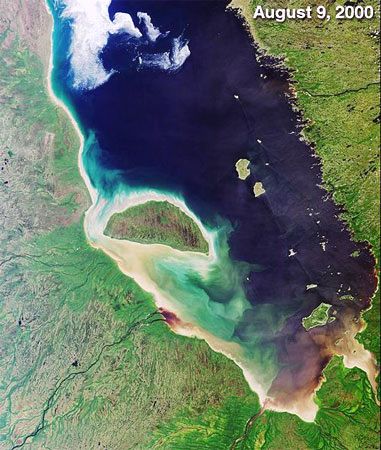
The Moose River is a river located in northeastern Ontario, Canada. It is formed by the confluence of two major headstreams, the Mattagami and the…
What is Moose River?
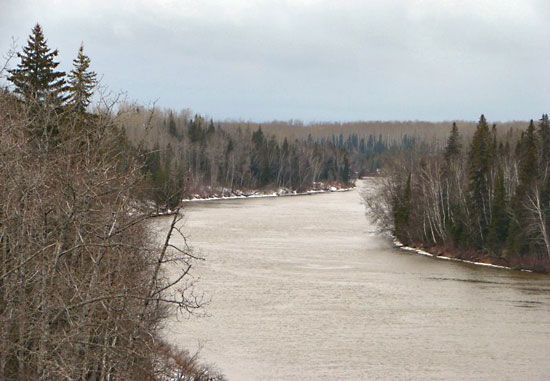
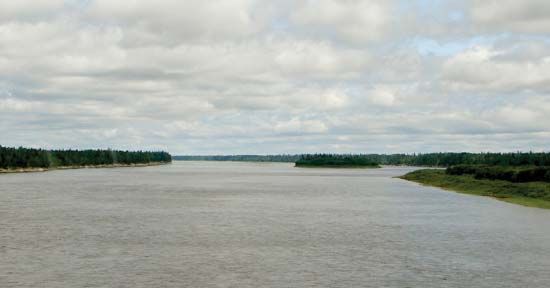
The Moose River is a river located in northeastern Ontario, Canada. It is formed by the confluence of two major headstreams, the Mattagami and the Missinaibi, and flows northeastward for more than 60 miles (100 km) into James Bay.1
Functioning essentially as an estuary for the Mattagami, the Abitibi River, and other tributaries, the river system drains a significant portion of northeastern Ontario. The watershed supports various economic activities, including mining and pulp and paper milling, which are powered by hydroelectric plants.12
Key locations within the basin include the town of Moosonee and the historic Moose Factory, situated at the river’s mouth. Nearby, Tidewater Provincial Park encompasses several islands in the area.1
What is the historical significance of Moose Factory?
Moose Factory holds significant historical importance as one of the earliest Hudson’s Bay Company fur-trading posts in North America. Established in 1673 by Charles Bayly, the site served as a vital node in the regional fur trade. Although it was captured and destroyed by the French in 1686, the company reestablished the post in 1730, marking the beginning of its continuous operation.4
The location also reflects the complex history of colonial and Indigenous relations. It became a center for religious and educational influence with the establishment of an Anglican mission church in 1840 and a residential school around 1851. Today, the community remains home to the Cree people of the Moose Cree First Nation. Historical preservation efforts, such as the maintenance of the Staff House (c. 1850) as a museum, continue to honor the site’s long-standing role in the history of Ontario and the Hudson Bay region.4
We could dive deeper into the impact of the fur trade on Indigenous communities or explore the history of the residential school system in Canada.
How do hydroelectric plants impact river ecosystems?
Hydroelectric plants and the dams that support them significantly alter river ecosystems, often leading to complex environmental consequences. A primary concern is the disruption of migrating fish, as dams can block or impede access to essential spawning grounds. While technologies such as fish passes—including fish ladders and locks—are used to help fish navigate these structures, their success varies, and significant population declines have been documented on several river systems.56
Beyond fish migration, dams transform the environment by creating large reservoirs. These impoundments can lead to the loss of natural landscapes, the inundation of cultural homelands, and the displacement of human populations. Furthermore, dams fundamentally change the physical character of a river by trapping sediment that would otherwise flow downstream, which alters downstream habitats and deposition patterns.57
While hydroelectric power serves as a major source of renewable energy, the balance between human utility and the preservation of riparian ecosystems remains a subject of ongoing debate, with some initiatives even focusing on dam removal to help revitalize river health.56
What is the difference between a river and an estuary?
A river is a natural, flowing watercourse that typically moves toward an ocean, sea, lake, or another river. In contrast, an estuary is a partially enclosed coastal body of water where a river meets the sea, resulting in the mixing of freshwater and seawater.910
The primary differences between the two include:
- Composition: Rivers consist primarily of fresh water. Estuaries are defined by their salinity gradients, where fresh water is measurably diluted by salt water.910
- Dynamics: While rivers are characterized by downstream flow, estuaries are influenced by tides. The term estuary is derived from the Latin words for “the tide” and “to boil,” reflecting the turbulence created when tidal and river flows interact.910
- Classification: Estuaries are often categorized by how these waters mix. In “salt-wedge” estuaries, fresh water floats over a layer of seawater with little mixing, whereas in “vertically homogeneous” estuaries, strong tidal currents cause total mixing, resulting in uniform salinity from top to bottom.1112
- Productivity: Estuaries are generally more biologically productive than adjacent rivers or the open sea because their unique circulation patterns trap nutrients, supporting diverse marine life.10
Sources
- Moose River — Encyclopædia Britannica
- Moosehead Lake — Encyclopædia Britannica
- Moose — Merriam-Webster
- Moose Factory — Encyclopædia Britannica
- dam - Rise of environmental and economic concerns — Encyclopædia Britannica
- dam - Fish passes — Encyclopædia Britannica
- dam - Construction techniques — Encyclopædia Britannica
- river - Environments of deposition — Encyclopædia Britannica
- estuary — Merriam-Webster
- river - Origin and classification — Encyclopædia Britannica
- river — Merriam-Webster
- river - Estuaries — Encyclopædia Britannica
- estuary — Encyclopædia Britannica
- estuary - Vertically homogeneous estuaries — Encyclopædia Britannica
Published on · 3 min read