Java Sea
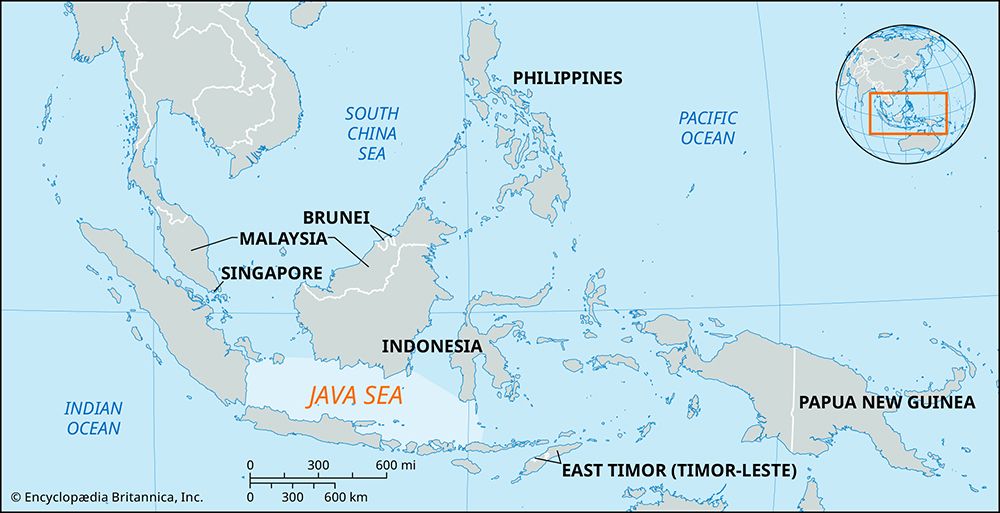
The Java Sea, a portion of the western Pacific Ocean, is connected to several surrounding bodies of water through various straits and passages:
How does the Java Sea connect to other bodies of water in the Pacific Ocean?
The Java Sea, a portion of the western Pacific Ocean, is connected to several surrounding bodies of water through various straits and passages:
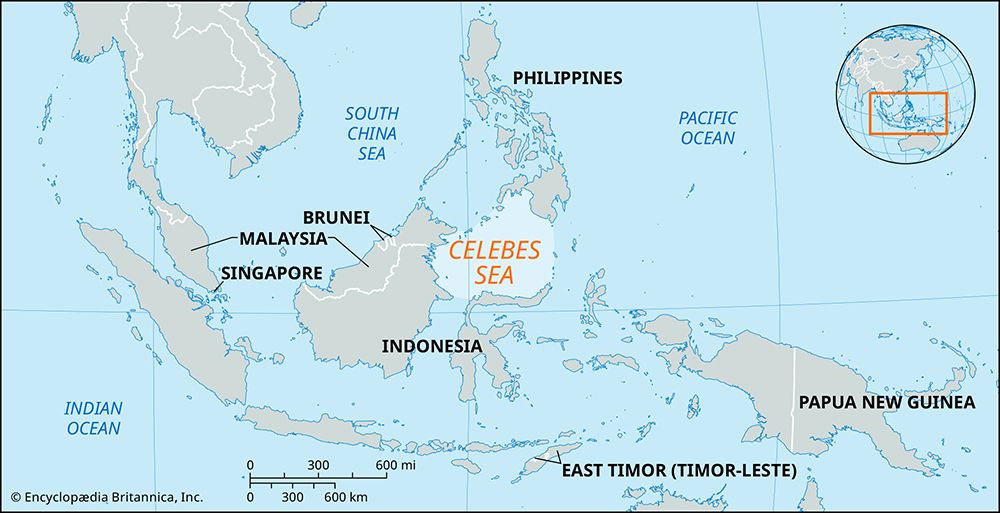
- Makassar Strait: Located to the northeast, this deep waterway connects the Java Sea to the Celebes Sea.12
- South China Sea: The Java Sea is linked to the South China Sea via the Karimata and Gelasa (Gasper) straits, which facilitate the exchange of water between these regions.3
- Flores and Bali Seas: These bodies of water border the Java Sea to the east.1
- Sunda Strait: Situated to the southwest, this channel connects the Java Sea to the Indian Ocean.14
The hydrology of the Java Sea is significantly influenced by monsoons, which control surface currents and the exchange of water with these adjacent seas. For instance, during August, surface water flows from the Java Sea into the South China Sea through the Karimata and Gelasa straits.3
What role did the Java Sea play in historical trade routes and exploration?
The Java Sea has served as a vital maritime crossroads for centuries, acting as a bridge for cultural exchange, trade, and exploration within the Indonesian archipelago and beyond.15
Historical Trade and Commerce
- Early Networks: By the first centuries CE, the sea facilitated the movement of timber, spices, and resins from the Indonesian hinterland to distant markets. Coastal estuary kingdoms prospered as international entrepôts, with local leaders often gaining power by controlling the arrival of foreign trading treasures.15
- Global Connections: The region was integrated into wider trade networks involving India, China, and western Asia. By the 7th century, ports like Palembang were active in seaborne trade, and later, kingdoms such as Kediri and Majapahit became significant centers for the spice trade.156
- European Expansion: In the 17th century, the Dutch East India Company established its headquarters at Batavia (modern-day Jakarta) on the Java Sea. This location became the focal point for commerce moving between Europe, China, Japan, and India, eventually leading to the Dutch monopoly on commodities like coffee and spices.786
Exploration and Navigation
- Monsoon Influence: Navigation was dictated by monsoon winds, which facilitated regular communication across the archipelago and with maritime Asia.15
- Scientific and Geographic Discovery: In the 17th century, Dutch officials sponsored voyages of exploration from their base in the East Indies. Notably, Antonio van Diemen commissioned Abel Tasman to investigate southern lands, leading to the discovery of Tasmania, New Zealand, and various Pacific islands.7
What is the geographical location and extent of the Java Sea?
The Java Sea is a portion of the western Pacific Ocean situated between the islands of Java and Borneo. It covers the southern section of the Sunda Shelf, a vast, shallow region with a mean depth of approximately 151 feet (46 meters).1
Geographical Boundaries
The sea is enclosed by several landmasses and bodies of water:
- North: Borneo (Kalimantan)
- Northeast: The southern end of the Makassar Strait
- East: Celebes and the Flores and Bali seas
- South: Java
- Southwest: The Sunda Strait, which connects to the Indian Ocean
- West: Sumatra
- Northwest: The islands of Bangka and Belitung, which border the South China Sea1
Extent
The Java Sea measures approximately 900 miles (1,450 km) from east to west and 260 miles (420 km) from north to south, encompassing a total surface area of 167,000 square miles (433,000 square km).1
What are the major islands and countries that surround the Java Sea?
The Java Sea is a significant body of water in the western Pacific Ocean that is almost entirely enclosed by the islands of the Indonesian archipelago. The major islands and landmasses surrounding it include:
- North: Borneo (specifically the region of Kalimantan)111
- West: Sumatra111
- South: Java111
- East: Celebes (also known as Sulawesi)111
- Northwest: The islands of Bangka and Belitung1
Politically, these surrounding islands are part of the nation of Indonesia. While Borneo is shared by Indonesia, Malaysia, and Brunei, the northern coast bordering the Java Sea is primarily Indonesian territory (Kalimantan).112
Sources
- Java Sea — Encyclopædia Britannica
- South China Sea — Encyclopædia Britannica
- Makassar Strait — Encyclopædia Britannica
- Sunda Strait — Encyclopædia Britannica
- Western colonialism - Eastern pursuits — Encyclopædia Britannica
- history of Indonesia - The archipelago: its prehistory and early historical records — Encyclopædia Britannica
- Indonesia - The archipelago: its prehistory and early historical records — Encyclopædia Britannica
- history of Southeast Asia - Chinese and Western incursions — Encyclopædia Britannica
- European exploration - The exploration of the coastlines of the Indian Ocean and the China Sea — Encyclopædia Britannica
- Java - History — Encyclopædia Britannica
- Indonesia - Relief — Encyclopædia Britannica
- Indonesia - Islands of the Sunda Shelf — Encyclopædia Britannica
- Java Sea — Merriam-Webster
Published on · 3 min read