Indian Ocean
The Indian Ocean monsoon system is a major climatic driver that dictates weather patterns across South Asia, Africa, and Australia through the seasonal…
How does the Indian Ocean’s monsoon system affect climate and weather patterns in surrounding regions?
The Indian Ocean monsoon system is a major climatic driver that dictates weather patterns across South Asia, Africa, and Australia through the seasonal reversal of winds caused by differential heating of land and sea.12
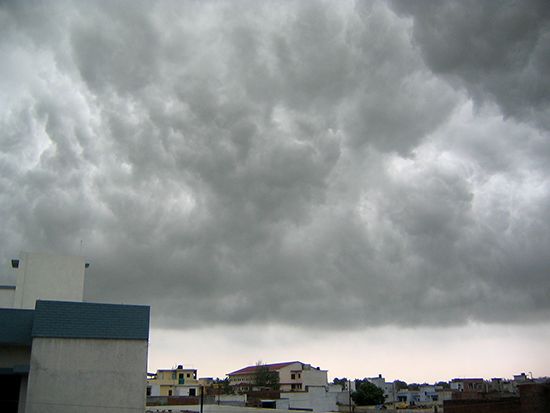
During the Northern Hemisphere summer (May–October), low atmospheric pressure over Asia draws in moisture-laden air from the Indian Ocean, resulting in the southwest monsoon and a critical wet season for South Asia. Conversely, the northern winter (November–April) brings high pressure over Asia, reversing the winds to a northeasterly flow that causes dry conditions across much of the region, while bringing rain to parts of Indonesia and northern Australia.132
This system is highly variable and linked to global patterns like the Southern Oscillation and El Niño. The region is also prone to destructive tropical cyclones, which typically form over the open ocean before and after the summer monsoon rains. Additionally, the Monsoon Current reverses its flow in tandem with these winds, significantly impacting coastal temperatures through upwelling.14
What are the geographical boundaries and unique features of the Indian Ocean?
The Indian Ocean is the world’s smallest, youngest, and most complex major ocean. It spans over 6,200 miles between Africa and Australia, covering approximately one-fifth of the global ocean area.8
Geographical Boundaries
Defining the ocean’s limits is complex and lacks universal agreement:
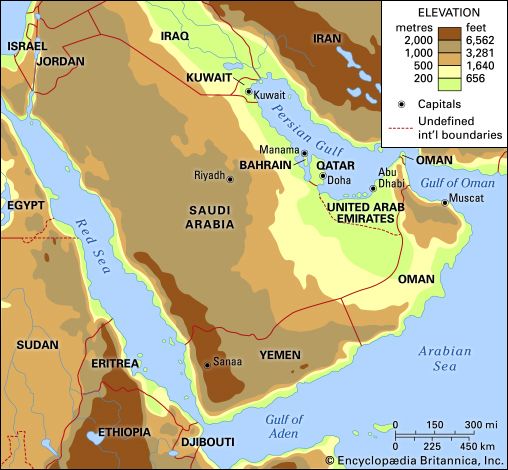
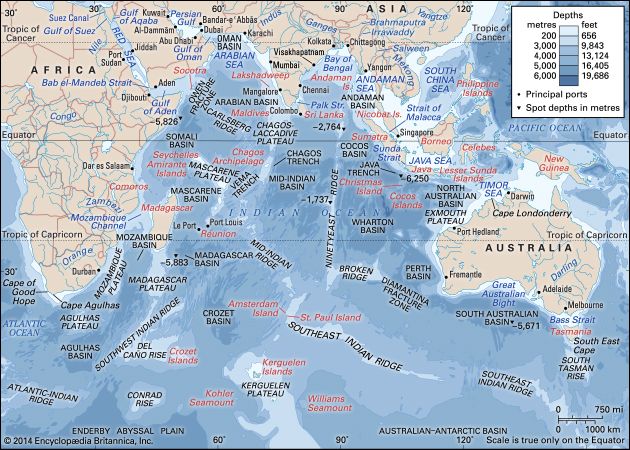
- North: Bounded by Iran, Pakistan, India, and Bangladesh.8
- West: Africa and the Arabian Peninsula.8
- East: The Malay Peninsula, Sunda Islands, and Australia.8
- South: Generally defined as extending to 60° S, where it meets the Southern Ocean.8
- Connections: It joins the Atlantic Ocean at the 20° E meridian and the Pacific Ocean near Tasmania.8
Unique Features
- Circulation: It is the only ocean with a semiannually reversing surface circulation.8
- Water Composition: It lacks a unique source of bottom water and contains highly saline water from the Persian Gulf and Red Sea. Northern deep waters are notably low in oxygen.8
- Geology: It features an inverted Y-shaped system of seismically active oceanic ridges and the Ninetyeast Ridge, the longest and straightest aseismic ridge in the world.5
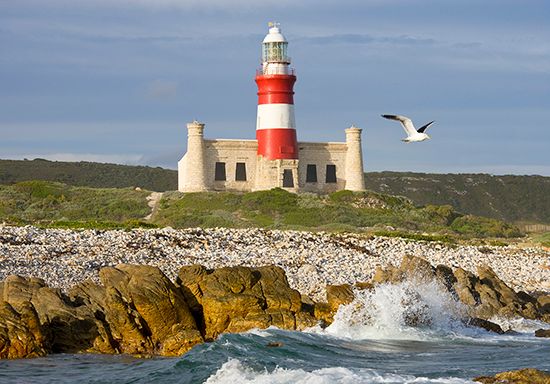
What are some of the major ports and trading routes in the Indian Ocean?
The Indian Ocean serves as a vital global maritime corridor, facilitating the transport of essential commodities such as crude oil, iron ore, coal, rubber, and tea.12
Major Trading Routes
Shipping in the Indian Ocean is primarily defined by three key transit points: the Cape of Good Hope, the Suez Canal and Red Sea, and the Strait of Malacca.12
- Tanker Traffic: Large volumes of petroleum move from the Persian Gulf across the northern Indian Ocean toward the Strait of Malacca or around the Cape of Good Hope to reach Europe and North America.12
- Bulk Cargo: Iron ore and coal are frequently shipped from Australia, India, and southern Africa to markets in Japan and Europe.12
Key Ports
Major ports facilitate this extensive trade network across the littoral states:
- Africa: Durban, Maputo, and Djibouti.12
- Arabian Peninsula: Aden.12
- Indian Subcontinent: Karachi, Mumbai, Chennai, Kolkata, and Chittagong.1213
- Southeast Asia: Singapore, a critical hub at the southern end of the Strait of Malacca.1214
- Australia: Melbourne, Port Adelaide Enfield, and Port Hedland.12
- Sri Lanka: Colombo and Trincomalee.1213
Can you describe some of the unique marine life found in the Indian Ocean?
The Indian Ocean hosts a diverse array of marine life, supported by nutrient-rich waters and varied tropical and temperate ecosystems.
Coral Reef Ecosystems
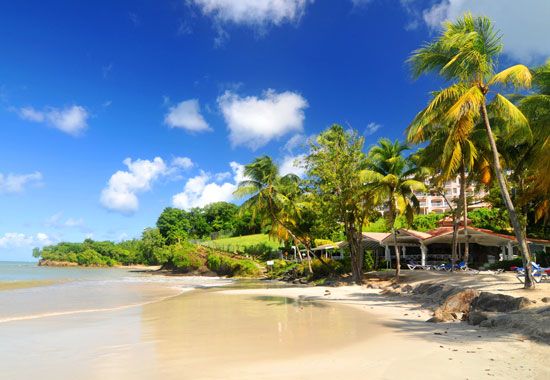
The shallow tropical waters of the Indian Ocean are defined by extensive coral reefs, which are built by corals in association with calcareous red algae. These structures provide essential habitats for a vibrant community of marine fauna, including:8
- Invertebrates: Sponges, worms, crabs, mollusks, sea urchins, brittle stars, and starfish.8
- Reef Fish: A variety of small, brightly colored fish species.8
Pelagic and Coastal Life
The ocean’s biological productivity is driven by seasonal upwellings that concentrate nutrients, fueling large populations of phytoplankton and supporting complex food webs.1718
- Crustaceans and Invertebrates: Small crustaceans, particularly copepods, are the most abundant animal life. Other notable invertebrates include jellyfish, polyps, and the Portuguese man-of-war, which can have tentacles reaching 165 feet in length.8
- Fish: The ocean is home to large schools of squid, flying fish, lantern fish, tuna, sailfish, and various shark species.178
- Marine Mammals and Reptiles: The region supports sea turtles, dugongs, and various species of dolphins and whales19.
- Coastal Vegetation: Tropical coasts are frequently lined with mangrove thickets, which serve as critical nursery and breeding grounds for many offshore species.8
Sources
- Indian Ocean - Monsoon zone — Encyclopædia Britannica
- Monsoon — Encyclopædia Britannica
- Monsoon Current — Encyclopædia Britannica
- South Asia: Top Questions — Encyclopædia Britannica
- Indian Ocean - Climate — Encyclopædia Britannica
- Climate change - Amplification of the Indian Ocean monsoon — Encyclopædia Britannica
- Indian monsoon - Monsoon withdrawal — Encyclopædia Britannica
- Indian Ocean — Encyclopædia Britannica
- Mid-Indian Ridge — Encyclopædia Britannica
- Indian Ocean - Oceanic ridges and fracture zones — Encyclopædia Britannica
- Indian Ocean - Hydrology — Encyclopædia Britannica
- Indian Ocean - Trade and transportation — Encyclopædia Britannica
- Strait of Malacca — Encyclopædia Britannica
- Indian Ocean - Early exploration — Encyclopædia Britannica
- India-China relations - Competition in the Indian Ocean region — Encyclopædia Britannica
- Bay of Bengal - Transportation — Encyclopædia Britannica
- Indian Ocean - Fisheries — Encyclopædia Britannica
- river dolphin — Encyclopædia Britannica
- Indian Ocean - Biological resources — Encyclopædia Britannica
- Indian Ocean - Upwelling of the Indian Ocean — Encyclopædia Britannica
- lagoon - Coral lagoons — Encyclopædia Britannica
- coral reef - Types of coral reefs — Encyclopædia Britannica
Published on · 4 min read