Javorníky
The Javorníky is a mountain range situated on the western edge of the Carpathian Mountains. It serves as the northern boundary between Moravia in the Czech…
What is Javorníky?
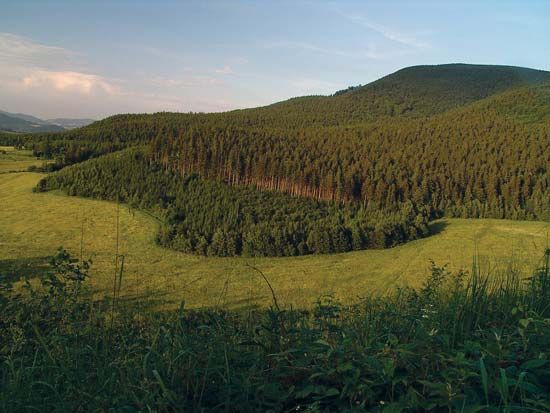
The Javorníky is a mountain range situated on the western edge of the Carpathian Mountains. It serves as the northern boundary between Moravia in the Czech Republic and Slovakia.1
The range’s highest peak is Velký Javorník, which reaches an elevation of 3,514 feet (1,071 metres) and overlooks the village of Velké Karlovice. Geographically, the ridge acts as a divide between the Bečva-Oder river systems to the north and west and the Váh River to the east. Due to the region’s climate and altitude, it is well-suited for sheep farming and is a popular destination for winter sports.1
What are the Carpathian Mountains?
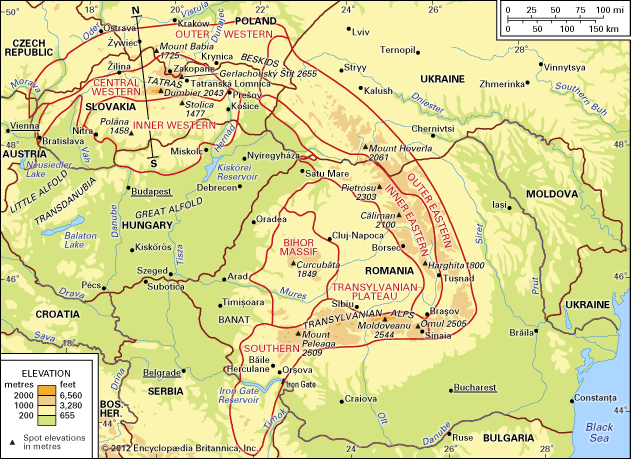
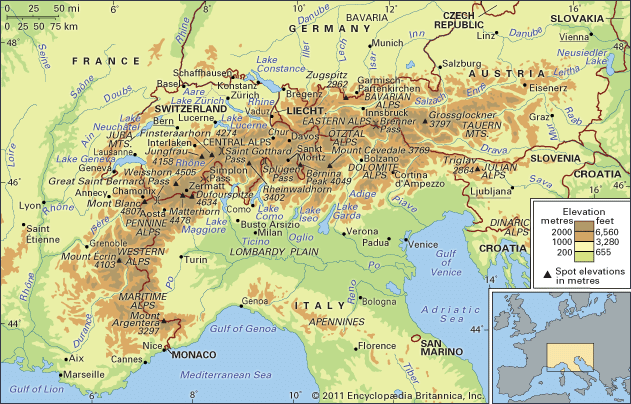
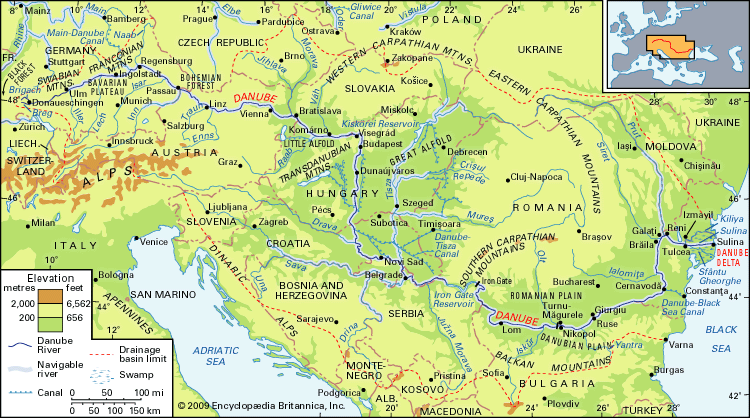
The Carpathian Mountains are a geologically young mountain chain in Europe that form an eastward continuation of the Alps. Stretching approximately 900 miles (1,450 kilometres) in a wide, crescent-shaped arc, the range extends from the Danube River near Bratislava, Slovakia, to the Iron Gate near Orșova, Romaniaplace/Iron-Gate) near Orșova, Romania.2
Physical Characteristics
Unlike the Alps, the Carpathians are less compact and are divided into numerous mountain blocks separated by basins. They are generally lower in elevation, with the highest peak, Gerlachovský Štít, reaching 8,711 feet (2,655 metres). The range is divided into the Western and Eastern Carpathians (often called the Southeastern Carpathians), with distinct differences in their geologic structure and relief.23
Geology and Drainage
The mountains consist of parallel structural ranges, including outer zones of flysch (sandstone-shale) and inner zones featuring crystalline, metamorphic, and volcanic rocks. Most water runoff from the range flows into the Black Sea, primarily via the Danube River and its tributaries.2435
How do mountain ranges affect local climates?
Mountain ranges significantly influence local climates through their impact on atmospheric flow, temperature, and precipitation patterns. As altitude increases, temperature, pressure, and humidity generally decrease, creating diverse mesoclimates and microclimates.9
Precipitation and Barriers
Mountains act as physical barriers to moving air masses. When moist air is forced upward over a range, it cools and condenses, resulting in orographic precipitation on the windward side. Conversely, the air that descends on the leeward side is drier, creating a rain shadow where precipitation is significantly reduced.101112
Atmospheric and Wind Effects
- Wind Patterns: Valleys can “funnel” regional winds, increasing their speed, while mountains can generate their own local wind circulations.9
- Temperature Regulation: Mountains can block the movement of cold air masses. For instance, north-south ranges like the Rockies help maintain milder coastal climates by preventing interior cold air from moving westward.11
- Slope Orientation: The direction a slope faces affects its exposure to wind and the amount of solar radiation it receives, further diversifying local conditions.9
What are some popular winter sports in the region?
The Carpathian Mountains are a premier destination for winter sports, with the region’s mountainous terrain and climate supporting a variety of popular activities.
Popular Winter Sports
- Downhill Skiing: This is a primary winter pursuit throughout the region, particularly in established centers like Zakopane in Poland, Sinaia in Romania, and various localities in Slovakia such as Štrbské Pleso, Tatranská Lomnica, and Smokovec.16
- Ice Skating: Enthusiasts frequently take advantage of the cold climate and available facilities for skating across the region.6
- General Recreation: The mountainous landscape, including areas like the Javorníky range, is widely recognized for its thriving winter sports culture.13
Beyond these specific activities, the region is also well-known for its ice hockey, which serves as a major spectator sport, drawing significant crowds throughout Slovakia and the surrounding areas.6
Sources
- Javorníky — Encyclopædia Britannica
- Carpathian Mountains — Encyclopædia Britannica
- Carpathian Mountains - Geology — Encyclopædia Britannica
- Carpathian Mountains - Physiography of the Carpathian Mountains — Encyclopædia Britannica
- Carpathian Mountains - Transportation — Encyclopædia Britannica
- Carpathian Mountains - Tourism — Encyclopædia Britannica
- Carpathian Mountains - Plant and animal life — Encyclopædia Britannica
- Carpathian Mountains - Drainage of the Carpathian Mountains — Encyclopædia Britannica
- Highland climate — Encyclopædia Britannica
- Rain shadow — Encyclopædia Britannica
- Orographic precipitation — Encyclopædia Britannica
- Atmosphere - Mountain barriers — Encyclopædia Britannica
- Slovakia - Sports and recreation — Encyclopædia Britannica
Published on · 3 min read