Jerusalem Cricket
The Jerusalem cricket (subfamily Stenopelmatinae) refers to any of approximately 50 species of insects in the family Stenopelmatidae. Despite their name…
What is Jerusalem cricket?
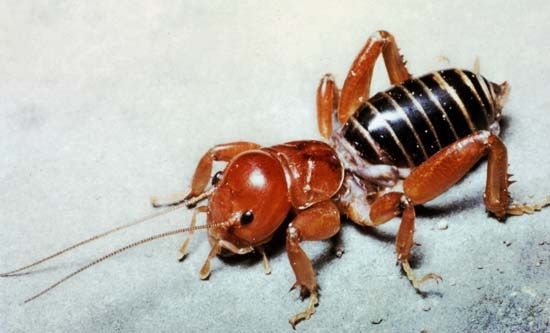
The Jerusalem cricket (subfamily Stenopelmatinae) refers to any of approximately 50 species of insects in the family Stenopelmatidae. Despite their name, they are not true crickets (family Gryllidae), though they are related to them and to grasshoppers within the order Orthoptera.12
These insects are characterized as large, brownish, and somewhat awkward in appearance, often featuring a large head. They are nocturnal and spend their daylight hours in burrows beneath rocks or in sand, utilizing their thick, heavily armored front legs for digging. They are found across various regions, including Asia, South Africa, and North and Central America.13
Because of their burrowing nature and specific habitat requirements, some species—such as Stenopelmatus cahuilaensis and Ammopelmatus kelsoensis—have been classified as vulnerable by the International Union for Conservation of Nature.1
How do Jerusalem crickets use their legs for digging?
Jerusalem crickets utilize their thick, heavily armored front legs to excavate burrows beneath rocks or within sand, where they spend their daylight hours for protection.1
While the specific biomechanics of the Jerusalem cricket’s digging are defined by these robust, armored front limbs, this behavior is a common adaptation among various burrowing Orthoptera. Similar to other notable burrowers like mole crickets, these insects rely on short, strong legs equipped with heavy spurs to move soil and create tunnels that serve as shelter or locations for laying eggs.4
What are some other insects that are often mistaken for crickets?
Several insects are frequently referred to as “crickets” due to their physical appearance or behavior, even though they do not belong to the true cricket family, Gryllidae. These insects are all members of the order Orthoptera, which also includes grasshoppers and katydids.56
Commonly misidentified insects include:
- Jerusalem crickets (subfamily Stenopelmatinae): These are large, brownish, and somewhat awkward-looking insects known for their large heads and burrowing habits.78
- Mole crickets (family Gryllotalpidae): Named for their mole-like appearance and underground lifestyle, these insects have specialized, broad front legs adapted for shoveling through moist soil.910
- Pygmy sand crickets (family Tridactylidae): These small insects are part of the suborder Caelifera, making them more closely related to grasshoppers than to true crickets.76
- Camel crickets: Often grouped with the suborder Ensifera, these insects are distinct from the family Gryllidae.65
While these insects share the order Orthoptera with true crickets, they differ significantly in their morphology, such as the structure of their legs, antennae, and auditory organs.111
Why are some species of Jerusalem crickets considered vulnerable?
Some species of Jerusalem crickets, such as Stenopelmatus cahuilaensis, Ammopelmatus muwu, and Ammopelmatus kelsoensis, are classified as vulnerable by the International Union for Conservation of Nature (IUCN).1
While the provided information confirms their vulnerable status, it does not explicitly detail the specific environmental pressures or threats—such as habitat loss or restricted geographic ranges—that have led to these designations for these particular sand-dwelling species.1
Sources
- Jerusalem cricket — Encyclopædia Britannica
- Jerusalem cricket — Merriam-Webster
- cricket — Encyclopædia Britannica
- Orthoptera - Movement — Encyclopædia Britannica
- List of insects - crickets , grasshoppers , and katydids (order Orthoptera ) — Encyclopædia Britannica
- katydid — Encyclopædia Britannica
- mole cricket — Encyclopædia Britannica
- Orthoptera - Distinguishing taxonomic features — Encyclopædia Britannica
- mole cricket — Merriam-Webster
- What’s the Difference Between a Grasshopper and a Cricket? — Encyclopædia Britannica
- Orthoptera — Encyclopædia Britannica
Published on · 2 min read