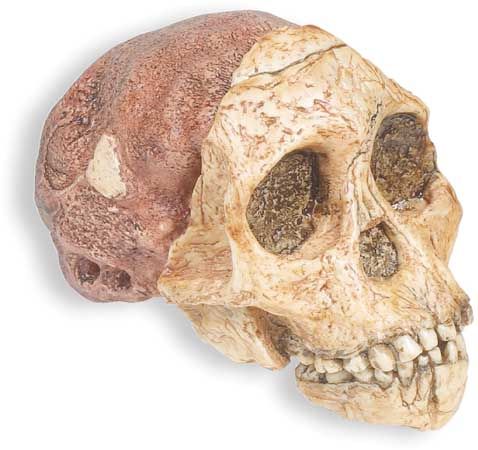
Kabwe Cranium
The Kabwe cranium, discovered in 1921 in Zambia, was historically referred to as "Rhodesian man" and initially assigned the taxonomic name H. rhodesiensis.
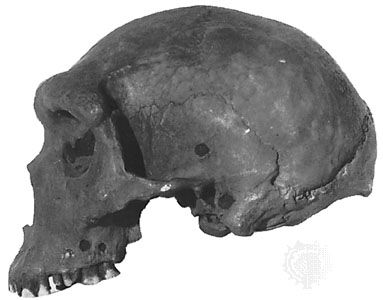
What species of human ancestor is the Kabwe cranium believed to represent?
The Kabwe cranium, discovered in 1921 in Zambia, was historically referred to as “Rhodesian man” and initially assigned the taxonomic name H. rhodesiensis.1
While there has been past disagreement regarding its classification, the specimen is now typically attributed to the archaic human species Homo heidelbergensis. This classification groups the Kabwe cranium with other significant fossils, such as those found at Bodo in Ethiopia and Petralona in Greece, which exhibit a transitional morphology between earlier members of the genus Homo and modern humans. Many researchers consider H. heidelbergensis to be the common ancestor of both Neanderthals and modern Homo sapiens.123
What can the Kabwe cranium tell us about the diet and lifestyle of early humans?
The Kabwe cranium, attributed to the archaic human species Homo heidelbergensis, provides limited direct evidence regarding the specific diet and lifestyle of its owner, though its physical features and the context of its discovery offer some insights.14
Anatomical Clues
The cranium possesses a very large palate and massive, archaic features, including heavy browridges. While the teeth of H. heidelbergensis and related species generally show a trend toward reduction in size compared to earlier hominins—a change often associated with improved food processing techniques—the Kabwe specimen itself retains a robust morphology. The presence of a large braincase (1,280 cc) suggests a level of cognitive capacity comparable to modern humans, which likely supported complex social or survival behaviors.145
Lifestyle and Environment
- Tool Use: Notably, the site where the Kabwe cranium was found lacks Acheulean hand axes, which are typically associated with the toolkits of H. heidelbergensis at other locations. This absence complicates our understanding of their specific technological capabilities at this site.16
- Fire and Diet: While there is evidence suggesting that H. heidelbergensis may have used fire as early as 460,000 years ago, it remains difficult to confirm the extent to which they relied on cooking to process food. The archaeological record does not currently provide definitive data to link the Kabwe individual’s specific diet to these broader evolutionary trends.5
How does the study of the Kabwe cranium relate to broader theories of human migration out of Africa?
The study of the Kabwe cranium is central to understanding the evolutionary transition from archaic Homo species to modern humans, particularly within the context of the “Out of Africa” theories.12
Taxonomic Significance and Human Origins
The Kabwe cranium is now widely classified as Homo heidelbergensis, a species that inhabited Africa, Europe, and parts of Asia between 600,000 and 200,000 years ago. Paleoanthropologists view H. heidelbergensis as a crucial evolutionary stage that bridges the gap between earlier African Homo (such as H. erectus or H. ergaster) and later, more derived species. Specifically, current research suggests that H. heidelbergensis served as the common ancestor for both Neanderthals in Eurasia and modern Homo sapiens in Africa.1210
Relation to Migration Theories
The classification of the Kabwe specimen supports the “single-origin” or “Out of Africa” model of human emergence. This theory posits that:211
- African Origins: The transition from archaic H. heidelbergensis to anatomically modern H. sapiens occurred within Africa prior to 300,000 years ago.2
- Successive Migrations: While earlier waves of Homo (such as the ancestors of Neanderthals and H. erectus) exited Africa much earlier, the emergence of modern H. sapiens represents a distinct, later evolutionary event.11
- Replacement: As H. sapiens migrated out of Africa, they eventually replaced other indigenous archaic human populations across the globe.11
By providing a clear look at the morphology of African H. heidelbergensis, the Kabwe cranium helps scientists distinguish the unique, derived features of modern humans from their archaic predecessors, reinforcing the view that our species originated as a distinct entity in Africa before spreading to the rest of the world.211
What is the Kabwe cranium and where was it discovered?
The Kabwe cranium is a fossilized skull belonging to an extinct species of the genus Homo, specifically identified as the archaic human species H. heidelbergensis.114
Discovered in 1921 in a metal-ore mine near the town of Kabwe, Zambia—formerly known as Broken Hill—it represents the first remains of premodern Homo ever found in Africa. Initially referred to as “Rhodesian man” and assigned the name H. rhodesiensis, the specimen was long misdated to be only 30,000 to 40,000 years old; however, current estimates based on associated animal fossils suggest an age between 500,000 and 300,000 years ago.114
The cranium is notable for its massive, archaic features, including a flattened profile and large, continuous browridges, yet it possesses a cranial capacity of 1,280 cc, which is nearly as large as that of modern humans which is nearly as large as that of modern humans.1
Sources
- Kabwe cranium — Encyclopædia Britannica
- Homo heidelbergensis — Encyclopædia Britannica
- Bodo — Encyclopædia Britannica
- Kabwe — Encyclopædia Britannica
- history of Zambia - Archaeology and early history of Zambia — Encyclopædia Britannica
- Heidelberg jaw — Encyclopædia Britannica
- Ndutu — Encyclopædia Britannica
- Origins of agriculture - Research techniques — Encyclopædia Britannica
- human evolution - Reduction in tooth size — Encyclopædia Britannica
- Homo sapiens - Bodily structure — Encyclopædia Britannica
- Homo sapiens - Modern populations — Encyclopædia Britannica
- Australopithecus - Quality of the fossil record — Encyclopædia Britannica
- Australopithecus - Transition to Homo — Encyclopædia Britannica
- Kabwe — Merriam-Webster
Published on · 4 min read