Taung Child
The discovery of the Taung child in 1924 by Raymond Dart was a watershed moment in paleoanthropology that fundamentally reshaped our understanding of human…
How did the discovery of the Taung Child impact our understanding of human evolution?
The discovery of the Taung child in 1924 by Raymond Dart was a watershed moment in paleoanthropology that fundamentally reshaped our understanding of human evolution.
Prior to this find, many scientists believed that human origins lay in Asia and that brain enlargement was the primary driver of hominization. The Taung specimen, identified as Australopithecus africanus, challenged these views by demonstrating that bipedalism (upright walking) evolved while brains were still essentially apelike in size.12
This evidence supported the concept of mosaic evolution—the idea that different human characteristics developed at different rates—and substantiated Charles Darwin’s prediction that human ancestors would be found in Africa. Although initially met with skepticism, the Taung child eventually established Africa as the cradle of humankind, a conclusion later reinforced by further fossil discoveries across the continent.23
What are the key physical features of the Taung Child fossil?
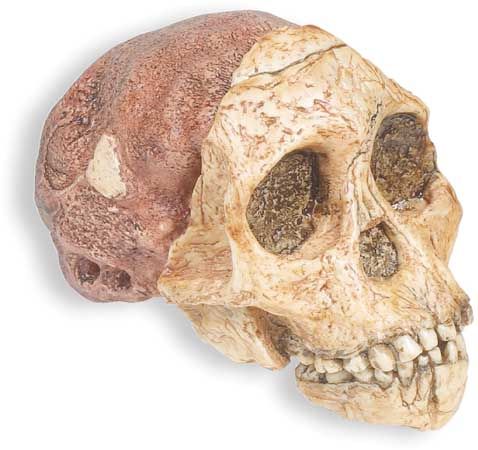
The Taung Child fossil, a specimen of Australopithecus africanus, provides significant insights into early hominin anatomy through its preserved skull and natural endocast. Key physical features include:
- Brain Size: The specimen possessed an ape-sized brain, measuring only about one-third the size of a modern human brain.1
- Dentition: Despite the small brain, the skull features humanlike teeth, which helped distinguish it from contemporary apes.1
- Foramen Magnum: The position of the hole at the base of the skull (the foramen magnum) indicates that the individual held its head in an upright posture, serving as a critical indicator of bipedalism.1
- General Morphology: As a juvenile estimated to be three or four years old, the fossil represents a transition in the human lineage, showing that upright walking preceded significant brain expansion.1
While A. africanus as a species is characterized by unique masticatory specializations—such as expanded cheek teeth and increased jaw size—the Taung Child remains a foundational example of the mosaic evolution that defines our early ancestors.12
What can the Taung Child fossil tell us about the environment and lifestyle of early hominids?
The Taung Child fossil provides limited direct evidence regarding the specific environment and daily lifestyle of early hominids because the original site was destroyed by mining activities before geologists could conduct a formal analysis of the surrounding strata.1
However, researchers have inferred aspects of the environment by examining associated animal fossils found at the site, which suggest a habitat consistent with the conditions of southern Africa approximately 2.3 to 3 million years ago. While the fossil itself is a crucial record of the physical transition toward bipedalism—demonstrated by the position of the foramen magnum—it does not preserve direct evidence of behavioral patterns, such as tool use or social structure.1
Because the site was compromised, we lack the contextual data necessary to reconstruct the specific ecological niche or daily activities of this individual. Our broader understanding of Australopithecus africanus lifestyle and environment is instead informed by more intact sites, such as Sterkfontein and Makapansgat, where additional specimens have been recovered.1
What is the Taung Child fossil and when was it discovered?
The Taung child is the first discovered fossil of the early hominin species Australopithecus africanus. It was unearthed by miners in South Africa in 1924 and subsequently identified as a primitive member of the human lineage by the paleoanthropologist Raymond Dart.1
The specimen consists of a natural endocast of the skull and the face of a child who was approximately three or four years old at the time of death. Although the fossil features an ape-sized brain, its humanlike teeth and the position of the foramen magnum—which indicates an upright, bipedal posture—provided critical evidence that human evolution began with the adoption of two-legged walking before significant brain expansion occurred.1
While the original site was destroyed by mining, preventing precise dating, associated animal fossils suggest an age of 2.3 to 2.8 million years, while a 2026 study estimates the specimen to be approximately 3 million years old.1
Sources
- Taung child — Encyclopædia Britannica
- Australopithecus - Australopithecus africanus — Encyclopædia Britannica
- Raymond A. Dart — Encyclopædia Britannica
- Ardipithecus - Developments in Australopithecus research — Encyclopædia Britannica
Published on · 3 min read