Kalmia
Kalmia is a genus of about seven species of evergreen shrubs belonging to the heath family (Ericaceae). These plants are primarily native to North America…
What are the defining characteristics of Kalmia plants?
Kalmia is a genus of about seven species of evergreen shrubs belonging to the heath family (Ericaceae). These plants are primarily native to North America and the West Indies.1
Key characteristics include:
- Foliage: The leaves are smooth-edged and arranged in opposite, alternate, or whorled patterns.1
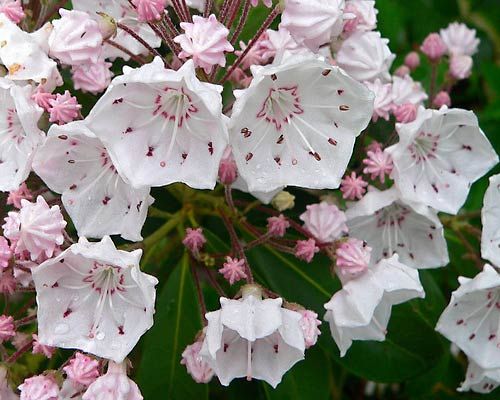
- Flowers: They produce showy, often bowl-shaped, five-lobed flowers in shades of pink, purple, lavender, or white. These are typically arranged in terminal or lateral clusters.1
- Pollination Mechanism: A unique feature is that the anthers are tucked into small pockets on the inner surface of the petals. When an insect touches the flower, the anthers spring free, effectively dusting the insect with pollen.1
- Toxicity: It is important to note that these plants contain toxins, such as andromedotoxin, which can be fatal if ingested by humans or animals.2
Well-known species include mountain laurel (K. latifolia), sheep laurel (K. angustifolia), and bog laurel (K. polifolia).1
Are there any toxicity concerns associated with Kalmia plants?
Yes, there are significant toxicity concerns associated with Kalmia plants. All species within the Kalmia genus, including mountain laurel, lambkill (K. angustifolia), and bog laurel, contain a potent poison known as andromedotoxin.43
This toxin poses a serious risk to both humans and animals if ingested. For humans, particularly children, consuming the leaves can lead to severe poisoning. In livestock—especially sheep grazing in abandoned pastures or meadows—ingestion of these plants can be fatal.345
Symptoms of Kalmia poisoning are severe and may include:
- Excessive salivation and nasal discharge4
- Tingling of the skin3
- Impaired vision and dizziness3
- Vomiting43
- Muscular paralysis43
- Convulsions and coma43
- Death43
Given the potential for fatal outcomes, it is essential to exercise caution and prevent the ingestion of any part of these plants by people or livestock.43
Where are Kalmia species naturally found, and what types of habitats do they prefer?
Kalmia species are primarily native to North America and the West Indies, with one species exhibiting a wider distribution across the Northern Hemisphere. These evergreen shrubs are adapted to a variety of environments, with specific preferences depending on the species:1
- Sheep laurel (K. angustifolia): Found throughout eastern North America, this species typically favors damp soil in open areas.1
- Mountain laurel (K. latifolia): This species is characteristic of mountainous regions across eastern North America.1
- Bog laurel (K. polifolia): As the name suggests, this species is found in northern North America, specifically in peaty or boggy soils.1
These plants belong to the heath family (Ericaceae) and are known for their distinct, showy flowers and unique pollination mechanisms.1
What is the origin of the name ‘Kalmia’ for this genus of plants?
The genus name Kalmia is of New Latin origin, derived from the name of the Swedish botanist Pehr Kalm.6
Pehr Kalm was one of the famous “Linnaean apostles”—students sent by the renowned scientist Carolus Linnaeus on global expeditions to collect and study exotic plants. Kalm traveled extensively through North America between 1748 and 1751, where he conducted significant botanical research. The suffix -ia was added to his name to form the botanical genus name Kalmia, honoring his contributions to the field.76
Sources
- kalmia — Encyclopædia Britannica
- mountain laurel — Encyclopædia Britannica
- poison - Plant poisons (phytotoxins) — Encyclopædia Britannica
- lambkill — Encyclopædia Britannica
- sheep laurel — Merriam-Webster
- kalmia — Merriam-Webster
- Carolus Linnaeus - Other contributions of Carolus Linnaeus — Encyclopædia Britannica
Published on · 2 min read