Kara Sea
The Kara Sea is characterized by a harsh, cold climate and extensive ice cover throughout most of the year.
What are the main characteristics of the Kara Sea’s climate and ice conditions?
The Kara Sea is characterized by a harsh, cold climate and extensive ice cover throughout most of the year.
Climate
The region experiences prolonged periods of freezing temperatures. In the north, air temperatures remain below 32 °F (0 °C) for 9 to 10 months annually, while the south experiences similar conditions for 7 to 8 months.
- Winter: Average temperatures in January range from -18 to -4 °F (-28 to -20 °C), with minimums reaching -51 °F (-46 °C). The season is marked by frequent gales and snowstorms.
- Summer: Average temperatures in July range from 30 to 43 °F (-1 to 6 °C), with a maximum of 61 °F (16 °C). The season is characterized by snow, snow squalls, and persistent fogs.
Ice Conditions
The sea is covered with ice for the majority of the year. The water masses are extremely cold and stratified, with winter water temperatures averaging 29.1 °F (-1.6 °C). In summer, surface temperatures may reach 43 °F (6 °C) in the southwest and 36 °F (2 °C) in the north.
How deep is the Kara Sea, and how does its depth compare to other seas in the Arctic Ocean?
The Kara Sea is a relatively shallow marginal sea located on the Siberian Shelf. It has an average depth of 417 feet (127 meters) and a maximum depth of 2,034 feet (620 meters). Because of its position on the shelf, approximately 40 percent of the sea is less than 160 feet (50 meters) deep, while only 2 percent exceeds 1,600 feet (500 meters) in depth.
When compared to other Arctic marginal seas, such as the Laptev Sea, the Kara Sea is significantly shallower. The Laptev Sea, for instance, has an average depth of 1,896 feet (578 meters) and reaches a maximum depth of 9,774 feet (2,980 meters). While the Kara Sea features deep-sea troughs in its northern reaches—such as the Svyatoy Anny—its overall bathymetry is dominated by the expansive, shallow Siberian Shelf.14
How does the Kara Sea contribute to Russia’s economy and maritime activities?
The Kara Sea serves as a vital component of Russia’s maritime infrastructure and economic strategy, primarily through its role in the Northern Sea Route.
Maritime Transportation
The sea is a key segment of the Northern Sea Route, which facilitates the transport of essential goods across the Russian Arctic. The primary port serving the region is Dikson, while Novy Port serves as a major hub within the Gulf of Ob. Historically, the route has been used to transport timber, building materials, furs, and foodstuffs.1
Economic Significance
The economic importance of the Kara Sea has grown substantially due to the discovery of vast natural gas and oil deposits in the Ob-Yenisey region. As Russia continues to develop its Arctic energy resources, the sea has become a critical corridor for the export of these commodities. The development of sophisticated icebreakers and improvements to port facilities have further enhanced the viability of these maritime operations, allowing for increased domestic and international shipping activity.15
Where is the Kara Sea located, and what are its geographical boundaries?
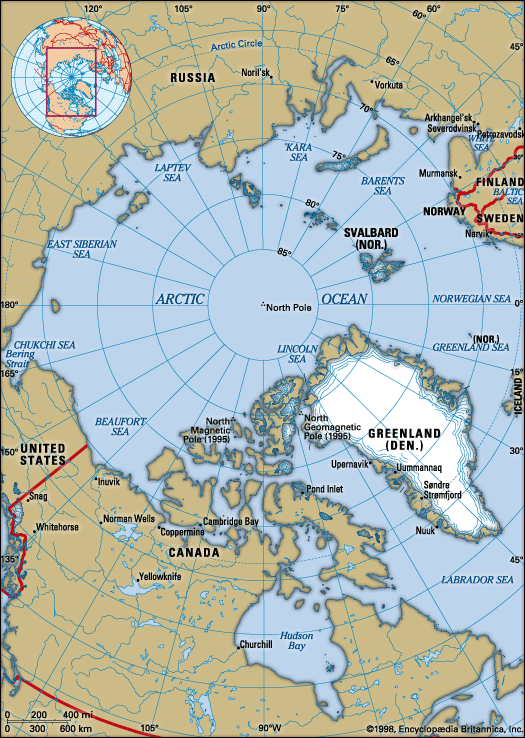
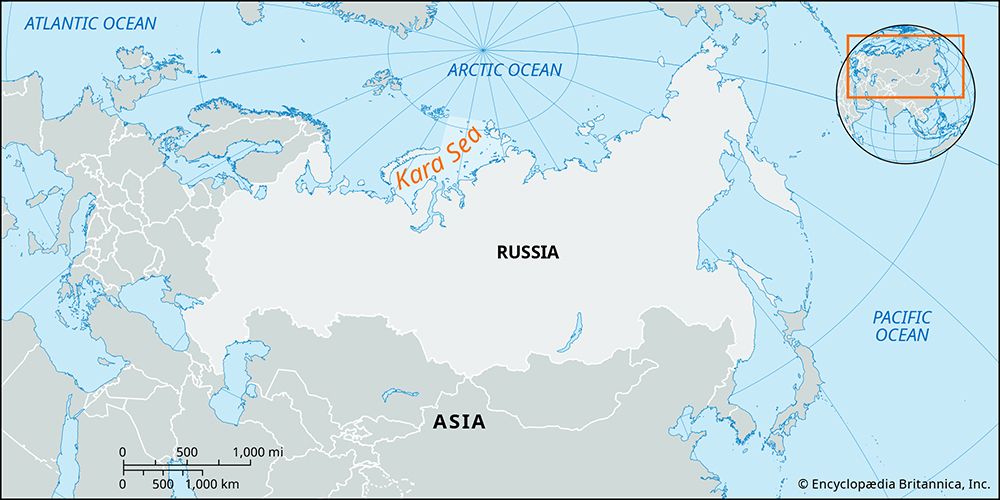
The Kara Sea is a marginal sea of the Arctic Ocean located off the coast of western Siberia, Russia.
Its geographical boundaries are defined by the following features:
- West: The Novaya Zemlya islands and the Barents Sea.
- Northwest: Franz Josef Land.
- East: The Severnaya Zemlya islands and the Laptev Sea.
- North: The Arctic Basin.
- South: The Siberian mainland, where the sea is bordered by the Taymyr Peninsula and features several deep inlets, including the Gulf of Yenisey.17
The sea covers an area of approximately 340,000 square miles (880,000 square km) and sits atop the Siberian Shelf, which characterizes its relatively shallow depth profile.1
Sources
- Kara Sea — Encyclopædia Britannica
- sea ice - The emerging impacts of recent changes to sea ice — Encyclopædia Britannica
- Arctic Ocean - Sea ice — Encyclopædia Britannica
- Laptev Sea — Encyclopædia Britannica
- Northeast Passage — Encyclopædia Britannica
- Gulf of Ob — Encyclopædia Britannica
- Taymyr Peninsula — Encyclopædia Britannica
Published on · 3 min read