Laptev Sea
The Laptev Sea contains dozens of islands, primarily located in its western region, which vary significantly in their landscape and origin. While the sea is…
Are there any notable islands within the Laptev Sea, and what are their characteristics?
The Laptev Sea contains dozens of islands, primarily located in its western region, which vary significantly in their landscape and origin. While the sea is bounded by major archipelagos—Severnaya Zemlya to the west and the New Siberian Islands to the east—these groups serve as the sea’s geographical borders rather than being contained within it.1
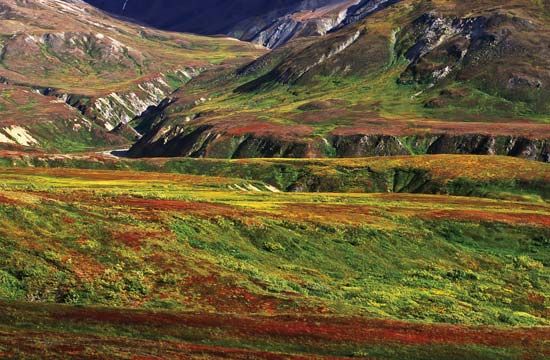
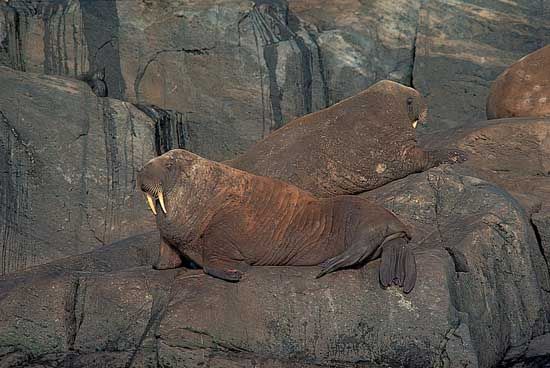
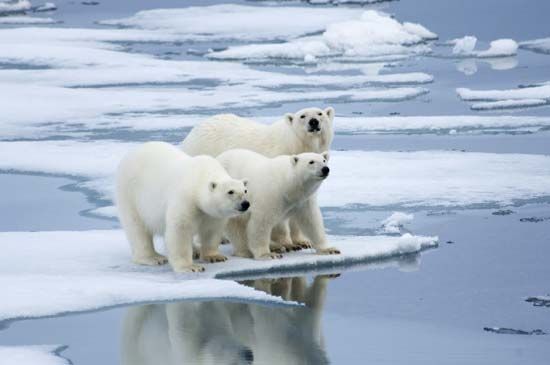
The islands within the Laptev Sea are characterized by the harsh, severe Arctic climate common to the region. The area experiences long, frigid winters with temperatures often dropping to -58° F (-50° C), and the sea remains ice-covered for most of the year. The environment is generally inhospitable, featuring poor tundra vegetation and limited animal life, though the surrounding waters support species such as walrus, various seals, and polar bears2. The geological history of the sea, shaped by ancient rivers and glaciers, has resulted in a diverse range of island formations across the basin.1
What role does the Laptev Sea play in the formation of Arctic sea ice?
The Laptev Sea plays a significant role in the dynamics of Arctic sea ice primarily as a source region for the Transpolar Drift. This major current system transports large volumes of ice from the Eurasian Arctic across the Arctic Ocean and eventually into the North Atlantic via the Fram Strait.3
The sea is covered by ice for the majority of the year, with its environment shaped by extreme cold and the inflow of fresh water from rivers like the Lena. This freshwater input, combined with the thawing of ice, influences the sea’s salinity levels, which in turn affects the freezing and melting processes of the ice cover. While the Laptev Sea serves as a starting point for ice moving through the Transpolar Drift, the ice thickness in this region is relatively thin—averaging about 1 meter (3 feet)—compared to the heavily ridged, thicker ice found along the coasts of Greenland and the Canadian Arctic islands.43
How was the Laptev Sea named, and who was it named after?
The Laptev Sea was formerly known as the Siberian Sea. It was renamed in 1935 to honor the Russian explorers and cousins, Khariton and Dmitry Laptev.4
The brothers were instrumental in the Great Northern Expedition (1733–1742), a massive undertaking commissioned to map the northern sea route along the Siberian coast. Between 1735 and 1740, the Laptevs successfully charted the coastline stretching from the Taymyr Peninsula to the Kolyma River, providing the foundational mapping for the region that now bears their name.34
What is the historical and economic significance of the Laptev Sea for Russia and the Arctic region?
The Laptev Sea holds significant historical and economic importance for Russia as a vital component of the Northern Sea Route, the primary maritime corridor connecting the Russian Arctic to global trade networks.3
Historical Significance
Historically, the region was essential for early exploration and mapping of the Siberian coastline. Renamed in 1935 to honor the explorers Khariton and Dmitry Laptev, who charted its shores between 1735 and 1740, the sea served as a critical frontier for Russian expansion into the Arctic. The area’s development was deeply tied to the broader efforts of the Russian state to secure northern territories and establish navigable routes across the Arctic Ocean.3
Economic Significance
Today, the Laptev Sea functions as a key logistical hub for the Russian Arctic economy:
- Maritime Trade: The port of Tiksi serves as the primary gateway for the region, facilitating the transport of essential goods.3
- Resource Logistics: The sea is a transit point for the movement of timber, building materials, and furs, which remain primary cargoes for the region.3
- Subsistence and Biodiversity: The sea supports local communities through fishing, particularly at the mouths of major rivers like the Lena, and sustains a diverse ecosystem including walrus and polar bear populations.3
Sources
- Severnaya Zemlya — Encyclopædia Britannica
- New Siberian Islands — Encyclopædia Britannica
- Laptev Sea — Encyclopædia Britannica
- Laptev Sea — Merriam-Webster
- sea ice - Pack ice drift and thickness — Encyclopædia Britannica
- Arctic - The Russian Arctic — Encyclopædia Britannica
- Great Northern Expedition — Encyclopædia Britannica
- Arctic - Southern and southwestern Alaska — Encyclopædia Britannica
Published on · 3 min read