Kenai Fjords National Park
Kenai Fjords National Park is home to a diverse array of marine and avian wildlife that thrive along its rugged coastline and fjords.
What are the main wildlife species that can be found in Kenai Fjords National Park?
Kenai Fjords National Park is home to a diverse array of marine and avian wildlife that thrive along its rugged coastline and fjords.
The park’s coastal waters and islands support several marine mammal species, including:
Additionally, the area serves as a vital habitat for tens of thousands of breeding birds. Among the most notable species found in the park are:
These animals inhabit the narrow belt of hemlock and spruce forest that lines the fjords, as well as the rocky coastal environments created by the park’s unique geography.
What is the geography and landscape of Kenai Fjords National Park like?
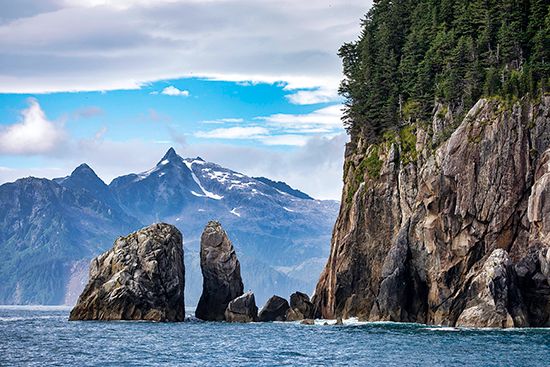
Kenai Fjords National Park is a rugged wilderness area located on the southern coast of the Kenai Peninsula in Alaska1. Its landscape is defined by a dramatic intersection of ice, mountains, and sea, covering an area of 1,047 square miles (2,712 square km).1
The park’s geography is dominated by the 300-square-mile (777-square-km) Harding Icefield, a massive expanse of ice that feeds numerous outflowing glaciers. Eight of these glaciers reach the sea, where they calve icebergs directly into the water. The park also features numerous coastal fjords and islands, which are geologically characterized as the remnants of drowned mountains.1
The terrain transitions significantly across different elevations:
- High Elevations: Alpine vegetation is found in the areas nearest to the glaciers.1
- Coastal Zones: A narrow belt of hemlock and spruce forest thrives along the fjords, situated between the glaciers and the sea.1
While the Exit Glacier is accessible by road, the broader fjord system is primarily reached by boat or float plane.1
What recreational activities are available for visitors to Kenai Fjords National Park?
Visitors to Kenai Fjords National Park have several opportunities to experience its rugged wilderness through both land and water-based activities.
- Hiking: The park features trails that provide access to the Exit Glacier, a prominent landmark near Seward. Additionally, there are trails that lead toward the Harding Icefield for those interested in exploring the alpine terrain.1
- Boating and Flightseeing: Because the majority of the park’s fjord system is remote, visitors typically access these areas by boat or float plane. These modes of transportation allow for exploration of the coastal fjords, islands, and the dramatic tidewater glaciers that calve icebergs into the sea.1
The park’s unique geography offers a rare chance to observe diverse marine life and bird populations in their natural habitat while navigating the intersection of mountain and sea.1
How large is Kenai Fjords National Park, and how does it compare to other national parks in Alaska?
Kenai Fjords National Park covers an area of 1,047 square miles (2,712 square km).1
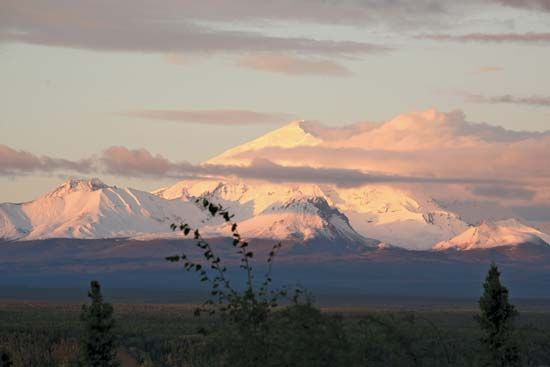
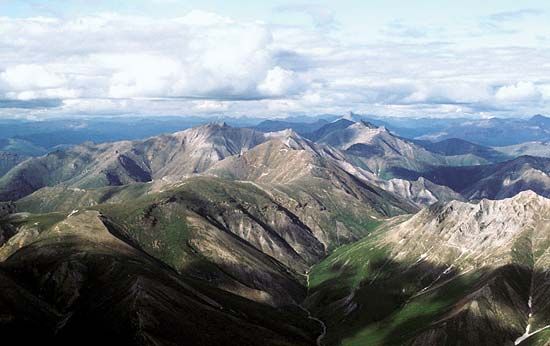
When compared to other major national parks in Alaska, Kenai Fjords is significantly smaller in scale. For instance, Wrangell–Saint Elias National Park and Preserve is the largest unit in the U.S. national park system, encompassing a total area of 20,587 square miles (53,320 square km). Similarly, Gates of the Arctic National Park and Preserve covers a combined area of 13,238 square miles (34,286 square km).34
While Kenai Fjords is smaller than these vast northern and eastern wilderness areas, it remains a significant protected landscape defined by its unique coastal geography, the Harding Icefield, and its role as a habitat for diverse marine life.1
Sources
- Kenai Fjords National Park — Encyclopædia Britannica
- Alaskan mountains - Physiography of the southern ranges — Encyclopædia Britannica
- Wrangell–Saint Elias National Park and Preserve — Encyclopædia Britannica
- Gates of the Arctic National Park and Preserve — Encyclopædia Britannica
Published on · 3 min read