Khone Falls
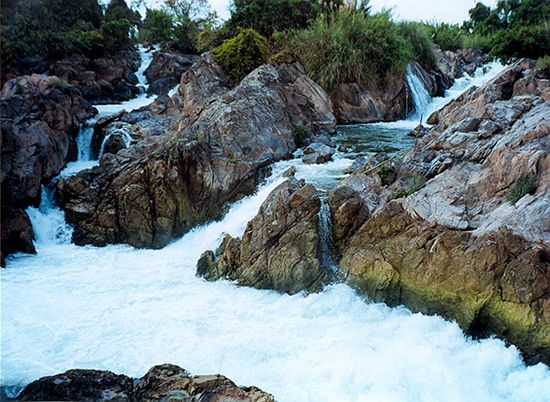
The Khone Falls, located on the Mekong River in southern Laos, were formed by a resistant bed of basalt. This geological feature acts as a barrier that…
How were the Khone Falls formed geologically?
The Khone Falls, located on the Mekong River in southern Laos, were formed by a resistant bed of basalt. This geological feature acts as a barrier that forces the river to tumble approximately 45 feet (14 meters) into a pool below.1
In general, waterfalls often arise when a river encounters a change in rock type, where the water erodes softer material more rapidly than harder, more resistant rock. In the case of the Khone Falls, the specific basalt strata are also responsible for the creation of several islands in the river, the largest of which is Không. While these falls are a significant natural feature, they are geologically temporary, as the constant energy of the river’s flow works to eventually smooth out such irregularities in the riverbed over time.21
What is the significance of Khone Falls in terms of its size and water volume?
The Khone Falls are widely considered the largest waterfall in the world by volume of water. Located on the Mekong River in southern Laos, this double series of cataracts carries an estimated 2,500,000 gallons (9,500,000 litres) of water per second.12
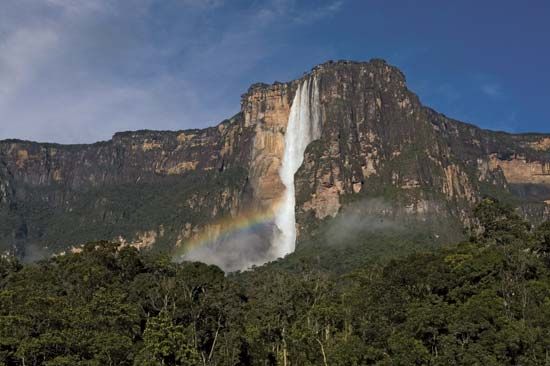
To put this scale into perspective, the volume of water passing over the Khone Falls is nearly double that of Niagara Falls. While other waterfalls, such as Angel Falls, are significantly taller, the Khone Falls are distinguished by their massive discharge, which has historically served as a major impediment to river navigation in the region.21
Where exactly are the Khone Falls located in Laos?
The Khone Falls are located in the extreme southern region of Laos, situated directly on the border with Cambodia.1
Geographically, the falls mark the point where the Mekong River transitions from southern Laos into Cambodia. They are positioned south of Pakxé, a major city in the region, and serve as the primary physical barrier for river navigation between the Cambodian plain to the south and the northern reaches of Laos.134
How accessible are the Khone Falls to tourists, and what activities can visitors engage in there?
The Khone Falls are located in a remote area of southern Laos along the Cambodian border. While the falls are a significant natural landmark, their primary historical role has been as a major impediment to river navigation, which necessitated the construction of a narrow-gauge railway to portage goods around the cataracts.1
Regarding tourism, the area is characterized by the river flowing over a resistant bed of basalt, creating a complex landscape of islands and cataracts. The largest of these islands, Không, serves as a local hub where a small port exists to facilitate the movement of goods. While the site is a destination for those interested in the geography of the Mekong River, the provided information does not detail specific modern tourist activities or infrastructure beyond the historical portage operations.1
Sources
- Khone Falls — Encyclopædia Britannica
- waterfall — Encyclopædia Britannica
- Mekong River - Physiography — Encyclopædia Britannica
- Cambodia - Drainage — Encyclopædia Britannica
Published on · 2 min read