Augrabies Falls
Augrabies Falls is a series of cataracts and rapids located on the Orange River in the Northern Cape province of South Africa. These falls occur where the…
What is Augrabies Falls?
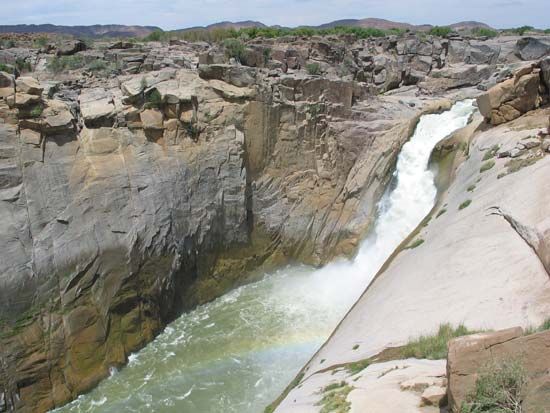
Augrabies Falls is a series of cataracts and rapids located on the Orange River in the Northern Cape province of South Africa. These falls occur where the river leaves a plateau of resistant granite, creating a dramatic landscape that serves as the central feature of the Augrabies Falls National Park.1
During flood conditions, the falls expand significantly, with 19 separate waterfalls cascading into an 11-mile (18-km) long ravine. The main drop of the water is 184 feet (56 meters), and the resulting plunge pool at the base is estimated to exceed 140 feet (43 meters) in depth. The falls are a result of the morphology of southern Africa, where a high plateau surrounded by a steep scarp slope creates waterfalls and rapids on many of the region’s major rivers.12
How do waterfalls change over time due to erosion?
Waterfalls are temporary geological features that rivers eventually eliminate through the persistent processes of erosion. Because rivers naturally work to smooth out irregularities in their flow to achieve a balanced, concave-upward longitudinal profile, they constantly act to wear away the steep gradients that create waterfalls.3
The evolution of a waterfall typically involves two primary erosive mechanisms:
- Headward Erosion: The force of falling water scours out a plunge pool at the base of the falls. This scouring undermines the cliff face, eventually causing it to collapse. As the cliff retreats, the site of the waterfall migrates upstream. For example, Niagara Falls has retreated approximately 11 km (7 miles) from its original position due to this process.3
- Downward Erosion: In other instances, the river’s energy acts to bevel the entire reach of the riverbed, gradually reducing the height and steepness of the falls until the river profile is smoothed.3
The speed at which these changes occur depends on the waterfall’s height, the volume of water, and the structural resistance of the local rock formations.3
What are some other famous waterfalls around the world?
There are many spectacular waterfalls around the world, each shaped by unique geological conditions and river systems. Here are some of the most famous examples:
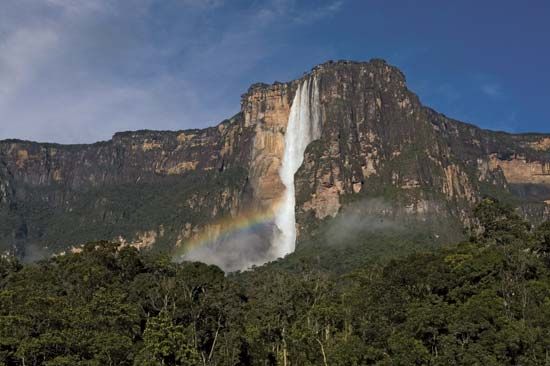
- Angel Falls: Located in Venezuela, this is the world’s highest waterfall, with a total drop of 979 meters (3,212 feet) from the Auyán-Tepuí plateau.63
- Tugela Falls: Situated in South Africa, this waterfall issues from the Great Escarpment and reaches a height of 948 meters.6
- Victoria Falls: Found on the border of Zimbabwe and Zambia, this iconic waterfall is known for its massive volume and 108-meter drop.6
- Niagara Falls: Straddling the border between the United States and Canada, these falls are famous for their significant retreat over time due to the erosion of weaker rock layers beneath a hard dolomite cap.7
- Iguaçu Falls: Located on the border of Brazil and Argentina, these falls are celebrated for their impressive width and series of cataracts.6
- Khone Falls: Located on the Mekong River in Laos, this is arguably the largest waterfall in the world by volume of water discharge.7
- Yosemite Falls: Found in California, USA, these falls are a classic example of a feature created by glaciation, where a tributary valley was left high above the main valley floor.7
What role does the Orange River play in South Africa’s geography?
The Orange River is a vital geographical and economic artery in southern Africa. Rising in the Lesotho Highlands, it flows approximately 1,300 miles westward to the Atlantic Ocean, serving as a significant boundary between South Africa and Namibia, as well as defining the southern limit of the Kalahari.
The river’s role in South Africa’s geography and economy is defined by several key functions:
- Water Management: Through the Orange River Project and the Lesotho Highlands Water Project, the river provides essential water for irrigation, urbanization, and industrial development in central South Africa.102
- Hydroelectric Power: Major infrastructure, such as the Gariep Dam and the Van der Kloof Dam, utilizes the river to generate hydroelectric power and manage water storage.2
- Physiographic Influence: The river has carved dramatic landscapes, including deep gorges and the Augrabies Falls, while its drainage basin—shared with the Vaal River—covers at least 330,000 square miles.1011
Sources
- Augrabies Falls — Encyclopædia Britannica
- Orange River - Physiography — Encyclopædia Britannica
- waterfall — Encyclopædia Britannica
- Augrabies Falls — Merriam-Webster
- river - Types of waterfalls — Encyclopædia Britannica
- river - High plateaus — Encyclopædia Britannica
- list of waterfalls — Encyclopædia Britannica
- Angel Falls — Encyclopædia Britannica
- Venezuela - Relief — Encyclopædia Britannica
- Orange River — Encyclopædia Britannica
- Orange River - Irrigation — Encyclopædia Britannica
Published on · 3 min read