Killarney Provincial Park
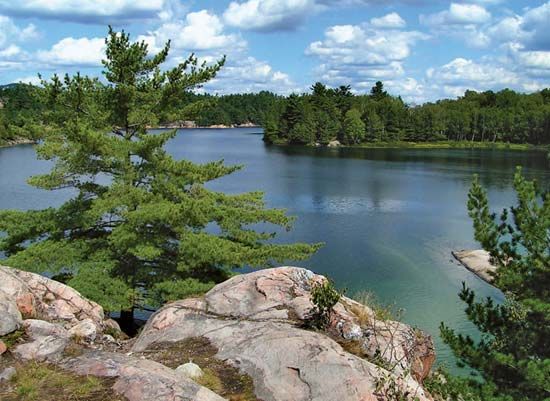
Killarney Provincial Park is a wilderness park located in southeastern Ontario, Canada, situated along the northern shore of Georgian Bay on Lake Huron.
What is Killarney Provincial Park?
Killarney Provincial Park is a wilderness park located in southeastern Ontario, Canada, situated along the northern shore of Georgian Bay on Lake Huron.1
Established in 1964, the park spans 132 square miles (342 square km) and is renowned for its rugged Canadian Shield landscape, which famously inspired the works of A. Y. Jackson and the Group of Seven. The park is characterized by its scenic birch and pine forests and the distinctive white quartzite ridges of the La Cloche Mountains. Its name is derived from the nearby village of Killarney, which historically served as a fur-trading post.1
(Note: This park is distinct from the town and national park of the same name located in County Kerry, Ireland.)2
Who were the Group of Seven artists?
The Group of Seven was a influential collective of Canadian painters active in the 1920s and 1930s, dedicated to developing a distinct national style of modern art through landscape painting.34
The original members, who first exhibited under the name in 1920, were:
- J.E.H. MacDonald
- Lawren S. Harris
- Arthur Lismer
- F.H. Varley
- Franklin Carmichael
- Frank H. Johnston
- A.Y. Jackson34
The group emerged from relationships formed at a Toronto commercial design firm, Grip Ltd., where members were encouraged to practice plein-air painting.4 They sought to capture the “spiritual essence” of the Canadian wilderness, particularly the Canadian Shield, using bold colors and expressionistic techniques influenced by Post-Impressionism and Fauvism.4
Although Tom Thomson died in 1917 before the group formally organized, he was their guiding light and most accomplished member. The group later expanded to include A.J. Casson, Edwin Holgate, and L.L. FitzGerald before disbanding in 1933 to form the Canadian Group of Painters.43
What is the Canadian Shield?
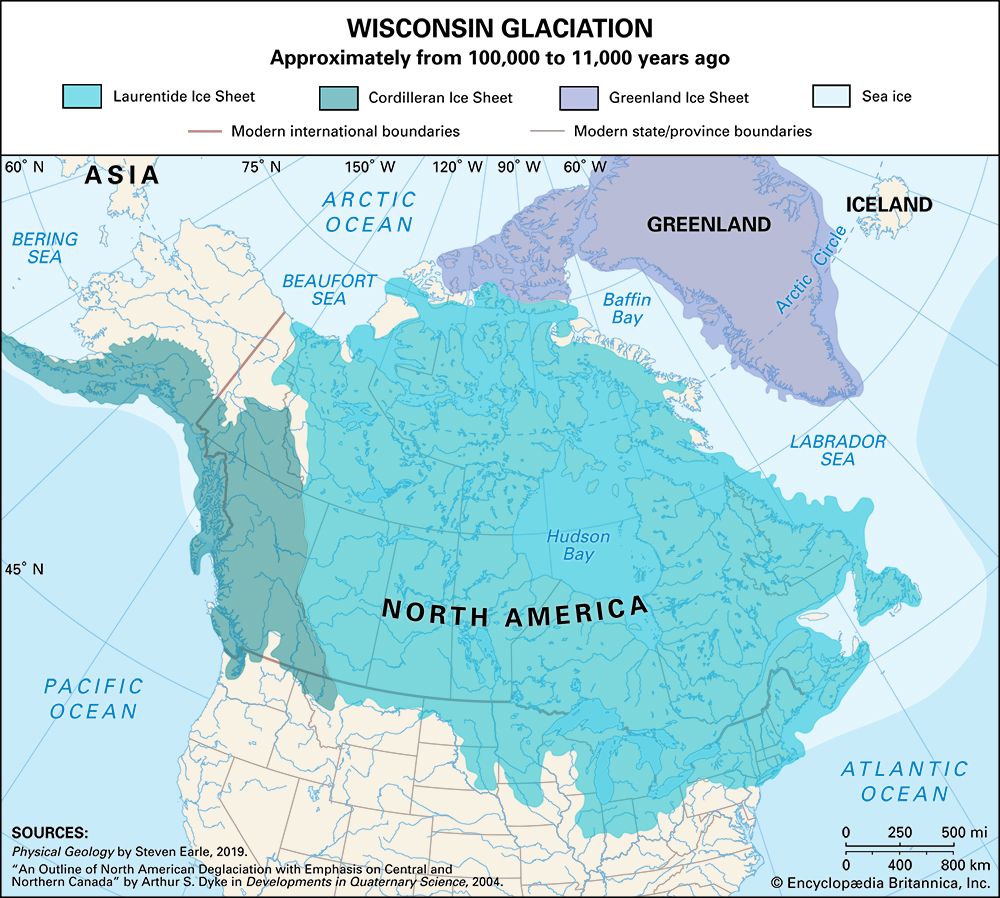
The Canadian Shield is one of the world’s largest geologic continental shields, covering approximately 8 million square kilometers (3 million square miles) across eastern, central, and northwestern Canada. Centered on Hudson Bay, it occupies about half of Canada’s total land area and represents the largest mass of exposed Precambrian rock on Earth.56
Geology and Landscape
The region is composed of ancient crystalline rocks shaped by a long history of mountain building and erosion.6 Its current appearance was significantly altered during the Pleistocene Epoch by continental glaciers, which scraped away weathered rock to create a “rock-knob” landscape filled with hundreds of thousands of lakes and swamps.56
Economic and Human Significance
While the thin, acidic soil makes agriculture difficult, the Shield is a vital source of mineral wealth, including gold, nickel, copper, and uranium. The region has been home to Indigenous peoples for millennia, though European settlement was historically limited due to the challenging terrain.576
How are quartzite mountains formed?
Quartzite mountains are not formed by a single process but rather through a combination of sedimentary deposition, tectonic transformation, and differential erosion.
The process begins with the accumulation of quartz arenites—sandstones composed of at least 90 percent quartz—which form in stable, low-relief environments like beaches or shallow marine settings. Over time, these sediments accumulate in thick layers on continental shelves.89
The transformation into quartzite occurs through two primary methods:
- Induration: The precipitation of silica from interstitial waters can “weld” sand grains together.8
- Metamorphism: Under high temperatures and pressures, the sandstone undergoes recrystallization to become metaquartzite.8
These quartzite units are eventually incorporated into mountain systems during tectonic events, such as continental collisions, which fold and fault the crust. Because quartzite is highly resistant to weathering, it erodes much more slowly than surrounding rock types. Consequently, as the softer materials are worn away, the durable quartzite beds remain, projecting as prominent ridges or mountain masses, such as those found in the Appalachian Mountains.1098
Sources
- Killarney Provincial Park — Encyclopædia Britannica
- Killarney — Encyclopædia Britannica
- Group of Seven — Encyclopædia Britannica
- The Group of Seven Remembered — Encyclopædia Britannica
- Canada - The Canadian Shield — Encyclopædia Britannica
- Canadian Shield — Encyclopædia Britannica
- Canada - Minerals — Encyclopædia Britannica
- quartzite — Encyclopædia Britannica
- metamorphic rock - Thermodynamics of metamorphic assemblages — Encyclopædia Britannica
- tectonic landform — Encyclopædia Britannica
- plate tectonics - Mountain building — Encyclopædia Britannica
- sedimentary rock - Quartz arenites — Encyclopædia Britannica
Published on · 3 min read