Komodo Dragon
Komodo dragons serve as apex predators within their limited range in the Lesser Sunda Islands of Indonesia. As carnivores, they play a significant role in…
What role do Komodo dragons play in their ecosystem?
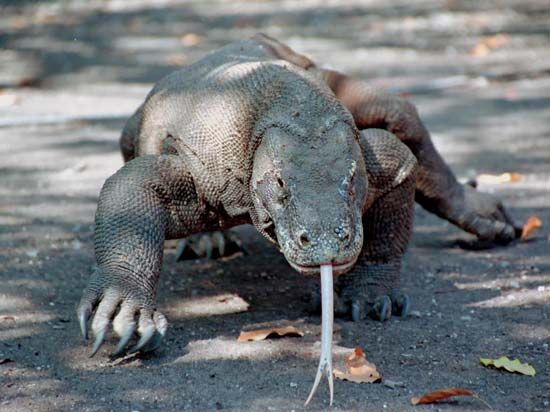
Komodo dragons serve as apex predators within their limited range in the Lesser Sunda Islands of Indonesia. As carnivores, they play a significant role in their ecosystem by regulating populations of large mammals such as pigs, deer, and cattle.12
Beyond active hunting, these lizards function as important scavengers, as carrion is their primary food source. By consuming both live prey and carcasses, they help maintain the health of their environment. Additionally, their status as a flagship species has made them a focal point for ecotourism, which provides a vital economic incentive for the protection of their habitat—a diverse landscape of savanna, scrub, and mangroves2. Currently listed as an endangered species, their survival is increasingly tied to conservation efforts aimed at mitigating habitat loss caused by rising sea levels and human encroachment.21
How do Komodo dragons interact with humans, and are they considered dangerous?
Komodo dragons are considered dangerous to humans, as they are powerful apex predators capable of attacking and killing people. While they primarily feed on carrion, they are known to ambush large mammals and have been responsible for a number of reported attacks on humans, both in the wild and in captivity, between 2000 and 2014.241
Their danger stems from several specialized physical traits:
- Venomous Bite: They possess a venomous bite that delivers toxins, which inhibit blood clotting and can cause victims to go into shock from rapid blood loss.24
- Physical Trauma and Bacteria: The physical trauma from their sharp, serrated teeth, combined with the introduction of harmful bacteria from their mouths into a wound, plays a significant role in incapacitating prey.24
- Speed and Size: Adults can grow up to 3 meters (10 feet) in length and weigh over 135 kg (300 pounds), yet they are capable of running swiftly when necessary.24
Despite these risks, the species has become a significant ecotourist attraction. This interest has fostered conservation efforts to protect their endangered status, even as human-wildlife conflicts persist due to competition for space and dragon attacks on livestock.24
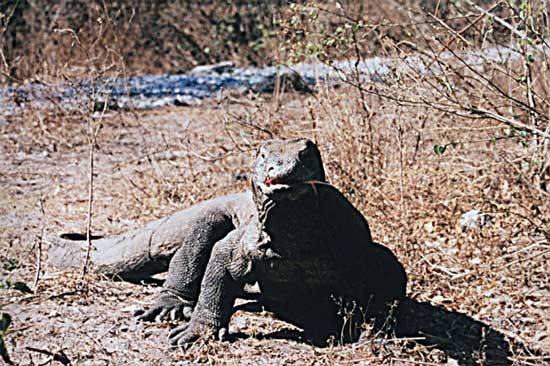
How do Komodo dragons reproduce and care for their young?
Komodo dragons primarily reproduce through sexual reproduction, which involves internal fertilization via hemipenes. Males often engage in physical combat, such as wrestling while standing on their hind limbs, to establish dominance and secure access to females.
In addition to sexual reproduction, female Komodo dragons are capable of parthenogenesis, an asexual strategy where eggs develop without fertilization. In this process, the offspring are genetically identical to the mother.
Regarding nesting and care:
- Nesting: Females dig deep burrows, sometimes reaching up to 9 meters (30 feet) in depth, to lay their eggs.
- Development: The eggs typically hatch in April or May.
- Independence: There is no evidence of parental care for the young. Newly hatched Komodo dragons are approximately 45 cm (18 inches) long and must immediately fend for themselves. To avoid being eaten by adult members of their own species, juveniles typically live in trees where they feed on small prey like insects and birds.
Where are Komodo dragons found in the wild, and what is their natural habitat like?
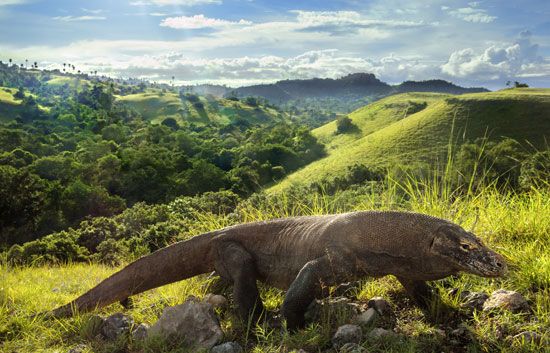
Komodo dragons are found in the wild exclusively on Komodo Island and a few neighboring islands within the Sunda Islands of Indonesia, including Flores.32
Their natural habitat is characterized by a diverse mix of environments, including:
- Dry Savanna and Scrub: These open, arid landscapes provide the primary terrain for these large lizards.2
- Coastal Areas: They are also found in mangroves and along beaches composed of sand and rock./sand) and rock.2
- Topography: The islands they inhabit, such as Komodo, are typically hilly, with elevations reaching up to 2,700 feet (825 meters).3
Currently, this endangered species faces significant threats from habitat loss. Climate models indicate that rising sea levels could destroy 30 to 70 percent of their available habitat by 2040, while the conversion of land for agriculture further fragments their environment.2
Sources
- Komodo dragon: Top Questions — Encyclopædia Britannica
- Komodo dragon — Encyclopædia Britannica
- Komodo — Encyclopædia Britannica
- 7 of the World’s Most Dangerous Lizards and Turtles — Encyclopædia Britannica
- reptile - Courtship and fertilization — Encyclopædia Britannica
Published on · 3 min read