Kuznetsk Coal Basin
The Kuznetsk Coal Basin, or Kuzbas, is a major coalfield located in south-central Russia within the basin of the Tom River. It is situated between the…
How was the Kuznetsk Coal Basin formed, and what geological features make it significant?
The Kuznetsk Coal Basin, or Kuzbas, is a major coalfield located in south-central Russia within the basin of the Tom River. It is situated between the Kuznetsk Alatau and Salair mountain ranges.12
While the provided information does not detail the specific tectonic or geological processes of its formation, the basin is geologically significant due to its immense scale and the exceptional quality of its reserves. Covering approximately 10,000 square miles, it contains over 300 billion tons of coal. The basin is distinguished by the thickness and concentration of its seams; for instance, the oldest coal-bearing series, known as the Balakhonka Series, features 30–35 workable seams that can reach up to 130 feet in thickness. These deposits include high-quality anthracite, steam coal, and coking coal, which are characterized by low sulfur content. This combination of accessible, high-grade resources has made the region a cornerstone of Russia’s heavy industry, particularly in steel production and metallurgy.1
What is the geographical location and extent of the Kuznetsk Coal Basin in Russia?
The Kuznetsk Coal Basin, also known as the Kuzbas or Kuzbass, is a major industrial region located in the Kemerovo oblast (province) of south-central Russia.12
Geographically, the basin is situated within the valley of the Tom River, positioned between the Kuznetsk Alatau and Salair mountain ranges. It extends across a significant area, covering approximately 10,000 square miles (26,000 square km), and stretches from the city of Novokuznetsk in the south to Tomsk in the north.12
As one of the largest coal-producing regions in Russia, the basin is a critical center for heavy industry, including extensive mining, steel production, and metallurgy, supported by a network of major industrial towns such as Kemerovo, Novokuznetsk, and Anzhero-Sudzhensk.1
How has mining technology evolved in the Kuznetsk Coal Basin over time?
Mining technology in the Kuznetsk Coal Basin has evolved from small-scale manual diggings, which began in 1721, to large-scale industrial operations. Significant expansion began during the first Soviet Five-Year Plan (1928–1932), which established the region as a cornerstone of heavy industry.1
Modern extraction methods in the basin are adapted to its unique geological features, particularly its exceptionally thick coal seams that can reach up to 130 feet. Because these seams often exceed the capacity of standard single-pass extraction, miners utilize techniques that divide the coal into multiple slices, which are then mined using longwall or conventional systems.14
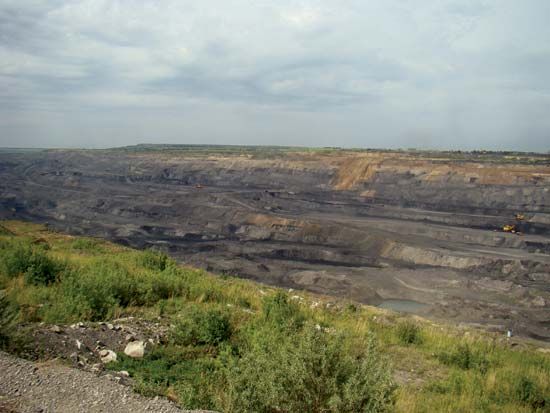
A notable technological feature in the region is the extensive use of hydraulic mining. This method employs high-pressure water jets to fragment coal, particularly in steeply pitching deposits. Beyond extraction, water is used to transport the coal through open channels to a collection point and then to the surface via high-pressure hydraulic systems. Additionally, about one-quarter of the basin’s production is now achieved through open-cast mining, primarily in the north, which helps maintain lower production costs.41
What role does the Kuznetsk Coal Basin play in Russia’s energy production and economy?
The Kuznetsk Coal Basin, or Kuzbas, serves as a vital pillar of the Russian economy and energy sector. As one of the country’s most significant coal-producing regions, it accounts for approximately two-fifths of Russia’s total coal output.1
Energy and Industrial Role
The basin contains minable reserves exceeding 300 billion tons, providing high-quality anthracite, steam coal, and coking coal. This production is essential for several key sectors:5
- Metallurgy: The region is a primary center for iron and steel production. Historically, it formed the Urals-Kuznetsk kombinat, exchanging coking coal for iron ore from the Urals. Today, it remains one of Russia’s largest steel-producing hubs, with major works located in Novokuznetsk.51
- Heavy Industry: The basin supports extensive engineering, machine building, and nonferrous metallurgy, utilizing local and regional mineral resources like lead, zinc, and copper.56
- Chemical Manufacturing: The well-developed coke-chemical industry in cities such as Kemerovo and Anzhero-Sudzhensk provides the foundation for producing plastics, fertilizers, and pharmaceuticals.5
By anchoring these heavy industries, the Kuznetsk Basin remains a critical engine for regional development and national industrial capacity.56
Sources
- Kuznetsk Coal Basin — Encyclopædia Britannica
- Kuznetsk Basin — Merriam-Webster
- Russia - The mountains of the south and east — Encyclopædia Britannica
- coal mining - Thick-seam mining — Encyclopædia Britannica
- Kemerovo — Encyclopædia Britannica
- Russia - Resources and power — Encyclopædia Britannica
Published on · 3 min read